Crouching Tiger, Hidden Dragon: Sword of Destiny
Sequel to international hit film fails to live up to lofty expectations
Ang Lee's Crouching Tiger, Hidden Dragon grossed $128 million in the US after its opening 15 years ago, and became the highest-grossing foreign-language film in US history.
Now screenwriter John Fusco has picked up the plot with sequel Crouching Tiger, Hidden Dragon: Sword of Destiny, directed by Yuen Woo-ping.
However, despite its pedigree, the sequel loses the veiled artistic conception and deep understanding of Chinese philosophy that made its prequel so special.
The story revolves around a mighty sword, the Green Destiny, which belongs to the legendary warrior Li Mubai.
To prevent people from fighting for this sword, a symbol for ethics and mighty power, it is preserved in the mansion of Li's friend Sir Te after Li's death.
The story begins 18 years after the prequel when Sir Te died and swordsmen started to cast greedy eyes on the weapon. Li's lover Yu Shu Lien (Michelle Yeoh), a great swordsman in her own right, volunteered to protect the sword.
In this course, Yu meets another high-level swordsman called Silent Wolf (Donnie Yen). Together they step forward bravely to protect the sword.
While the plot might be alright for Western audience who don't have much knowledge of wuxia, for Chinese audience the understanding of wuxia spirit is too shallow.
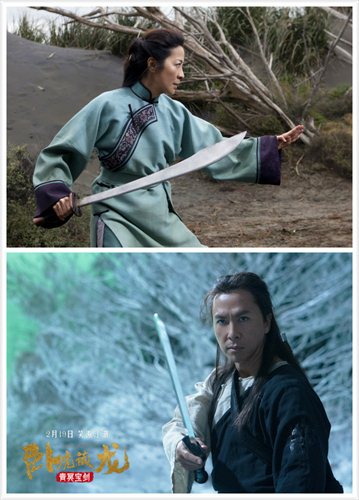
Michelle Yeoh (top) as Yu Shu Lien and Donnie Yen as Silent Wolf in Crouching Tiger, Hidden Dragon: Sword of Destiny Photos: CFP
The Chinese word wuxia is a combination of wu which means martial and xia which means the pursuit of courage and ethics.
Though the screenwriter repeats words such as honor and duty, he fails to interweave the meaning of these words into the plot.
Honor is simply interpreted as fighting for the right course and dying for it. In a scene in which Silent Wolf gets himself into trouble with some hooligans, five swordsmen step forward with a sense of justice, saying that he is not alone.
One by one, the swordsmen are killed in a predictable scene before they can display their distinct dispositions. A gang fight like this is more like a Western cowboy film, but is certainly not the best interpretation of honor.
Duty is interpreted in a scene when Silent Wolf is in a duel with a bad guy. Silent Wolf is injured and Yu comes to his rescue, saying that he has done his duty regardless of his life, and that he won't be lonely any more.
But without the foreshadowing motivation, it is jarring to hear the sudden mention of duty.
The way that the dialogue is delivered is also plain. The dubbed Chinese is delivered in a really plain way that fails to match the inner thoughts and feelings of the characters, making it hard for the audience to get into the film.
That said the fight scenes choreographed by Yuen Woo-ping may alone be worth the price of admission.
There is a humorous fight in an inn, during which Silent Wolf steps on the toes of his enemies following a zigzag course to bring them down, while the landlady ambushes the rest with steel spoons.
There is poetry in the swordplay on a frozen snowscape and a delicate touch in the actors' movements as they slide across the surface whilst fighting. It is reminiscent of the first film's fight scene on the bamboo rooftops.
The best fight scene, not surprisingly, belongs to veteran kung fu star Donnie Yen and Michelle Yeoh as they fight the boss in the showdown on a tower.
Two new faces, Australian actress Natasha Liu Bordizzo and Costa Rican-American actor Harry Shum Jr., play two juniors Xue Ping and Wei Fang.
The chemistry between the young pair forms a balanced parallel to the pairing of Yu and Silent Wolf.
Shanghai-based film viewing group Tengjingshu recently held a screening of the movie, at which it scored 7.19/10 based on the accumulated votes of the 89 viewers in attendance.
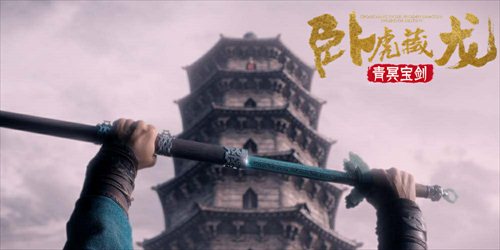
A poster for the film
Everyone's a critic
GT: What is the worst aspect of this film?
Xiao Qi, 25, clerk and Tengjingshu member
"Like every film, the supporting actors die too quickly. When they first appear, I think it's something to behold. When the first dies, they can't dodge the destiny of being killed. I think it would be better if they can get more screen time and survive."
GT: Did the film live up to your expectations?
Kimi, 26, clerk and Tengjingshu member
"It has nothing to do with the first film except that Michelle Yeoh played the same role. The first half is not very attractive. Natasha Liu Bordizzo sounds like an ABC when she delivers the lines of Xue Ping. It doesn't sound like Chinese. I would still give 6.5/10 to this film because the two young actors look good and the fight scenes in the second half are okay."
GT: Do you like the score to the film?
Xiao Hui, 22, marketing
"The music is as good as in the original. Many Chinese traditional instruments were used. In a fight scene between Xue Ping and Wei Fang, the rhythm of the drum matches each of the actors' movements. It comes compact when they quickened their pack and a little bit relaxed when they slow their movement."