HOME >> METRO BEIJING
Combating computer face
By Li Lin Source:Global Times Published: 2016-2-23 18:33:01
How can office workers protect their skin from modern life?
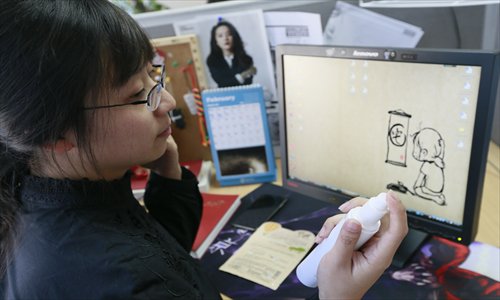
People who suffer from computer face look older than their peers and are more likely to suffer from allergies. Photo: Li Hao/GT
Twenty-four-year-old Feng Hao, who works as a manager at a real estate company in Beijing, has recently been nurturing a new fear - that she's "getting old fast.""I've found that my skin, especially my face, is losing its luster and has a dull look," said Feng. "It all started three years ago when I took my first job, which requires me to sit in front of a computer all day long to process documents."
Things don't get any better after work; Feng is a semi-professional player of the popular online game League of Legends, and recently signed a contract with an Internet bar to live-broadcast competitions there each week, meaning she will be spending even more time in front of computer screens.
"Last week I spent fewer than 15 hours away from the computer," Feng said. "My skin became rather bad and I couldn't even cover up the fatigue with makeup."
What Feng is suffering has been dubbed "computer face," which refers to the saggy skin, dark circles around the eyes and uneven pigmentation that result from excessive, long-term computer use. The condition was first proposed by British plastic surgeon and dermatologist Michael Prager in 2010. However, according to a February 16 report by express.co.uk, studies have found that daily stress, an unhealthy diet, fatigue and excessive face washing can worsen computer face symptoms in addition to the ill effects of the low-level UV rays emitted by some computer monitors and long-term use of smart phones and tablets.
In the report, British facialist Cherry Woods, who is an expert in collagen production, asserts that most computer face problems can be attributed to a shortage of collagen, which is responsible for maintaining the strength and elasticity of skin. She warned that UV rays along with lifestyle factors, such as drinking and smoking, high-sugar foods, as well as staying up late, can accelerate collagen degradation and cause people to look older.
Wei Chunbo, a dermatologist at Beijing Ditan Hospital, shares Woods' opinion, saying that today, many people have higher-pressure lives than before due to the amount of time spent working in front of computers.
"When pressure and negative emotions accumulate, they can cause an endocrine disorder that is expressed in the skin by making it loose and more sensitive," Wei said.
Wei added that skin problems, especially allergy problems triggered by hormonal disorders that cause blood capillaries to shrink, and long periods of sedentary time in front of a computer, can decrease circulation and worsen the problem. "Actually sitting in front of a computer, people are subconsciously getting tired and nervous no matter whether they are working or playing games," said Wei.
People should also be wary of over-washing their skin, especially their faces, Wei said. He suggests using a mild soap and washing no more than twice a day to protect the skin's moisture barrier.
In the express.co.uk report, Woods also offers a few tips for ladies suffering from computer face. "Reduce sugar in the diet to limit this glycation process, stop smoking and step up your Vitamin C intake, which will assist in stimulating collagen production," says Woods. "UV exposure is accountable for a very high percentage of collagen breakdown so apply sunblock before you go out. Remember, even your computer is emitting low-level UV rays, so apply a sunscreen if you are working on the laptop too!"
Posted in: Intel