HOME >> BUSINESS
Former State-owned iron and steel foundry reinvents itself with 3D printing
Source:Xinhua Published: 2016-2-28 19:13:01
It used to take about eight days for KOCEL Group to produce a diesel engine block. Now, with the help of 3D printing, the iron and steel foundry has cut that time down to a day. The technology has helped make KOCEL leaner and cleaner by upgrading a production process that hadn't changed much over the years, according to one company executive. Many manufacturers have problems that can be helped by 3D printing, such as overcapacity and pollution. Still, 3D printing has only been adopted by a fraction of China's manufacturers, so it's too early to tell how quickly it will catch on.
Founded in 1966, the company, which was once owned by the State, has employed 3D printing to create a cleaner, leaner production process.
"3D printing is changing the way foundries operate, revitalizing a process that has basically remained the same in China for years," said Meng Qingwen, deputy director of the company's 3D printing center.
Traditionally, molten metal is cast into shapes by pouring it into a mold, usually made of sand, and then waiting for it to solidify.
In the past, to make a complex shape, technicians would break the design down into simple components, make templates of each part and then combine the pieces before going on to make the mold.
A 3D printer, on the other hand, can directly make an integrated sand mold of the most complex of shapes.
With the new technology, the accuracy of the casting process has increased from 1 millimeter to two-tenths of a millimeter, and the scrap rate has fallen from around 30 percent to less than 5 percent, Meng said.
A diesel engine block, one of the most difficult jobs for any ironworks, now takes only one day, compared with eight days in the past.
Always innovating
KOCEL Chairman Peng Fan, said the company bought 3D printing equipment from Germany in 2012 following its privatization.
KOCEL now uses 3D printing to make parts ranging in size from a few kilograms to 10 tons for General Electric, Siemens and other big international players.
One of the main advantages of 3D printing is that the process is much cleaner and less labor-intensive than traditional foundry work.
Peng said that some technicians who have been freed from their grimy, sweaty work by the technology have been transferred to traditional workshops for the time-being. They are awaiting training for other positions in the company, like sales and customer service.
"Innovation is not a short-term thing. A company has to continually innovate to stay alive," Peng said.
Planes, trains and automobiles
Apart from foundries, 3D printing has applications across many industries, including automobiles, electric appliances, biomedicine and aeronautics.
Lu Bingheng with the Chinese Academy of Sciences teaches 3D printing at Xi'an Jiaotong University. He said 3D printing research is thriving in China.
According to the world intellectual property organization, Chinese applicants account for a quarter of worldwide patents in 3D printing and robotics, making it the only middle-income country approaching the level of technological innovation of developed countries.
Lu said 3D printing, vital to research and development of high-end items, will greatly help enterprises.
A new engine
Affected by the global economic downturn, many manufacturers have problems that can be helped by 3D printing, such as overcapacity and pollution and low-end products.
Research by the McKinsey Global Institute found China had performed well in customer-focused and efficiency-driven innovations, which include consumer electronics, Internet services and flexible manufacturing.
According to McKinsey, new opportunities could contribute $1 trillion to $2.2 trillion a year to the Chinese economy, or 24 percent of total GDP growth by 2025, if transformation of manufacturing continues, particularly digitization.
However, He Jun of the Chinese Academy of Social Sciences' Institute of Industrial Economics believes 3D printing is only a small factor in China's giant manufacturing industry, and it is too early to say if China is heading toward an "intelligent manufacturing stage."
"3D printing is hard to apply on a large scale considering it prints irregular, customized products at very high cost," he noted.
While He and others are cautious about 3D printing's prospects, others argue that the technology will transform global manufacturing someday soon.
Lin is team leader at Tsinghua University's laboratory of biofabrication and rapid prototyping technology, which studies the 3D printing's application in biomanufacturing.
He said that unlike traditional manufacturing that is subtractive, 3D printing is additive.
"Traditional manufacturing is like digging a cave house, in which you need to remove the unwanted earth, while 3D printing is like building a house, or whatever you want with bricks, laid piece by piece," he explained.
"The technology may not change current manufacturing instantly, but for sure it will have a profound impact," he said.
The debate is expected to be brought to the annual two meetings of lawmakers and political advisors in early March, which will set specific plans for the country's manufacturing aspirations by 2025.
Newspaper headline: Breaking the mold
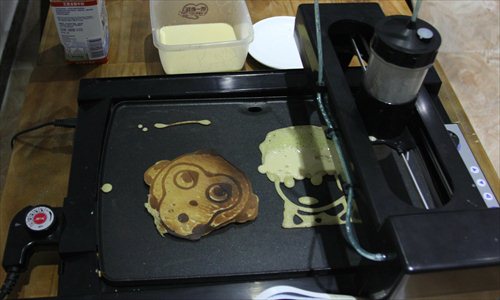
A locally made 3D printer produces a pancake in the shape of monkey's face in Wuhan, capital of Central China's Hubei Province. Photo: CFP
KOCEL Group, an iron and steel foundry in Northwest China's Ningxia Hui Autonomous Region, has remade itself through new technology.Founded in 1966, the company, which was once owned by the State, has employed 3D printing to create a cleaner, leaner production process.
"3D printing is changing the way foundries operate, revitalizing a process that has basically remained the same in China for years," said Meng Qingwen, deputy director of the company's 3D printing center.
Traditionally, molten metal is cast into shapes by pouring it into a mold, usually made of sand, and then waiting for it to solidify.
In the past, to make a complex shape, technicians would break the design down into simple components, make templates of each part and then combine the pieces before going on to make the mold.
A 3D printer, on the other hand, can directly make an integrated sand mold of the most complex of shapes.
With the new technology, the accuracy of the casting process has increased from 1 millimeter to two-tenths of a millimeter, and the scrap rate has fallen from around 30 percent to less than 5 percent, Meng said.
A diesel engine block, one of the most difficult jobs for any ironworks, now takes only one day, compared with eight days in the past.
Always innovating
KOCEL Chairman Peng Fan, said the company bought 3D printing equipment from Germany in 2012 following its privatization.
KOCEL now uses 3D printing to make parts ranging in size from a few kilograms to 10 tons for General Electric, Siemens and other big international players.
One of the main advantages of 3D printing is that the process is much cleaner and less labor-intensive than traditional foundry work.
Peng said that some technicians who have been freed from their grimy, sweaty work by the technology have been transferred to traditional workshops for the time-being. They are awaiting training for other positions in the company, like sales and customer service.
"Innovation is not a short-term thing. A company has to continually innovate to stay alive," Peng said.
Planes, trains and automobiles
Apart from foundries, 3D printing has applications across many industries, including automobiles, electric appliances, biomedicine and aeronautics.
Lu Bingheng with the Chinese Academy of Sciences teaches 3D printing at Xi'an Jiaotong University. He said 3D printing research is thriving in China.
According to the world intellectual property organization, Chinese applicants account for a quarter of worldwide patents in 3D printing and robotics, making it the only middle-income country approaching the level of technological innovation of developed countries.
Lu said 3D printing, vital to research and development of high-end items, will greatly help enterprises.
A new engine
Affected by the global economic downturn, many manufacturers have problems that can be helped by 3D printing, such as overcapacity and pollution and low-end products.
Research by the McKinsey Global Institute found China had performed well in customer-focused and efficiency-driven innovations, which include consumer electronics, Internet services and flexible manufacturing.
According to McKinsey, new opportunities could contribute $1 trillion to $2.2 trillion a year to the Chinese economy, or 24 percent of total GDP growth by 2025, if transformation of manufacturing continues, particularly digitization.
However, He Jun of the Chinese Academy of Social Sciences' Institute of Industrial Economics believes 3D printing is only a small factor in China's giant manufacturing industry, and it is too early to say if China is heading toward an "intelligent manufacturing stage."
"3D printing is hard to apply on a large scale considering it prints irregular, customized products at very high cost," he noted.
While He and others are cautious about 3D printing's prospects, others argue that the technology will transform global manufacturing someday soon.
Lin is team leader at Tsinghua University's laboratory of biofabrication and rapid prototyping technology, which studies the 3D printing's application in biomanufacturing.
He said that unlike traditional manufacturing that is subtractive, 3D printing is additive.
"Traditional manufacturing is like digging a cave house, in which you need to remove the unwanted earth, while 3D printing is like building a house, or whatever you want with bricks, laid piece by piece," he explained.
"The technology may not change current manufacturing instantly, but for sure it will have a profound impact," he said.
The debate is expected to be brought to the annual two meetings of lawmakers and political advisors in early March, which will set specific plans for the country's manufacturing aspirations by 2025.
Newspaper headline: Breaking the mold
Posted in: Insight