Eddie the Eagle
A safe jump onto the big screen
It is getting harder to find more than likable yet another film that features an underdog-turned-star and can-do spirit. Dexter Fletcher's inspirational biopic Eddie the Eagle does little to change that.
In spite of being quirkily exciting thanks to good pacing and its breathtaking cinematography of a risky sport, the film is fundamentally a genre exercise that doesn't do justice to a protagonist known for pushing limits.
The 105-minute film is based on the story of Eddie "The Eagle" Edwards, the first British competitor in Olympic ski jumping.
Yet, the connection is much looser than most viewers might come to believe - Edwards himself told the BBC that only 10 percent to 15 percent really happened.
In other words, the film throws in fictional plot devices and even characters to lead up to Edwards' participation in both the 70-meter and 90-meter ski jumps at the 1988 Winter Olympics in Calgary, Canada.
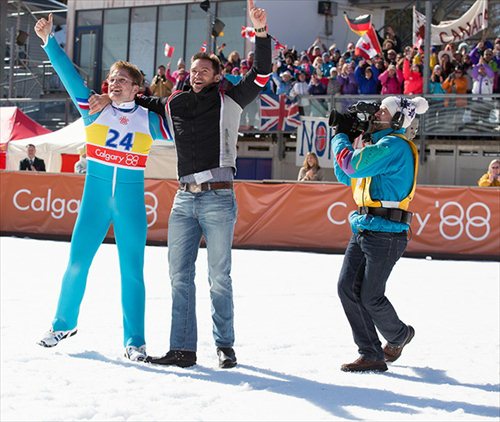
A scene featuring Taron Egerton (left) as Michael Edwards and Hugh Jackman as Edwards' coach in Eddie the Eagle Photos: CFP
Edwards came last in both games, but broke British records and became popular worldwide.
The film follows Eddie (Taron Egerton, Kingsman: The Secret Service), starting when he's a kid with a dream of going to the Olympics, then a teenager who is rejected from the British ski team.
We see his falls before landing his first proper ski jump and a series of obstacles before qualifying for the Games, and eventually the events where he earned his nickname.
The storytelling follows the genre formula, but is at least done properly, stressing the protagonist's struggles with well-timed ups and downs.
Likewise, it presents somewhat caricature-like minor characters: his father, a paperhanger who is thoroughly disapproving, beside a supportive, doting mother; arrogant, top ski jumpers from continental Europe; and a snobby British Olympics Committee officer and unfriendly teammates, each doing their part to make Edwards' devotion and courage, which is absolute, admirable as well as interesting to watch.
But the complete invention of the very important role that is Eddie's coach, Bronson Peary (Hugh Jackman), is far more than just a plot device.
The entirely fictional Peary is a former American ski jump champion who was considered the best of his generation, if not ski jumping history.
But because of his lack of discipline, he was kicked off the team. Now a coach, he finds the clumsy guy with thick glasses a lunatic. But over time, he realizes that Eddie, who is a late-starter at 20 when most professionals started ski jumping at 6, has what he himself lacks about the sport, and starts to train him scientifically and rigorously.
This interesting pairing of, in the words of the Olympic committee officer, an "amateur" who takes it seriously and a "God-given genius" who is considered to have wasted his talents, is one of the highlights of the film.
Moreover, as much as they differ from each other, they share a great enthusiasm for ski jumping: when the drunken and seemingly careless Peary explains on a whiteboard the four different levels of ski jumps and says, "this is the Goddess," when he reaches the 90-meter event, his undying love for the sport is heartfelt.
The casting, however, is a bit lazy in its similarity to Kingsman. Last year we saw Taron Egerton evolve from an underprivileged young hooligan into a suave, professional spy under the tutorship of Colin Firth.
This time, under the help of another A-list star, it's another transformation - though less conventional or heroic, as it celebrates participation over triumph, rather than Kingsman's underlying message that the winner takes all.
Moreover, though Egerton proves himself an impressively versatile actor as he delivers a giddy, nerdy and goofy Eddie, his portrayal has partly reduces Eddie's uncanny will, determination and perseverance to more or less groundless optimism. This is a pity.
But the film is still worth seeing, especially on the big screen, because it captures the thrills and beauty of ski jumping. Be it wide shots from the bottom of the slope, bird's-eye views of the white expanse, or the downhill run and subsequent flight, the cinematography is gripping, formidable and almost majestic.
It is a film that makes you fall in love with ski jumping.
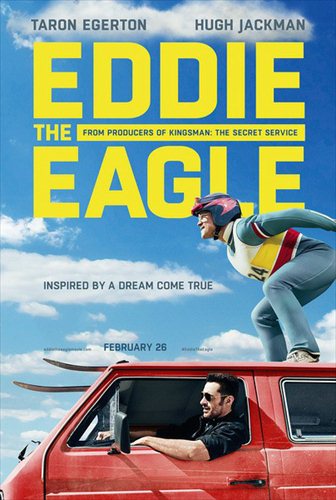
A poster for the film
Everyone's a critic
GT: Did you relate to the film?
Mr Yang, 29, website editor
"When I see the British protagonist being ridiculed by Nordic athletes for his physical limitations and the fact that his country had no real ski jumpers before him, I realize how very similar it is for Chinese people at a time when they were questioned of what they can do. As a Chinese man, I am aware that I am still expected to be more or less underperforming in sports, so this film is convincingly uplifting."
GT: Whose performance do you enjoy the most?
Lin Chenchen, 31, accounting
"Definitely Hugh Jackman, because he is very charismatic, in a cowboy kind of way, and he's at his best when he really gets down to the tutoring. Moreover, I really like the senior British broadcaster reporting the game live, with all those witty comments and adorable expressions."
GT: What is your biggest take-away from the film?
Johnson, 33, hospitality
"I know it's a cliche that participation is more important than victory, which the film repeats, but I really believe that, and I hope it becomes a mind-set that the Chinese public shares. I am fed up with the fact that most Chinese people take winning instead of a sport too seriously, and only cheer for those who win the gold medals. Also, I begin to think I might want to have my kid try ski jumping when he turns 6!"