The British vs American twang
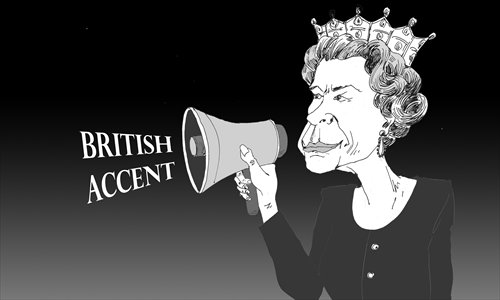
Illustration: Luo Xuan/GT
The other day I had a job interview with a candidate - a stylish 20-something-year-old girl. I was not surprised that she spoke decent English given her background of studying abroad; however, I was unexpectedly impressed by her strong American accent, and her often exaggerated way of chatting.
The strange thing was that the candidate studied in the northern part of the UK, not the US. Shouldn't she be speaking British English with a Northern England, or Liverpool accent? I was curious.
"I used to speak with a British accent when I was in the UK. But, naturally, I turned to the American accent after I returned to Beijing and was in an environment where most of my friends and colleges speak English with an American accent," she explained after the interview.
She is right. Foreigners who often chat with Chinese English language speakers would notice Chinese people's efforts to imitate the American pronunciation and intonation. Of course, mimicking is an important skill in language learning. It's normal for English learners to follow American English, considering the enormous cultural influence of the US, a powerhouse at the frontier of the global entertainment industry. Even the post 80s generation in China, who were educated with British English textbooks and used to listen to English language teaching tapes featuring BBC English accents, speak with an American accent.
But there are many big fans of the British accent as well, like myself. When I was at college, I binge-watched a lot of American TV dramas and movies but soon got fed up with them. Then I was drawn to British TV dramas and started to enjoy British humor and expressions.
Eventually, I had a kind of British accent after spending a year learning and practicing English with the locals in a northern city in the UK. After I returned to Beijing, for quite a while people could tell I had stayed in the UK from my accent - I used to be really proud of it, too, as my little vanity was satisfied.
However, the distinctive British sign in me began to fade away the longer I stayed in Beijing because most of my friends and colleges don't speak that way.
A Chinese person who intentionally speaks English with a British accent is unnatural and awkward. Thus, I changed to a mixed accent of American, British, and Chinglish.
The way people speak is decided by their environment. I recalled that my grandpa used to speak fluent Cantonese as he was born in Guangdong Province. But, after decades of life in Sichuan Province, he forgot how to speak Cantonese, although he can still understand when he hears it.
With China not being an English speaking country, there are still discussions related to "American accent and British accent, which is better?" among Chinese English language learners. The answer is simple: If you are going to the US, then adopt the American accent.
Nevertheless, I have gradually come to favor the Chinese accent, as long as what you say is clear and understandable. For a Chinese, it's the most comfortable way to speak. Look at those senior interpreters at the two sessions; they all speak English with a Chinese accent.
This article was published on the Global Times Metropolitan section Two Cents page, a space for reader submissions, including opinion, humor and satire. The ideas expressed are those of the author alone, and do not represent the position of the Global Times.