Tang Xianzu: the literary master who is undervalued in his homeland
Shakespeare meets Tang Xianzu
March 27 marks the 55th World Theatre Day, which was initiated by the International Theatre Institute to celebrate achievements in theaters around the globe. Life is an endless exploration, and so is theater. It can create fantasy and pierce social realities; it entertains but also intrigues and educates. This year marks the 400th anniversary of the deaths of both Britain's greatest playwright, William Shakespeare, and the classic Chinese opera master, Tang Xianzu. The Global Times invites you to meet these two geniuses and their works.
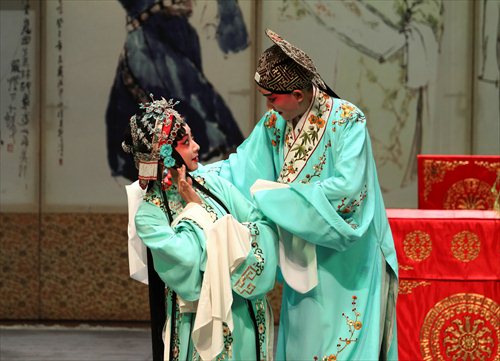
A scene from the Shanghai Kunqu Opera Troupe's production of The Peony Pavilion Photo: CFP
In October last year in the UK President Xi Jinping noted that in China the playwright Tang Xianzu was seen as a counterpart of Shakespeare and the two countries should work together to commemorate these masters and promote cultural communication and mutual understanding.
Tang, an often-neglected theater genius of China, has been getting unprecedented attention this year.
Born in 1550, Tang grew up in a rich land-owning family in Linchuan, Jiangxi Province. Unlike Shakespeare, whose father was an alderman and glove maker, Tang's family were scholars. He was named Xianzu ("glory to our ancestors") suggesting he should become a government official, which he did become when he was 34, holding a position as a minor official in Nanjing, Jiangsu Province.
However, he was outspoken on politics and corruption and wrote poems that accused the emperor of causing social problems. This led to professional problems which finally triggered his resignation in 1598. He went back to his hometown where he completed the famous Four Dreams which are his only surviving operas.
A catalyst to drama
The Four Dreams are The Legend of the Purple Hairpin, The Dream of Nanke, The Dream of Handan and The Peony Pavilion which is the most famous, being performed regularly in China and abroad. In these plays Tang uses dreams as a catalyst to the drama and romance in the works. The plays have become classic texts for different Chinese opera styles with Kunqu Opera the most prominent.
Unlike Shakespeare's plays, each of the Four Dreams are full-length traditional operas with 30 to 55 scenes that each take some 20 hours to stage in their entirety. The People's Daily reported it was a ritual for people to watch an opera from daytime till night in the Ming Dynasty (1368-1644) and they would bring their meals with them. At other times the operas were divided into sections and performed over several days. Today's productions are usually selected excerpts.
Like Shakespeare, Tang's opera performers were all men although some wealthy families employed their own opera companies and hired women for the female roles. It wasn't until the 1950s that women were allowed to perform in public opera companies in China.
Yue Meiti was one of the first women to perform Kunqu Opera professionally and this year the 75-year-old will be the artistic director of two different The Peony Pavilion productions for the Shanghai Kunqu Opera Troupe and then the Northern Kunqu Opera Theatre from Beijing.
The opera tells the love of the young woman Du Liniang for the scholar Liu Mengmei, and Du has become one of China's great literary heroines, famous for being a woman whose love could not be extinguished by death.
Appalling repression
"The repression of women by tradition was appalling, but Tang told women that they should follow their own hearts and chase what they love despite obstacles. Women in the audience could feel passionately about themselves and the play became a hit," Yue said.
For Yue, Tang is an outstanding writer with profound messages. "The Four Dreams tell very different stories, but all address the repressions that the people in that era suffered as well as discussing the meaning of life."
Zhou Yude is the director of Tang Xianzu Studies for the Chinese Opera Society and spoke about Tang's influence on later writers. "Tang believed in the importance of human emotions, and inspired by him, playwrights in the late Ming Dynasty became more and more open about writing about humanity."
Zhou said Tang also influenced famous writers like Hong Sheng (The Palace of Eternal Life) and Cao Xueqin (A Dream of Red Mansions - one of the four masterpieces of ancient Chinese literature). As well as the Four Dreams, Tang wrote a great deal of poetry and essays, which all resound with his philosophy and principles. But awareness of his writing is very low in China compared to the way Shakespeare is esteemed.
Yu Rongjun, vice-president of Shanghai Performing Arts Group, said that even though the two masters were being celebrated this year and some of their works shared common themes, people should be aware that they were very different.
More realistic
"Shakespeare's works are richer and more realistic in content, the characters have different philosophies and the plays are embedded with universal values that can easily be accepted by different cultures," Yu said. "While Tang's works relate to oriental philosophies and rely on music and a specific cultural background to make themselves complete. They're very difficult to translate and the Chinese opera genre and poetical lyrics are quite inaccessible for modern audiences."
"I think the key to increase Tang's popularity is to find the relevance of his work with the current era. We can't turn him into a legend just by promoting his work - this is something artists and audiences come to agree on. If we can find a way to link ancient classics with contemporary society, then promotion won't be a problem anymore," Yu said.
Yue Meiti told the Global Times that she thinks Tang's works could be more easily accessed by ordinary people by education and low budget opera productions. Some Chinese People's Political Consultative Conference members have also suggested there should be a Tang theater festival established as well as taking Kunqu Opera to more schools in China.