Hokkaido: A winter wonderland
A dreamland embracing winter scenes, sports and cuisine
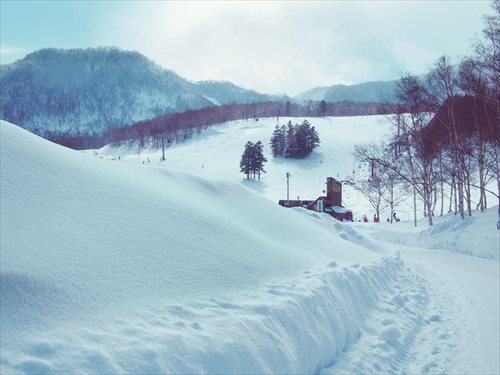
A view of Sapporo Teine Ski Resort Photo: Liao Fangzhou/GT
Widely known as the best winter playground in Asia, Japan's northernmost island Hokkaido is a superb destination to visit during the Chinese New Year holidays if you are into whiter-than-white snow, skiing and pufferfish.
Cruising past the Tsugaru Strait from the mainland city of Sendai, I kicked off my Hokkaido trip with the island's southernmost city, Hakodate, and later took the railway to it's capital city of Sapporo.
Though this snow enveloped region generally enjoys a temperature comparative to Beijing's and lower than Shanghai's, in actual fact it felt surprisingly milder than the two Chinese cities.
Yet, it is still very important to leave trendier footwear behind and put on slip-resistant and water-proof boots, preferably ones that go above ankle, which makes walking on ice and (often thick) snow a lot more comfortable.
Hakodate
I love cities that immediately make me think "I want to come back here one day." I hadn't felt that way about any destination for quite a few years, that is until Hakodate. This seems to be a feeling shared by many, because in 2015 it was voted Japan's most attractive city.
It was around dusk when I started exploring. The harbor, charming blue color from far away, had just started to glitter with reflected lights. Walking randomly past neat residential houses with finely manufactured yards, I often ran across an old temple or statue standing quietly on a corner.
The city is famous for the night views from the summit of Mount Hakodate, a site awarded the highest ranking of three stars in the Michelin Green Guide Japan. I didn't even need to go all the way to the top to be enchanted - walking along the uphill streets heading to the mountain's ropeway departure point, by which trees are beautifully illuminated, was a refreshing and dreamy experience.
For a hiking enthusiast like me, it was a bit disappointing that the ropeway is the only way up in the evenings. However, it was understandable as the uphill pathway is completely dark at night and walking would be very dangerous.
It takes about three minutes to ride the ropeway to the top, where a dazzling panorama awaits. What makes this vista special is that it roughly resembles the shape of an hourglass - the middle region is the narrowest and sandwiched by the bays.
If this can be considered the place for taking in glowing city lights, the area around the ropeway departure point is where one can enjoy darkness and, after around 8 pm, privacy. I still can't decide which experience was more breathtaking.
I loved wandering around the giant red-color torii (a traditionally Japanese gate marking the transition from the profane to the sacred) and the dark ancient shrines, all tourist-free, and gazing at the stars - yes, there were quite a lot of them far above me. I felt I had the entire world to myself and my companion.
My biggest highlight in Hokkaido was Goryokaku, one of the very few Western-style star-shaped forts in Asia. It was completed about 150 years ago and is now used as a park, which I visited the next morning.
Built to protect the Tsugaru Strait against a possible invasion from the Russian fleet, Goryokaku became a historically important site as the last battle of the Boshin War (a civil war between an army of shogunate and the troops of the newly established Meiji government) took place here - the shogunate, who used it as the main fort, surrendered.
To get an overview of this massive fort, I first went up the 107-meter Goryokaku Tower Observatory adjacent to it. From the deck, my treat was a wonderful full view of the fort - the frozen moat that forms a broad outline of a star, the unique walls designed to reduce the number of blind spots where a cannon cannot reach and the Former Magistrate Office located right at its heart.
It is also impressive that the observatory explained the history and backstory of the fort in clear language complemented by well-drawn, entertaining four-frame comics and exquisite models depicting important events.
Next, I went down and entered Goryokaku through the bridge at its front. I took my time observing the walls at a close distance and then went on to visit the Former Magistrate Office, which meticulously displays how the officers of the shogunate administered Hokkaido from here.
The park is gorgeous in all seasons, but I would love to revisit it in springtime. With more than 1,000 cherry trees along the moat, the site is one of the best cherry blossom spots in Hakkido - it becomes a pink paradise around early May.
Sapporo
After quiet and relaxing Hakodate, the capital city immediately felt much louder and crowded. I arrived during the last days of the week-long Sapporo Snow Festival, which meant that tourists from Japan and all over the world had fully booked the city's hotels.
The festival's main site was located at Odori Park, where enormous artworks sculpted of pure snow and clear ice - in the shape of a castle or a speed railway train, for example - stood one after another through the 1.5-kilometer-long park at the heart of downtown. The music and light only added to the excitement.
This might also be the best place to see the Sapporo TV Tower, a landmark located in the easternmost section of the park. You can take your picture in front of this tourist trap (it turns sapphire blue at night), but you might not want to spend your time and money on actually visiting it - after all, the observation deck is just 90 meters tall and Sapporo doesn't have a particularly impressive night view.
Sapporo is very shopper-friendly. Commercial streets around the park are packed with the city's best department stores. I found everything I was interested in - from luxury goods to Hokkaido-produced cosmetics - in Marui Imai, which spans across four buildings.
Skiing
A ski day trip was all I needed to take my Hokkaido vacation from good to great. My destination was the Sapporo Teine Ski Resort, a winter sports paradise less than half an hour's train ride from Sapporo, where the first Winter Olympic Games in Asia were hosted.
Hokkaido snow is world-famous for being light and fluffy, something I immediately proved true once I set foot on the powder-like snow mounds of Teine Olympia - the ski area for beginners like myself.
The place offers reasonably-priced ski equipment for rent and provides quality private or group classes. My private tutor was not only an extremely experienced and patient ski coach, but spoke clear English and passable Chinese. Turns out he had studied in Beijing for three months last year.
As I skied down with my tutor and companion from Olympia's highest slope, I had a magnificent view of the faraway ocean, the beautiful mountains and the meandering trail ahead. In spite of all my nerves, I felt I was in a dreamland.
Fugu
Winter is the prime season for Japan's most desirable and pricey fish, fugu, or pufferfish. I came across the dish in three different restaurants, but my favorite place was the Ryotei Fumoto, the only 2-Michelin-star restaurant in Hakodate.
The restaurant, located in a historic and delicate Japanese-style mansion, prides itself in using fresh local ingredients.
From the appetizers to the main meal, each dish featured pufferfish prepared in a different way. My favorite discovery was the translucent, chewy skin that came in strips, which I put in the midst of a slice of pufferfish sashimi alongside spring onions to make a roll.
A special treat was milt (the sperm-filled reproductive glands of male fish), which was not originally on the menu and just happened to be available that day. This cooked version tasted incredibly tender, creamy, and even kind of similar to custard.
Service was top-notch. The waiters left the room immediately after dropping off each dish, but somehow returned with a new dish within a minute of us finishing the last one.
Be aware that the restaurant does not accept guests without reservation. It's best to book a table by phone two weeks ahead.