HOME >> ARTS
Chinese writer Cao Wenxuan wins ‘Nobel Prize’ of children’s literature
Source:Global Times Published: 2016-4-5 19:43:01
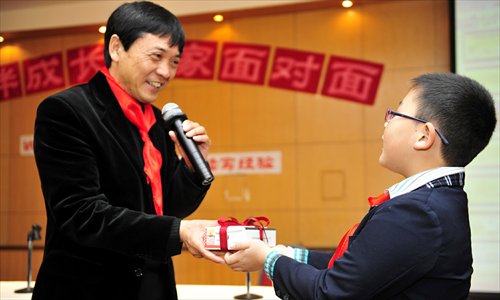
Author Cao Wenxuan accepts a gift from a fan. Photo: CFP
On Monday in Bologna, Italy, children's literature writer Cao Wenxuan became the first Chinese author to win the Hans Christian Andersen Award.
First established in 1956, the award became known as the "Nobel Prize" for children's literature. It recognizes a writer's achievements over their lifetime and can only be obtained once for each author. Named after the famed fairy tale writer and sponsored by Queen Margrethe II of Denmark, the award selects one children's book author and one illustrator from around the globe once every two years. To date, 26 authors and 25 illustrators have won the prize.
Over the years, six Chinese authors have been nominated for the award - including Cao, who was first nominated in 2004 - yet did not win. As the first Chinese to win the award, Cao told the Beijing Morning Post, "I wasn't as excited as my friends were. Many of them attended the ceremony and waited for the result. After the awards were announced, the atmosphere was very welcoming. As for me, I really feel honored because this is a really important prize in this field, and this means my efforts have been recognized."
A professor with Peking University's Chinese Department, Cao became a well-known author in China with his works The Grass House, Bronze and Flower and the Dingding Dangdang series. The author has also had great success overseas. He boasts one of the largest collections of overseas copyrights for his works among Chinese authors, with his works having been translated into numerous languages including English, Japanese, Korean, German and French.
Born in 1954 in a small rural village in China, much of Cao's work is set 1950s and 1960s China and features animals and children as protagonists. On more than one occasion the author has said that his strongest background is China, which has provided a constant out-pouring of priceless writing resources.
In a 2012 interview with Hu Shaoqing, an associate professor at the University of International Business and Economics, Cao revealed that he seldom communicated with the translators of his novels, with the Japanese translator of The Grass House being the exception.
"I would talk to the translator when she wasn't clear about something or ran into problems concerning details. She even visited my hometown of Yancheng (in Jiangsu Province). I took her to visit people's homes and experience the lives of the local people," he told Hu.
Cao admitted that language is the biggest obstacle to translation, but that he doesn't "worry about that because no matter which language they are translated into, my stories are still there."
According to a report on xinhuanet.com, when announcing the winner, Patrica Aldana, this year's jury president for the award, praised Cao as "the unanimous choice of the jury" and that "Cao writes beautifully about the complex lives of children facing great challenges."
As for Cao's future plans, the author revealed to China Youth Daily, "I will finish two novels in 2016 and keep working on the series Dingding Dangdang and A Cool Bird Wawa."
Newspaper headline: Child’s play
Posted in: Books