HOME >> ARTS
Studios trying to dominate the big screen in an increasingly competitive market
By Mtime.com - Global Times Source:Global Times Published: 2016-4-12 18:33:01

Promotional material for Railroad Tigers Photos: IC
In yesterday's article we took a look at the big five studios within China's ever-expanding film industry. Today we delve into the State-owned side of the industry and examine how China's reform and opening up movement has impacted these companies. Last we'll take a look at how two of China's Internet giants are putting their own spin on the movie industry.State-owned companies
The China Film Group Corporation (CFGC) and the Shanghai Film Group Corporation (SFG) are the largest and oldest State-owned film companies in China. These studios' special background gave them incredible advantages back in the day, but as the market became increasingly open to free competition both CFGC and SFG had to adapt to changes in the market.
Cooperating with private companies has been a major strategy for CFGC. For example, CFGC had a hand in almost all the major blockbusters that debuted during this year's Spring Festival Holiday, including The Mermaid, Kung Fu Panda 3 and The Monkey King 2. Looking at the list of upcoming films for 2016, almost half of these 33 works involve cooperation between CFGC and private companies. The genres of these films widely vary, from historical epic Xuan Zang, about the famous Tang Dynasty (618-907) monk, the Chinese remake of Hollywood's My Best Friend's Wedding to sci-fi film The North Pole.
CFGC is also focused on films that adhere to mainstream ideology. For example, the star-filled war film My War is about to hit theaters, while French director Jean Jacques Annaud was invited back to work on next year's period film The Legend of the Mengol King after working with CFGC on Wolf Totem.
Meanwhile, SFG has shown a special interest in literary works. One highly anticipated project is the studio's adaptation of Mao Dun Award-winning Shanghai-dialect novel Fan Hua, which will be directed by Wong Kar-wai (The Grandmaster). Other similar adaptations of contemporary literature works include Red Poppies and Soul of a Great Country.
One special resource that SFG can call on is the vast library of cartoons made by its subsidiary the Shanghai Animation Film Studio. The studio produced a number of cartoons for TV, such as Black Cat Detective and Calabash Brothers in the 1980s. With children of that time period now making up the majority of audiences today, remaking these cartoons into feature length films is one of the major projects on the studio's agenda.
SFG is working on a few mainstream films as well, such as the remake of the 1956 red classic Railroad Tigers.
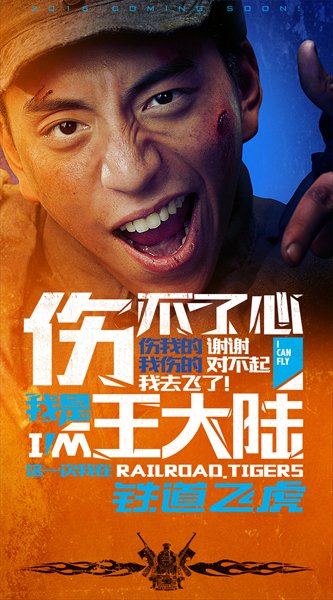
Promotional material for Railroad Tigers Photos: IC
Evolving onlineEver since Alibaba Pictures was founded in the middle of 2014, everyone has been curious about the approach Internet giant Alibaba would take when it comes to film. Although it's been nearly two years, Alibaba Pictures hasn't released a single film. Yet its latest financial statements show that it managed to earn 466 million yuan ($72 million) in 2015.
Most of this revenue came from the marketing Alibaba Pictures provided for Tiny Times 4.0, Mission: Impossible - Rogue Nation and The Third Way of Love. Additionally, the acquisition of YKSE, the largest online movie ticket seller in China, helped make online marketing Alibaba Pictures' highest earning business division.
Zhang Qiang, CEO of Alibaba Pictures, once said that the company's goal for 2015 was to transform from a traditional film and TV studio into a platform model similar to an Internet company. The studio has four business divisions: content production, online marketing and distribution, entertainment e-commerce and international business.
Alibaba Pictures has three films, such as The Ferryman, set to release this year and several others, including an animated film, still in production. For the most part, these are either IPs that can be made into cross media franchises or that can target the international market.
International coproductions such as Real (starring South Korean actor Kim Soo-hyun) and The Flying Tigers (Randall Wallace as scriptwriter) are important projects for the studio's global strategy.
Alibaba Pictures has also launched a project aimed at supporting young directors to help build a reservoir for rising talents.
Following Alibaba Pictures, Internet giant Tencent set up Tencent Penguin Pictures and Tencent Pictures in September 2015. Announced projects from Tencent Pictures for 2016 include computer animated motion capture fantasy adventure film L.O.R.D: Legend of Ravaging Dynasties and video game adaptation Moonlight Blade.
While Tencent Penguin Pictures focuses more on producing online dramas, investing in films and running a talent agency, the core goal of Tencent Pictures is to develop IPs in a manner similar to the "Disney + Marvel" formula. Able to call on manga, game and novels published by Tencent Interactive Entertainment, an online entertainment platform, Tencent Pictures has plenty of resources to establish its own closed ecosystem.
In addition to Internet giants Alibaba and Tencent, smaller Internet companies have also been making their way into the film industry.
iQiyi, a Chinese Internet streaming company, has also set up a studio which is expected to bring six films by Hong Kong director Wong Jing. Last December video sharing website Bilibili joined hands with the Shanghai Media Group in a joint-venture studio and this February Xiaomi Tech announced the establishment of a subsidiary company dedicated to film production.

Promotional material for Railroad Tigers Photos: IC
Newspaper headline: Mapping China's Film Industry - Part II
Posted in: Film