Shanghai taxis must improve or lose to private car services
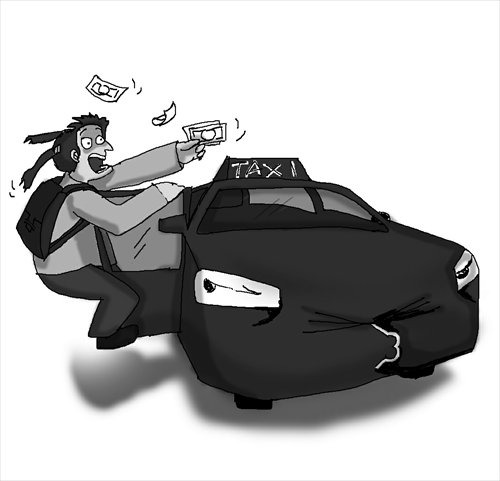
Illustration: Lu Ting/GT
Over the past year, chauffer services and private car-hailing apps such as Didi Kuaidi and even the American Uber have soared in popularity among Shanghai residents, which has left the city's taxi drivers feeling even more bitter about their dead-end jobs. But the irony in their discontentment is that it is their own bad attitudes and lousy service that have resulted in this Darwinian-like devolution.
The most recent incident occurred at Hongqiao International Airport, when a female passenger hopped into one of the many taxis queueing up outside the airport but only needed to go to the nearby Terminal 1, a 30-yuan fare, as opposed to into the city, which is usually a 200-yuan fare. Pissed off that the cabbie had waited in the taxi queue for nearly two hours for such a small fare, the driver began berating and physically threatening the passenger.
Shanghai taxi drivers, especially the ones who circle around the airports like vultures, are notorious for kicking out passengers they don't want. Such a thing happened to me several months ago when I caught a taxi at Hongqiao airport. Upon realizing that my destination was less than two kilometers away, the driver suddenly pulled over, saying something was wrong with his engine, and asked me to step out of the car while he checked. As soon as I did he sped away.
I had to walk back to the airport queue, where I complained to an employee at the taxi stand. But not even he could convince any of the other drivers to take me such a short distance. I wound up walking. As a newcomer to Shanghai, that was my very first experience with local cabbies, but my subsequent experiences never got better.
For example, I have found that if you only give a general address instead of specific roads, the cabbies tend to complain unless you show them the exact directions on your mobile map app. It seems that because many Shanghai cabbies are not true locals, not even they are very familiar with this huge city, so they place the onus on the passenger to navigate. I've never had that happen to me in any other Chinese city, where the drivers are usually familiar with destinations.
Another underhanded tactic that passengers should aware of in Shanghai is getting overcharged. Cabbies will either take you the long way to your destination or press a secret button on their meter that adds extra yuan to your fare. Cabbies in Shanghai must submit a minimum quota of 5,000 yuan every month to their companies regardless of how many fares they have earned, which means that every day they automatically owe 300 yuan before they even turn on their ignition. Under such pressure, most cabbies work nine hours or longer per day, much of the time just driving around aimlessly or waiting in long queues. It's no wonder that drivers are so impatient and greedy.
But then again, nobody forced them to become taxi drivers.
Adding to their bad moods is the growing competition of private driver services, most which use nicer cars, offer friendlier and more knowledgeable service, and for much cheaper. It's the perfect example of the theory of causality, which suggests that the nature of every action on the universe is due to a perfect combination of factors and forces; nothing "just happens." In this regard, companies like Didi Kuaidi and Uber didn't just suddenly appear; they were created because passengers demanded a better alternative to taxis.
In 2015, a UK travel website ranked the quality of taxis around the world, with Shanghai's cab drivers among the worst on the list. The primary reasons cited were their bad tempers and shoddy service. We should sympathize with these drivers - most are uneducated migrants struggling to make a living - but their social status is still no excuse to cheat and mistreat their passengers.
And if they ever want to survive this survival-of-the-fittest battle against private car services, then local cabbies need to immediately improve their professionalism.
The opinions expressed in this article are the author's own and do not necessarily reflect the views of the Global Times.