Reforging China’s steelmakers
Burdened by overcapacity, industry turns to upgraded technology, M&A
China's steel industry is downsizing. In an effort to deal with the glut of capacity that has become the cement shoes of the domestic steelmaking industry, steelmakers from around the country have been cutting back. In 2015, domestic steel production fell 2.3 percent to 804 million tons - the first time in 30 years that steel output declined from the previous year. However, in cities and regions where steel is a pillar industry, slashing capacity often comes with the unwelcome side effect of lowering GDP growth. The Global Times recently visited Handan, North China's Hebei Province, as part of series on how local steelmakers and coal producers are dealing with overcapacity, and the effects their efforts are having on the economy.
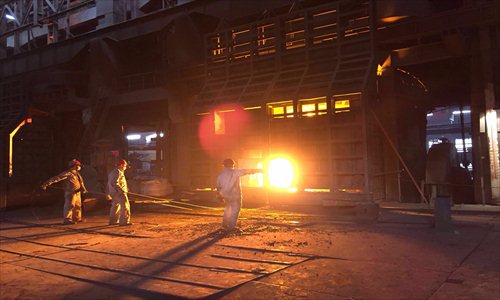
Workers for Jinan Steel Group, a private steelmaker in Wu'an city near Handan, North China's Hebei Province, check out the melting pot on Monday. Photo: Chen Qingqing/GT
"I've been here for almost my whole life, and now I can hardly breathe," said Ma Fenli, a 52-year-old resident of Jiuwulou, a small village in Handan, North China's Hebei Province.
A few years ago, Handan Iron & Steel Group (Han-Steel) set up several new steel plants next door to the village.
The plants belch acrid smoke day and night, disturbing every resident in the village, Ma said.
"The only good days were during the preparations for the V-day parade last year, when we had the most blue sky ever," she told the Global Times on Sunday.
China held commemoration activities, including a grand military parade on September 3, 2015, to mark the 70th anniversary of the victory of the Chinese People's War of Resistance against Japanese Aggression (1931-45) and World War II.
To ensure clean air for the military parade on that day, the government implemented temporary controls on factories, power plants and construction sites. More than 10,000 factories suspended or curtailed production during that time, according to media reports.
A troubled city
Smog has been a major problem for the area, which relies on the heavily polluting steel and coal industries.
The local government has attached great importance to improving air quality in recent years, raising standards for steelmakers' emissions. But this has greatly added into the costs of steelmakers because technological upgrades come at huge costs while the industry is suffering from severe overcapacity.
Financially troubled steelmakers are also hurting the local economy.
"In cities with pillar industries such as Handan, almost 50 percent of their fiscal revenues come from the steel and coal mining industries, so restructuring is no easy task," said Feng Liguo, an expert at the Beijing-based China Enterprise Confederation.
Unlike China's first-tier cities such as Beijing and Shanghai, Handan lacks the "innovative spirit" to push into other sectors such as services and online commerce, he noted.
"It has become a major obstacle to its economic growth," Feng told the Global Times on Monday.
However, the city has been pushing forward industrial restructuring in the past five years, which has made some progress, said Li Xinchuang, president of the China Metallurgical Industry Planning and Research Institute.
The GDP growth in Handan reached 6.8 percent in 2015, media reported in February, which was three percentage points higher than that in 2014.
"But the local economy is still facing downward pressure today," Li noted in an e-mail sent to the Global Times on Monday.
Up the value chain
Due to illegal fundraising scandals since 2015, many housing projects have been suspended or abandoned in Handan, which hurt demand for construction steel, said a trade company employee surnamed Wei, who refused to give his full name, in one of Handan's steel retail markets.
"For some steel products such as rebar, prices were even lower than the prices for cabbage by the end of 2015," the 48-year-old man told the Global Times on Sunday.
In December 2015, the price of a certain type of steel rebar produced in Handan dipped to 1,600 yuan ($247) per ton -its lowest price since 1994, according to data the Beijing Lange Steel Information Research Center sent to the Global Times on Monday.
With prices falling, local enterprises have been slashing output in recent years, which is in line with government guidelines to reduce overcapacity in the steel sector.
Handan is one of the cities that has succeeded at reducing their output. Local producers have cut their output of low-end steel products by more than 5 million tons since 2012, costing an estimated 10 billion yuan in losses, said Li.
"However, there were around 50 million tons of crude steel in total in different counties in Handan as of the end of 2015, and the local government has to push ahead and reduce production by another 100 million tons by 2017," Li noted.
Han-Steel, which is affiliated with Hebei Iron and Steel Group, one of the largest steelmakers in the country, doesn't produce much crude steel or low-end steel products, said Wang Jian, who has worked at Han-Steel for years and is now a trade partner with the company.
"For example, cold rolled strips are one product with high added value. It is widely used in the production of appliances such as refrigerators and air conditioners," he told the Global Times on Monday.
For one thing, such high value-added products can help the company generate higher profits, Wang noted.
"For another, it shows the company's intention to adjust in accordance with demand, especially after the volume of orders for certain types of steel plate plunged," he told the Global Times.
Coming up with more high value-added products is now seen as a solution for some steelmakers in difficult times, Wang said.
"But there are not many companies like Han-Steel that have sufficient cash flow to upgrade equipment to make a technological breakthrough," he noted.
Joining forces
Located about half an hour's drive from Handan, the city of Wu'an is home to many private steel enterprises that have been undergoing rounds of mergers and acquisitions (M&As) since 2015. M&A is considered a "sufficient" way to aid small steelmakers on the verge of bankruptcy, industry experts said.
At a steel plate rolling mill operated by private steelmaker Jinan Steel Group, which was established in 2014 by combining two private steelmakers in Wu'an, steel slabs passed through a roughing mill and moved along a conveyor belt. Several masked workers measured each steel slab twice as it exited the mill.
"Considering the decline in demand, the company cut production of medium steel plate, its major product, by about 50 percent during certain periods in 2015," said Zou Linzhong, who is in charge of the Jinan Steel's export business.
The steelmaker exported a lot more of its products overseas in 2015 because demand was stronger than in China, Zou told the Global Times on Monday.
However, the company is likely to return its focus this year to the domestic market, which has been showing signs of a recovery in prices.
South Korea remains a key market for Jinan Steel because South Korean steelmakers cannot meet the demand of the country's shipbuilders and machinery makers, as well as other big steel consumers, he said.
Zou also noted that the profit margins on exported products are usually 500 yuan per ton higher than on products sold domestically.
"Once Chinese steelmakers decrease [steel] exports, the overseas anti-dumping claims will probably disappear," he said.
Local companies like Jinan Steel are expecting to see more M&A deals rather than bankruptcies, which means avoiding potential labor disputes and earning more room for new production lines.
"Going bankrupt sometimes means large layoffs and paying off all the debts," Feng said. "However, encouraging M&A could help struggling small steelmakers survive.