Complete poetry of Tang Dynasty’s Du Fu published for first time

Stephen Owen Photo: Courtesy of Stephen Owen
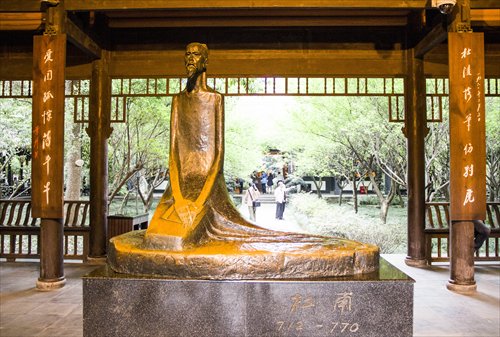
A statue of Du Fu sits in the Du Fu Thatched Cottage in Chengdu, Sichuan Province. Photo: IC
While Tang Dynasty (618-907) poet Du Fu holds an irreplaceable position in China's literary history, globally he is not quite as well known as his contemporary Li Bai. However, that just may change as a US sinologist is currently blazing a path for Du Fu to reach the world stage.
Professor Stephen Owen - a translator and sinologist who has focused on Chinese literature, especially Tang Dynasty poetry, for more than two decades - recently published the first ever complete English edition of Du Fu's poetry.
The Poetry of Du Fu, a six-volume work 3,000 pages in length, took Owen eight years to finish. The work is the first part of Owen's larger project: The Library of Chinese Humanities, which seeks to bring Chinese classical literature to the English-speaking world.
Teaching at Harvard University, Professor Owen took time out for an e-mail interview with the Global Times, during which he shared more details about his latest work and his views on translation.
Q: Du Fu is a prolific poet (more than 1,400 poems). Why did you decide to work on something that would take so much time and energy to complete?
A: There are many reasons. I was unexpectedly given a large Mellon Fellowship that I had not applied for so that I could do any scholarly project I wanted to do. This was one of the projects I had always wanted to do.
Many poets have some great poems and a great many ordinary ones. Du Fu almost always has something new and exciting. If you are doing a large project, this is important. It is better to read all of Du Fu than a selection of Du Fu; anthology selections try to give one image of Du Fu, but the complete Du Fu allows us to see why Yuan Zhen [an important Tang Dynasty politician, writer and poet] said that Du Fu did everything.
Q: What was the biggest challenge when translating Du Fu's poetry?
A: The greatest challenge is Du Fu's style. He is not like other contemporary poets. We can talk about poetic "style" in ways we could never do before with our digital resources and the excellent work in Chinese lexicography in past decades. When I teach a class, we can come to what seems to be an ordinary phrase - and I can tell students, "It may sound ordinary to you, but that phrase had never been used before in either poetry or prose."
We can begin to understand how a poem "sounded" in the Tang. It's easy to do this in a graduate seminar; it is hard to do in translation - but a good translator can begin to convey the variety of Du Fu's poetry. He has a poem on building a chicken coop. It alternates between the very down-to-earth and a political discourse. It is hard to know if Du Fu is very serious or very funny (and ironic) - and he could be both serious and funny at the same time. Du Fu is truly a great poet.
Q: Do you have any expectations when it comes to the influence The Poetry of Du Fu may have?
A: The print version is beautifully done and quite reasonably priced by current standards - about $35 a volume. But anyone who wants can download high quality pdf files of the Du Fu translation free at degruyter.com. I have used the Mellon Fellowship money to make this possible; we can do this for any volumes we can get into production next year. We hope to get an endowment so that we can continue to do this for all volumes in the future.
This means that anyone who reads English can read an English version free of charge.
The primary audience I have in mind for the series are those with some Chinese, but whose wenyan [literary Chinese] is not good enough to read earlier classical texts with ease and accuracy. This will help such readers learn and return to the original Chinese. The series has a clear purpose.
Q: As the first published work of The Library of Chinese Humanities, does The Poetry of Du Fu have any special meaning?
A: Translating all of Du Fu was a good way to begin a project that we hope will continue for a century or more, continuously translating important works of the Chinese tradition in a form that is both scholarly and very readable, with enough basic notes for a reader without much background and more scholarly notes at the end. The "Loeb Classics" of Greek and Latin literature have been ongoing for more than a century, and have one of the ways a connection has been preserved and modern readers who know some Latin or some Greek can keep contact with the classical past. Recently the Murti family gave a $5 million endowment to begin a similar series in Indian literatures. I have always wanted to see such a series in Chinese humanities, texts of history, thought, and literature. We are seeking an endowment for the series. This seems to be the only way to give the modern reader some direct access to an earlier textual tradition that requires immense learning.
Q: Among your students, you have students from China, Chinese-Americans and non-Chinese Americans and Europeans. What are the most significant differences they have in understanding ancient Chinese culture?
A: I have had a few students from China who had a real mastery of the language, the tradition and the ability to ask the right questions. Most students from Chinese departments in China have a good training, and we have to teach them new questions and to justify what they think they know. The Chinese-Americans are often very good: They have good instincts with the language and some of them have been reading wenyan since childhood. The non-Han [Chinese] Americans and Europeans simply have to work harder. They often get discouraged. We treat them here in the same way we treat the Chinese students (unlike the simplified, special programs for non-Han students in China). Our non-Han students have to learn or give up. Those that do succeed can be among the best - and are a good addition to the community of Chinese scholars.
Q: What else do you plan to publish?
A: I rashly promised to do a translation of Ruan Ji's [210-263] poetry for The Library of Chinese Humanities, to be published with Wendy Schwartz's translation of Ji Kang [223-262]. I have also finished a book on Northern Song ci [a type of lyric poetry], which I started at about the same time as the Du Fu translation. I like this book very much. As a graduate student I hated ci; over the years I have learned to love it and to understand why it is important.
Newspaper headline: Window to the classical past