Farming toxins
New report warns of biocide impact in Laos
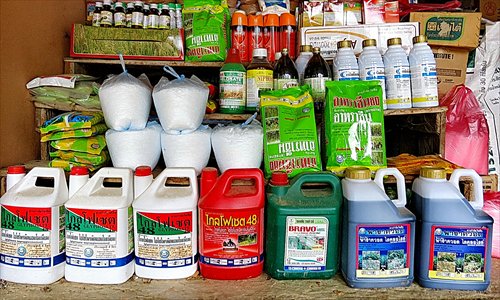
Pesticides are displayed in a Southeast Asian market.
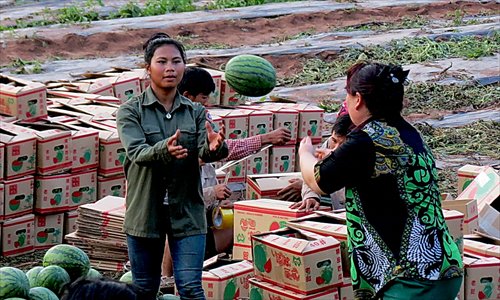
Farmers pick watermelons in northern Xieng Khouang province, Laos. Photos: Courtesy of Andrew Bartlett.
A recent report from the Lao Rural Upland Advisory Service (LURAS), a project run by Swiss development group Helvetas, on biocide use in northern Xieng Khouang province has confirmed the fears of many locals that the use of biocides is taking a toll on the small country's health. Biocides are chemicals or microorganisms designed to tackle or control "hostile" organisms, such as pesticides intended to protect crops from parasites.
Increasingly heavy biocide use is associated with many deaths, illness and heavily contaminated food, coupled with decreasing soil fertility and has caused growing concern among agriculturalists, farmers and the Lao public.
A senior Lao government official, interviewed in an informal context, confided that the issue was of growing concern as "contract farming," a common code for Chinese investment, expands. "The government is taking measures," he insisted, but responded with banalities when pushed for specifics.
According to one Helvetas researcher, who asked not to be named, farmers' preference for Chinese investors, who often make heavy use of biocides when farming, stems from that the Chinese deal directly with them, cutting out government rent seeking and gatekeeping. This has stirred anger among Lao officials, who often rely on corruption to bolster their inadequate incomes, and may drive part of a government and public response that has focused on their giant neighbor.
Chinese are often primarily blamed for the spread of biocides. But the reality is that the chemicals are more likely to come from Vietnam or Thailand than from China. This was confirmed by the Helvetas field team who toured local markets checking labels as well as the stated country of manufacture.
Yet fears over biocide use are part of a wider pattern in Laos. Policies that government officials say are a necessary part of "poverty reduction" are seen by many locals, especially poor farmers, as a severe disruption to traditional life. Laos' rural economies and cultures are struggling to cope with markets in which land and water are commoditized, rather than distributed according to community or tradition-based norms.
Higher production for distant urban elite makes little sense to some farmers. Richard Arnst, an agricultural consultant, recounted how a farmer told to grow more rice responded, "The problem is ... you people in the cities want to eat rice, but don't do any real work."
Vulnerable target
Expanding urban populations, rural migration and an aging population as suitable land shrinks, has spurred some farmers to increase production and chase thin profits by using agrochemicals.
Laos had a tradition of hak peng gang or mutual self-help, but what used to be free neighborly mutual assistance that helped cohere communities now comes with expectations of payment.
Gender-based division of labor in some ethnic groups makes herbicides increasingly attractive for overworked upland women. Pressure pushes them into using chemicals like the notoriously toxic Paraquat, responsible for most deadly pesticide accidents even in developed countries and with a 50 percent fatality rate if accidentally ingested.
Despite existing regulations on pesticide use in Laos, the absence of comprehensive or competent oversight of the small country's highly porous borders, makes Laos vulnerable to an inflow of a variety of biocides, ones illegal or strictly controlled elsewhere.
Herbicides like Atrazine, which has been compared to notorious mosquito-killer DDT due to its effects on amphibian life, are freely used. Others, like Carbendazim, are both reproductive and environmental hazards that can cause permanent damage to aquatic environments. Biocide use often poisons humans as well as flora and fauna, either through accidents or through entering into the food chain.
Khamphasit Sophinvong, head of an Australian funded labor welfare project, said little knowledge exists in Laos' medical fraternity on dealing with biocide poisonings. Virtually no epidemiological data against which to compare associated deaths and illness, much less reproductive effects.
The supervisor of one contracted melon plot in Bokeo, who refused to give her name, was making sure her workers applied Forchlorfenuron, a relatively harmless plant hormone being pioneered in Laos by China, she said. She was undeterred by footage of exploding melons, allegedly because of heavy pesticide use, that made the news last year. She had trained her workers well; they applied the chemical sparingly and with precision, and despite criticisms in Laos over lack of equal pay for local workers, were paid equitably.
Andrew Barlett, a Helvetas researcher, expressed some concern that the hormone, while innocuous in small doses, could nonetheless be risky if broadly applied or entered nearby water courses. "We have no idea how it might affect, aquatic life or about what will happen if environmental concentrations rise, its half-life and break down products. That is always the problem; keeping up with the new technologies," he added.
Persistent poisons
Laos and Vietnam were victims of aerial spraying by the US Air Force Operation Ranch Hand in the 1960-70s as part of the use of herbicides to destroy jungle cover for Communist forces. The program destroyed lives, crops and forest.
But while 7 million liters were sprayed on Laos in the war years, a new study found that around 19 million liters of biocide and plastics used in banana production have been used in two Lao provinces alone, some of the chemical and plastics are persistent and break down into various forms of dioxin, particularly when incinerated in burn pits.
Along with effects on humans, persistent effects on the environment are cause for concern. Bee populations, edible plants and vital aquatic life forms are collapsing. Rural people depend on fish, frogs and eels for micronutrients. They also depend on nuts, leaves, seeds and fungi, pollinated by bees, and all effected by herbicides. And other research points to chronic disabling diseases, mental deterioration and death, including elevated levels in Laos of amyotrophic lateral sclerosis, a progressive and fatal neurodegenerative disease.
Experts agree there is a need for the Association of South-East Asian Nations to introduce both policies and technical measures to deal with this issue. Toxicology needs to be shared and a list of banned substances compiled and policed. According to Bartlett, from Helvetas, "We need coordinated research on the long term interactive and environmental consequences of all this stuff. We are making it up on the run while the amounts being used increase under production demands."
The author is a writer based in Vientiane, Laos. musi@ecoasia.biz