All Shanghai taxis should have surveillance systems
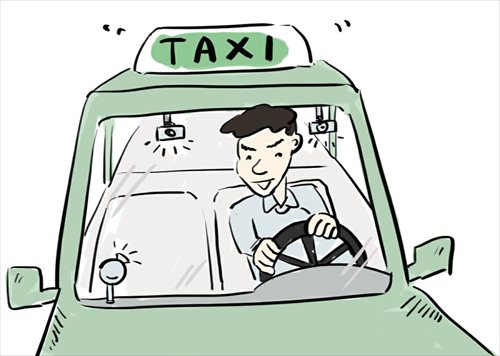
Illustration: Chen Xia/GT
Seeing my pregnant belly growing bigger, my husband has recently been trying to convince me to transition from public transportation, which I use to commute from our home in Minhang district to my office in Jing'an, to taxis or chauffeured car services. However, cabbies rampaging through this city like hell on wheels make me want to vomit more than my morning sickness does.
Just three weeks ago, a teenaged schoolgirl was sexually molested by a Shanghai taxi driver as she dozed off in the front seat. And in January, a pregnant woman was strangled and drowned by a Shanghai taxi driver just so he could steal her money to pay his gambling debts. Even more common complaints are of local taxi drivers who steal phones or purses left behind by passengers, taxis purposely taking detours to run up the fare, refusing to pick up people waiting curbside and even kicking passengers out of the cab because they only need to go a short distance.
My husband insists that sitting in a car would be safer for me, a three-month pregnant woman, than standing on a bus, which are always crowded and tend to lurch and halt, throwing passengers fore and aft. But as a journalist who has written many times about the maniacal disregard that Shanghai drivers, especially taxis, have for traffic laws, I stand by my assertion that taxis are less trustworthy than public transportation.
One of the primary reasons why taxis here are so criminally negligent is the lack of supervision of their profession. Drivers simply rent out their cabs from taxi companies, then basically live inside them to make a living. The vehicles become their private domain, free of quality control or inspection, making it nearly impossible for authorities to obtain evidence when a passenger's rights have been infringed.
One taxi company manager told local media that among the 2,000 calls they received from passengers in 2011 to report belongings left behind in a cab, only 480 items were retrieved. Calls complaining about dishonest or abusive drivers were even more frequent but seldom resolved.
The good news is that Shanghai Qiangsheng Taxi Co. recently announced that they have installed surveillance devices in 40 of their cabs. Each vehicle will have four cameras, one outside the vehicle and three inside, to take photos of, film video and record audio between taxi drivers and passengers. Whenever a passenger gets into or out of the vehicle, a camera will take their photo. When the fare meter is turned on, the video and audio will start filming. The recordings will be encrypted and can only be played by special staff of the taxi company. Eventually, 10,000 Qiangsheng taxis will have surveillance installed.
This might seem like a revolutionary idea, but in fact it was first proposed over a decade ago here in Shanghai. But concerns about privacy resulted in the plan getting scrapped. Now that local taxi drivers are once again making headlines for their unsafe driving, lousy service and criminal behavior, Shanghai Qiangsheng has taken the lead by bypassing the privacy debate and installing the surveillance systems.
And yet, 20 percent of Chinese netizens still say that these kinds of in-car recording devices will violate passenger and driver privacy. But in my opinion, clearly these netizens have never ridden in a Shanghai taxi or they'd probably change their minds once they were ripped off by a dishonest driver or put in a near-death traffic accident, which happens every single day here on the dangerous streets of Shanghai.
Not to mention that, if the ride is uneventful and nobody gets hurt or ripped off, the taxi company will, five days later, automatically delete the recordings from their servers, making the privacy argument moot.
In recent years, chauffeured car apps such as Didi Kuaidi and Uber have become increasingly popular around China for their consistent availability and reasonable prices - two things that taxi companies no longer seem to offer. As a result, more taxi drivers are quitting their profession, which in turn means even less cabs on the roads as well as taxi companies being forced to lower their standards to recruit inexperienced and unprofessional cab drivers.
Thus, in-vehicle surveillance systems are needed now more than ever in local taxis, and hopefully in private chauffeur cars as well, which to me seem even more precarious and unsafe for female passengers.
The opinions expressed in this article are the author's own and do not necessarily reflect the views of the Global Times.