HOME >> ARTS
Shanghai restores valuable frescos discovered in Russian Orthodox cathedral
By Liu Dong Source:Global Times Published: 2016/6/22 20:13:00
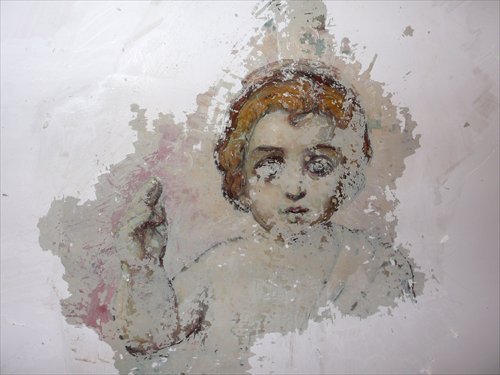
The frescos discovered in the Shanghai Russian Orthodox cathedral before restoration Photo: Courtesy of the Shanghai Zhuzong Group Construction Development Co. Ltd.

The frescos discovered in the Shanghai Russian Orthodox cathedral after restoration Photo: Courtesy of the Shanghai Zhuzong Group Construction Development Co. Ltd.
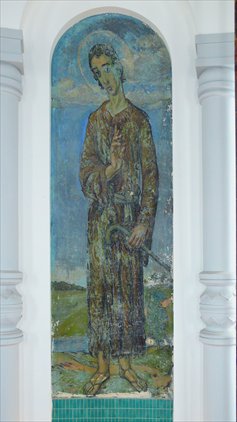
The frescos discovered in the Shanghai Russian Orthodox cathedral after restoration Photo: Courtesy of the Shanghai Zhuzong Group Construction Development Co. Ltd.
For nearly 40 years, they were quietly waiting under a layer of dust for someone to rediscover them one day.On June 11, China's 11th Cultural Heritage Day, local authorities announced they had restored nine valuable frescos discovered in a well-known Russian Orthodox cathedral in downtown Shanghai - a first-of-its-kind-project in modern Shanghai history.
Hiding under a coat of paint on the inside ceiling of one of the domes at the former "Surety of Sinners" cathedral, the frescos managed to survive the Cultural Revolution (1966-76) to once again enter the public's sight.
Changing roles
Located at No.55 Xinle Road in Shanghai's Xuhui district, once the French Concession, the Cathedral was initially built in 1934 after the arrival of the newly consecrated Russian Orthodox Bishop John (Maximovitch), who later supervised completion of the cathedral.
The cathedral was once the biggest Orthodox church in East China until it closed during the Cultural Revolution, after which it was used as a warehouse and later an office for a security company. In July 1988, the Shanghai Cultural Heritage Committee recognized the building as a city cultural relic and began repairs.
Before local government started a more thorough renovation in 2007 in an attempt to turn the building into a museum, the church had been used as a restaurant for a number of years. After the museum project failed to take off, on May 15, 2013, the building resumed its role as a place of prayer as His Holiness Patriarch Kirill celebrated the Divine Liturgy in the cathedral for the first time in more than 50 years.
"This Orthodox Cathedral is a shining pearl in Shanghai's history of modern architecture," Shen Sanxin, general engineer of the Shanghai Zhuzong Group Construction Development Co. Ltd, the company in charge of the renovation, told the Global Times.
According to Shen, they had detected paintings beneath the plaster in the dome area after a thorough search of the cathedral. Later it was confirmed some beautifully preserved frescos had been laying there for several decades.
History uncovered
According to historical records, the walls inside the church used to be covered with murals presenting stories from the Bible. However, none of them remained by the time officials began the renovation.
"We could only see a white coating everywhere," Shen said.
Some elder local residents living nearby recalled that a poster asking to remove the paintings of religious figures from the cathedral had appeared next to the church when the Cultural Revolution began. Soon after that, all the murals mysteriously disappeared.
In order to figure out what happened to these lost frescos, Shen and his team carefully analyzed the cathedral's documents and files, eventually identifing the dome as the most likely location where any frescos would remain hidden but otherwise untouched.
After wetting the white layer on the dome's surface and carefully removing it, the existence of the frescos was proved.
The fresco on the dome of the cathedral is about eight square meters in size. Instead of the common portrayal of three angels representing the Holy Trinity, this fresco used the academic "Nizhny Novgorod-style Trinity" for its portrayal: The Holy Father in the middle of the dome with the Son sit on his lap. The Holy Spirit, in the form of a dove, floats over the head of the Son.
As work continued, eight other well-preserved frescos of Christian saints were discovered around the dome area.
"The plaster layer which covered the frescos saved them from destruction back during the Cultural Revolution. The stained-glass windows also helped block ultraviolet light and strong sunlight over the years," Shen said.
Ties with Moscow
During the restoration process, experts were surprised to find that the frescos possessed remarkable similarities to The Cathedral of Christ the Saviour in Moscow.
The cathedral in Moscow was initially built to celebrate Russia's victory over Napoleon in 1812, but wasn't finished until 1880. Unfortunately, the church was razed to the ground in 1931 by the Soviet government to make way for a government palace that never got built. After the Soviet Union collapsed in 1991, the Russian government decided to restore the old church. Reconstruction was completed in 2000.
"The composition, content, and main characteristics of the frescos in Shanghai's Orthodox Church are almost the same as those in The Cathedral of Christ the Saviour in Moscow, except differences brought about by differences in size," Shen said.
"According to our analysis, the frescos in the old Cathedral of Christ the Saviour must have made a deep impression on the designer and the painter of the cathedral in Shanghai, which inspired them to create an 'accurate and professional' recreation in the cathedral in Shanghai after the Moscow cathedral was destroyed in 1931. They were trying to keep their memory of it alive," Shen said.
Newspaper headline: Brought to light
Posted in: Art