HOME >> BUSINESS
Vanke founder teeters at the top
Source:Global Times Published: 2016/7/3 20:53:00
After 30 years leading real estate giant, Wang Shi could lose control
For almost three decades, China Vanke Co's chairman and founder Wang Shi, a magnate in the real estate industry, has been well known for leading a company with transparent corporate governance and professional management system. But that all changed when insurer Baoneng Group emerged with a takeover bid. It remains unclear how the high-profile power struggle will end, but it is almost certain that Wang will no longer be in charge, regardless who ends up in control of Vanke.
The resumption marked the latest development of the Game of Thrones-style battle for control of Vanke, which has been fraught with drama.
To counter a hostile takeover bid by Baoneng Group, Vanke, under the leadership of its chairman and founder Wang Shi, announced a 45.6-billion- yuan ($6.9 billion) deal that would have made the State-owned Shenzhen Metro its largest shareholder, diluting Baoneng's stake and undermining its takeover attempt.
However, both Baoneng and Vanke's second-largest shareholder, China Resources, opposed the deal, leaving it almost certain to fail.
Vanke received a requisition notice from two units of Baoneng on June 24, demanding an extraordinary general meeting to dismiss Wang and almost all board members.
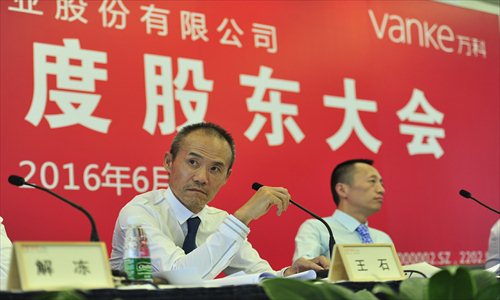
At Vanke's shareholders' meeting on June 27, Wang apologized for his inappropriate words about Yao Zhenhua, Baoneng's chairman. He also promised to resign if Yu Liang, president of Vanke, could take his place.
On Thursday, the China Resources said on social media that it would not support Baoneng in its proposal to oust the board, adding to the uncertainty over whether Wang would leave the company he founded.
Wang, one of the most well-known figures in China's real estate industry over the last three decades, has been widely recognized and respected for Vanke's transparent corporate governance, nonintervention of major shareholders and professional management system.
However, although the drama is not yet over, it seems almost certain that Wang will no longer have the final say at Vanke, regardless who ends up in control of the company.
In the limelight
The 65-year-old tycoon is no stranger to the limelight.
In the 1980s, Wang made his first bucket of gold by trading corn in Shenzhen.
Although Wang told people on several occasions how he made 3 million yuan in just eight months, some media reports later suggested that his family connections may have helped.
At time, Wang was married to the daughter of a deputy secretary of the Guangdong Provincial Committee of Communist Party of China.
The marriage lasted until October 2012 when news broke that Wang had divorced his wife for another woman - Tian Pujun, an actress 30 years younger than him.
The high-profile affair was controversial enough and a shareholder expressed concern at last week's shareholders' meeting that it might have driven Wang to distraction.
But Wang just responded: "You are just jealous, aren't you?"
In 1984, Wang founded Vanke's predecessor - the Shenzhen Exhibition Center for Modern Science and Education Equipment, which was established as a State-owned enterprise.
In 1991, Vanke became the second company to get listed on the Shenzhen Stock Exchange.
With the development of China's real estate sector, Wang's fame reached its height when he made a report in person to former premier Zhu Rongji in Shenzhen in 1997.
He described the meeting in his book The Road and the Dream. After answering several questions, Zhu said, "You are such a real estate expert. I would like to hire you as my real estate consultant, but with no pay."
"My face flushed and I stammered, 'I don't need salary. I'm so honored,'" Wang wrote.
Fame over fortune
In 1999, Wang resigned as Vanke's president and handed power to Yu Liang, becoming the board chairman.
After the resignation, Wang became a lifestyle icon and started climbing mountains, becoming the oldest Chinese person to reach the summit of Mount Qomolangma.
In 2011, he started studying at the top universities in the West.
Wang again took center stage at Vanke when Baoneng emerged to threaten the broad ownership strategy that Wang had long pursued for his company.
In December 2015, Shenzhen Jushenghua Co and Foresea Life Insurance Co, two units of Baoneng, quietly bought up Vanke's shares with leveraged capital, increasing their stake in Vanke to 24.29 percent and overtaking the State-backed China Resources as the largest shareholder.
The conflict between Vanke's management - led by Wang - and major shareholders escalated when Wang's plan to bring in a new major shareholder hit the news, upsetting the company's current owners.
Wang's lack of communication with major shareholders was to blame, Hua Sheng, one of Vanke's four independent directors, wrote in a letter published in the Shanghai Securities News on June 24.
"When State-owned China Resources, the company you trusted and relied on, has publicly aligned with a hostile bidder you are trying to stop ... It's like a storm that is about to break or your mom is going to remarry. What can you say?" Wang wrote in a post on a personal social media account on June 26, after China Resources openly opposed his restructuring plan.
For many years, China Resources, the biggest shareholder before Baoneng, never held more than 20 percent of the company and didn't interfere much with Vanke's operations.
However, media reports have said that the relationship between the two companies has cooled since China Resources appointed a new chairman, Fu Yuning.
Wang had been good friends with China Resources's previous chairman Song Lin, who was sacked in August 2014 for serious violation of disciplines, which is a euphemism for corruption.
Many also attributed the awkward situation to Wang's arrogance toward Baoneng.
He openly said in social media that he didn't welcome Baoneng, which lacks credibility and may have a negative impact on Vanke's corporate culture.
But perhaps the most deeply rooted mistake should be dated back to 1988 when Vanke underwent a joint-stock reform.
In his book, Wang said under the 1988 stock reform, about 10 percent or about 500,000 shares could be held by the management. But Wang and his management team chose to give up those shares.
It was dangerous to suddenly have such a large sum of wealth back then. "You have to pick one from fame and fortune," Wang said, according to a report on guba.eastmoney.com in June.
He picked fame, and applied a highly dispersed shareholding structure in Vanke, which he said allowed him to be a professional manager.
"I believe I can control and manage the company through my ability, not a controlling stake," he said.
Wang Shi (left) attends the 2016 shareholders' meeting of China Vanke Co in Shenzhen on June 27. Photo: CFP
Following a six-month trading suspension, shares of Shenzhen-listed China Vanke Co, the country's largest real estate developer by market value, are set to resume trading on Monday, the company said in a filing it sent to the Shenzhen Stock Exchange late Friday.The resumption marked the latest development of the Game of Thrones-style battle for control of Vanke, which has been fraught with drama.
To counter a hostile takeover bid by Baoneng Group, Vanke, under the leadership of its chairman and founder Wang Shi, announced a 45.6-billion- yuan ($6.9 billion) deal that would have made the State-owned Shenzhen Metro its largest shareholder, diluting Baoneng's stake and undermining its takeover attempt.
However, both Baoneng and Vanke's second-largest shareholder, China Resources, opposed the deal, leaving it almost certain to fail.
Vanke received a requisition notice from two units of Baoneng on June 24, demanding an extraordinary general meeting to dismiss Wang and almost all board members.
At Vanke's shareholders' meeting on June 27, Wang apologized for his inappropriate words about Yao Zhenhua, Baoneng's chairman. He also promised to resign if Yu Liang, president of Vanke, could take his place.
On Thursday, the China Resources said on social media that it would not support Baoneng in its proposal to oust the board, adding to the uncertainty over whether Wang would leave the company he founded.
Wang, one of the most well-known figures in China's real estate industry over the last three decades, has been widely recognized and respected for Vanke's transparent corporate governance, nonintervention of major shareholders and professional management system.
However, although the drama is not yet over, it seems almost certain that Wang will no longer have the final say at Vanke, regardless who ends up in control of the company.
In the limelight
The 65-year-old tycoon is no stranger to the limelight.
In the 1980s, Wang made his first bucket of gold by trading corn in Shenzhen.
Although Wang told people on several occasions how he made 3 million yuan in just eight months, some media reports later suggested that his family connections may have helped.
At time, Wang was married to the daughter of a deputy secretary of the Guangdong Provincial Committee of Communist Party of China.
The marriage lasted until October 2012 when news broke that Wang had divorced his wife for another woman - Tian Pujun, an actress 30 years younger than him.
The high-profile affair was controversial enough and a shareholder expressed concern at last week's shareholders' meeting that it might have driven Wang to distraction.
But Wang just responded: "You are just jealous, aren't you?"
In 1984, Wang founded Vanke's predecessor - the Shenzhen Exhibition Center for Modern Science and Education Equipment, which was established as a State-owned enterprise.
In 1991, Vanke became the second company to get listed on the Shenzhen Stock Exchange.
With the development of China's real estate sector, Wang's fame reached its height when he made a report in person to former premier Zhu Rongji in Shenzhen in 1997.
He described the meeting in his book The Road and the Dream. After answering several questions, Zhu said, "You are such a real estate expert. I would like to hire you as my real estate consultant, but with no pay."
"My face flushed and I stammered, 'I don't need salary. I'm so honored,'" Wang wrote.
Fame over fortune
In 1999, Wang resigned as Vanke's president and handed power to Yu Liang, becoming the board chairman.
After the resignation, Wang became a lifestyle icon and started climbing mountains, becoming the oldest Chinese person to reach the summit of Mount Qomolangma.
In 2011, he started studying at the top universities in the West.
Wang again took center stage at Vanke when Baoneng emerged to threaten the broad ownership strategy that Wang had long pursued for his company.
In December 2015, Shenzhen Jushenghua Co and Foresea Life Insurance Co, two units of Baoneng, quietly bought up Vanke's shares with leveraged capital, increasing their stake in Vanke to 24.29 percent and overtaking the State-backed China Resources as the largest shareholder.
The conflict between Vanke's management - led by Wang - and major shareholders escalated when Wang's plan to bring in a new major shareholder hit the news, upsetting the company's current owners.
Wang's lack of communication with major shareholders was to blame, Hua Sheng, one of Vanke's four independent directors, wrote in a letter published in the Shanghai Securities News on June 24.
"When State-owned China Resources, the company you trusted and relied on, has publicly aligned with a hostile bidder you are trying to stop ... It's like a storm that is about to break or your mom is going to remarry. What can you say?" Wang wrote in a post on a personal social media account on June 26, after China Resources openly opposed his restructuring plan.
For many years, China Resources, the biggest shareholder before Baoneng, never held more than 20 percent of the company and didn't interfere much with Vanke's operations.
However, media reports have said that the relationship between the two companies has cooled since China Resources appointed a new chairman, Fu Yuning.
Wang had been good friends with China Resources's previous chairman Song Lin, who was sacked in August 2014 for serious violation of disciplines, which is a euphemism for corruption.
Many also attributed the awkward situation to Wang's arrogance toward Baoneng.
He openly said in social media that he didn't welcome Baoneng, which lacks credibility and may have a negative impact on Vanke's corporate culture.
But perhaps the most deeply rooted mistake should be dated back to 1988 when Vanke underwent a joint-stock reform.
In his book, Wang said under the 1988 stock reform, about 10 percent or about 500,000 shares could be held by the management. But Wang and his management team chose to give up those shares.
It was dangerous to suddenly have such a large sum of wealth back then. "You have to pick one from fame and fortune," Wang said, according to a report on guba.eastmoney.com in June.
He picked fame, and applied a highly dispersed shareholding structure in Vanke, which he said allowed him to be a professional manager.
"I believe I can control and manage the company through my ability, not a controlling stake," he said.
Posted in: Insight