Ineffaceable imprints on culture
Exhibit celebrates British illustration through the ages
When A'gang went to London to study computer science in 2002, he fell in love not with data and coding, but prints in old bookstores and galleries.
Recently he brought his private collection of prints, individual works as well as illustrated books, for an exhibit titled Books and Illustrations to Shanghai.
With examples spanning from the early 19th century to the present, A'gang said he intends to show the tradition, history and evolution of an art that he believes is narrow-stream in China.
"Illustrations first appeared because many readers at the time were not that literate and showed little interest in pure text. The addition of nice-looking illustrations was a way to attract them, an approach of communication," A'gang told the Global Times.
Pious passion
He referred to Beijing writer Xiao Qian's (1910-99) prologue to his book British Graphic Art, published in 1947, in which Xiao said it is British writers' and artists' courage, vision and "pious passion" for illustrations that bolstered the prospering of prints and the printing industry.
Before the invention of photography, illustration was an important messenger of fashion and style.
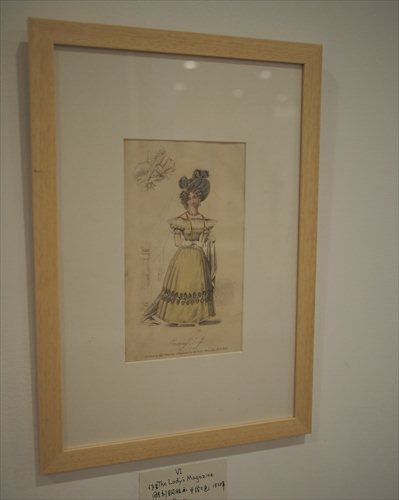
One exhibit (pictured above) from an 1828 edition The Lady's Magazine shows an exquisite dress on a lady, with a line below saying that it is designed by a Miss Pierpoint.
It is a typical example of steel engraving, and the beautiful colors were added by technicians afterwards.
By the late 1890s, English textile designer and poet William Morris (1834-96) launched the British Arts and Crafts Movement and determinedly favored craftsmanship over industrial, mass production.
He founded Kelmscott Press in 1891 and published 53 books, including The Tale of Beowulf (1895), which is on display.
"The book is completely handmade, with a typography designed by William Morris himself and woodcut prints by Edward Burne-Jones, who was a designer and a lifelong friend of Morris. It is extremely precious because it is one of 350 copies made over one to two years," A'gang said.
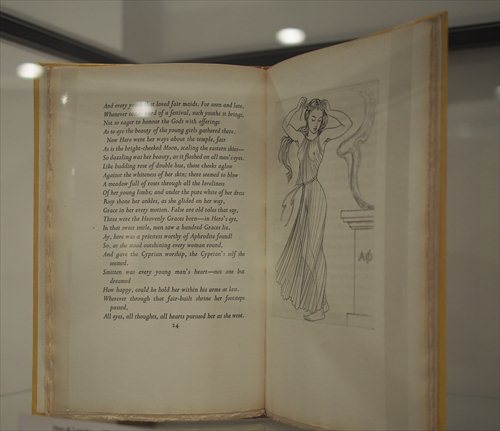
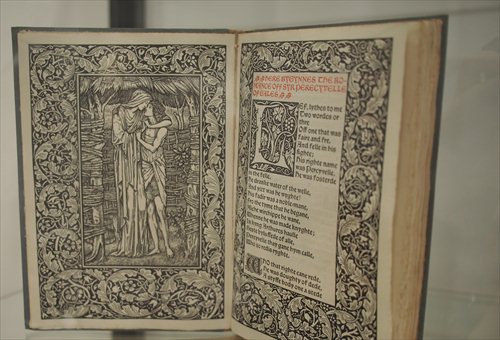
Prints and illustrated books on display at the exhibition Photos: Liao Fangzhou/GT
Powerful woodcuts
Another trend at the time was the Aesthetic Movement, led by Aubrey Beardsley (1872-98), who contributed significantly to the development of art nouveau and poster styles.
He is represented at the exhibition by his last published illustrated book, Volpone (1898), for which he created the cover and seven illustrations; likely he would have made more but he died from tuberculosis that March.
"Beardsley's works traveled to other parts of the world and had a great impact on the development of Chinese modern literature in the Republic of China (1912-49). His woodcut prints, which stands out with its sense of power and strength, seemed right for the revolutionary spirit at that time and was thus very appreciated by leftist writers like Lu Xun," A'gang said.
In the early 20th century, a number of small, private publishing houses emerged in the UK and continued Kelmscott Press's mission of craftsmanship. The exhibition shows three books by Golden Cockerel Press, the most high-profile of them.
In the biblical storybook Samson and Delilah, one can enjoy the prowess of woodcut artist Robert Gibbings (1889-1958), who is known for his simple and understated black-and-white images.
A'gang pointed to the woodcut illustrating Samson fighting a lion. "This work vividly depicts the tension of Samson's muscles; they emphasize the image of a hero, and show Gibbings' artistic talent."
Another book is Hero & Leander (1949), which includes 11 copper engravings by John Buckland Wright (1897-1954). He brings to life the beautiful Leander from Greek mythology with fine lines and elegance.
The last section, which consists of several contemporary prints, sees some female artists who touched upon bucolic themes (as in Susan Glassford's Poppies and Daisies) and metropolitan life (as in Eileen Cooper's Private View).
"Many visitors are amazed to find that the 19th-century books can be so well-preserved. That is because the books on display rely on handmade paper that did not go through whitening product or other acidic chemicals," A'gang said.
Unlike when seeing oil paintings, for which many visitors take a few steps backward to appreciate the whole picture, A'gang invites people to step closer and absorb the rich details.
"German designer Dieter Rams once described the world we live in as an impenetrable confusion of forms, colors and noises, and I believe it is so. I hope visitors can calm down in front of these elegant British prints, and enjoy a moment of peace and serenity," A'gang said.
Date: Until August 8, 10 am to 6 pm
Venue: Yun Contemporary Arts Center
Address: 3/F, 407 Yishan Road
宜山路407号3楼
Admission: Free
Call 5450-3282 for details