Manchu folk singer paves his own way
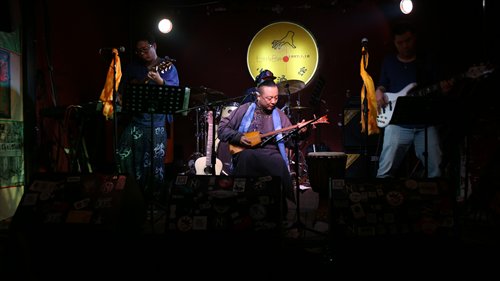
Manchu singer Akxan plays with his band in Chengdu. Photo: Courtesy of Serguwen
With a current population of about 10.41 million according to the latest official nationwide population census in 2010, the Manchu people are one of the largest minority groups in China. Yet, those who speak and even understand the Manchu language, one of the official languages of the Qing Dynasty (1644-1911), are few and far between.
"Among the 10 million, the number of people who can speak the language is no more than 100," said Akxan, a Manchu language folk singer and songwriter.
"I hope my songs can provide some basic knowledge of the Manchu language for today's young Manchu kids, and inspire them to learn even more."
His choice of music genre means Akxan is destined to remain far outside the mainstream, yet he is a star in this niche. Although he has never received any formal training at a music school, Akxan is regarded as a professional in the musical and language fields.
"My name means 'the autumn tree leaves which fall into the water.' Wherever they go is up to nature," Akxan told the Global Times.
"That is exactly how I am."
With a long braid draping down his back - which he said is not meant to represent his Manchu heritage - and wearing a T-shirt with a bull-headed skeleton and some drop-crotch pants, Akxan looks pretty much like what many people imagine an alternative musician should look like. Yet his angular face makes it clear that he is not part of the Han majority ethnic group.
Transforming tradition
Differing from many folk singers who try to stick as close to tradition as possible, Akxan's songs are actually very modern. He makes use of non-folk instruments, includes rock'n'roll elements and sometimes lyrics incorporate words from Putonghua (Standard Chinese) and English.
Though the words are often hard to follow, I found myself humming the tunes after listening to them one or twice.
"If I had spoken the language since I was a child and lived a life fishing and hunting the traditional way, no matter how I sing a song, it would be considered traditional. But I didn't grow up that way, so I don't want to pretend that I did just to be cool. That would be fake," Akxan explained.
"For a culture that is almost dying out, wouldn't it be better to do things in a way that would make it more easily accepted and loved?"
Being true is very important to Akxan. He said that this is one of the reasons he hasn't given up drinking and smoking to preserve his voice.
"I admit I don't have a good voice. But when it comes to music, it's your true feelings that really matter. Someone may spend a dozen years honing their skills but still only be a machine that produces sound," Akxan said.
Over the past decade or so, Akxan has collected dozens of Manchu folk songs from elderly Manchus who live in small villages in Northeast China. Akxan pointed out that thanks to these areas' comparatively closed environment, traditional culture has been well preserved.
Having composed some 20 Manchu songs so far - some are more loyal to tradition, while others are covers of popular songs from other languages, like the famous Levan Polkka.
Big city realization
From a traditional Manchu family, the musician, now in his late-30s, said his late father forbid him to become a singer, because entertainers were traditionally looked down upon in China.
Leaving home and heading to Beijing to pursue his music dream, Akxan can still recall the moment when his teenaged self walked out of the Beijing Railway Station at around 10 pm on September 27, 1997.
"It was like a giant machine monster to a boy who came from a small town to the capital alone," Akxan told the Global Times.
His first year, Akxan earned his way in Beijing washing dishes in a bar, but the next year he began singing on stage. Like many young men that age, Akxan liked rock'n'roll and the late Hong Kong singer Wong Ka-kui was one of his idols.
It was not until the early 2000s, when Akxan talked with other ethnic minority people in Beijing about their own languages and music, that a strong sense of frustration began building up inside him.
"I realized how little of the Manchu spoken or written language, or music I knew," Akxan said.
Yet, one thing good about being in the capital, according to Akxan, is that you can find almost anything or anyone you want.
In the library at Minzu University of China, Akxan found an introduction to Manchu folk music, the lyrics of which were transcribed using Chinese characters. Talking with some of the school's professors, Akxan learned where to look for people who still spoke the language of his ancestors.
A non-commercial project
Regarding the collecting and creation of Manchu language songs a matter of spreading his culture, Akxan has never thought of turning it into a real business. In fact, his Manchu projects have largely been supported through his other commercial projects.
Akxan started his own studio and band to better popularize Manchu songs a year ago. Four of his long time friends are the band members, while Serguwen, a Manchu woman who was a fan of Akxan's, is their manager.
Even though he is considered a professional in certain circles, with only some 4,000 followers on his official Sina Weibo account, Akxan is far from being considered a star. Yet, Serguwen said Akxan has been invited to several famous variety shows in China, it's just that he has refused to take part.
"You can't control what will happen once you take part in these programs. You just have to follow what the program director wants," Akxan said, explaining that he does not want to over commercialize himself or his works.
Having just finished their first nationwide tour of about 14 cities, the musician said they now want to have a rest and think about what to do next.
Newspaper headline: A lost language