It is the time of the world's largest annual migration of people and the time when fireworks soar and explode in the night sky all over China. It is also the ideal time for Shanghai residents and visitors to explore some of the other sides of the city and its culture.
Traditions are a big part of life here and even if some traditions have been given a modern treatment with lasers and micro chips, ancient spirits remain firmly at their heart.
The Global Times has selected a few places and events that will help you welcome the Year of the Dragon with a difference.
Trips to temples
Hoping for a great 12 months ahead this is a time when many Chinese people visit Buddhist temples where the rituals of burning incense, chanting monks and the sound of bells create an atmosphere of joy and optimism.
Popular destinations for Shanghai devotees include the Longhua Temple, Jing'an Temple and the City God Temple of Shanghai.
But try looking further afield for in Shanghai's suburbs there are some great places to welcome the New Year, immerse yourself in Chinese culture or find quiet zones far from the city hustle.
The Fangta Pagoda in Songjiang
Over the coming days from January 23 to 29, this pagoda in Fangta Park will welcome the New Year with traditional ceremonies, bells and drums, written wishes and poetry.
This is a good way to see how traditions are kept alive and still attract families and young people.
The impressive pagoda was first built in the Northern Song Dynasty (960-1127). It has had a stormy history and in 1975 was rebuilt in its current square shape. It is a classical Buddhist pagoda, more than 42 meters high, in the Tang Dynasty (618-907) style and is one of the most admired pagodas in the Yangtze River Delta area.
Fangta Park spreads over 12 square kilometers and is well worth exploring for its natural beauty and views and its cultural treasures. On sunny days it is a good place for a picnic, flying a kite or strolling about enjoying fresh air.
Address: 1 Fangta Road South,
Songjiang district
Admission: 12 yuan ($1.90)
Call 5950-9874 for details
The Big Buddha Temple in Xinchang
Every Spring Festival the Big Buddha Temple offers special prayer sessions called "fo fu tong yuan" ("May Buddha bless you with good fortune.") Here visitors can light Kongming Lanterns (airborne paper lanterns) to pray for fortune during the New Year and pay respects in the Mahavira Hall.
The Big Buddha Temple can be found in the southwestern part of Xinchang county, Zhejiang Province near Shicheng Hill. It is one of the treasures of Chinese Buddhism.
Its centerpiece is the Xinchang Maitreya Buddha which was carved out of a massive hunk of granite 1,600 years ago and, is regarded as a match for the Leshan Giant Buddha in Sichuan Province. A full 15 meters high, the Xinchang Buddha is a masterwork of Chinese religious art and is regarded as "the largest Buddha south of the Yangtze river."
While there don't miss the Thousand Buddha Court nearby which showcases over 1,000 statues of Buddha, elegantly arranged.
Address: 117 Renmin Road West, Xinchang county, Shaoxing city, Zhejiang Province
Admission: 100 yuan per person
Call 0575-8622-7141 for details
Life in the old style
The second New Year Royal Temple Fair 2012 will be staged at the Shanghai Grand View Garden over the first six days of the Chinese Lunar New Year.
The Shanghai Grand View Garden replicates the setting of Daguanyuan, the home of the imperial family at the heart of the great Chinese saga A Dream of Red Mansions written by Cao Xueqin in the Qing Dynasty (1644-1911). This is where the 1987 television adaptation was filmed.
During the fair visitors will be able to watch and sometimes join in as scenes from the book are brought to life.
Visitors will walk past teams of stern imperial bodyguards at the entrance and as they stroll around the gardens they might encounter the "Emperor" himself surrounded by guards and administering his blessings. Or they might meet the beautiful Yuanchun, the eldest daughter of the book's family and the emperor's concubine, being borne regally on a sedan chair accompanied by beautifully clothed eunuchs and maids. Selections from great operas will be staged at the Grand View Hall.
Address: 701 Qingshang Road, Qingpu district
Admission: 60 yuan
Call 5926-2831 for details
Website: www.sh-daguanyuan.com
The Shanghai Oriental Land
From January 22 to January 28, the Shanghai Oriental Land, a park on the shores of Dianshan Lake in Qingpu district, offers a range of events for adults and children to welcome the New Year. A cruise on the lake is essential but there will be folk displays in the square, clowns, dragon and lion dances and drummers galore.
You can get into the spirit of China even more by working for a bit on a local farm or orchard and picking your own vegetables and fruit and then enjoying a reasonably priced family dinner afterwards.
Address: 6888 Huqingping Highway
Admission: 50 yuan
Call 5923-3000 for details
Website: www.ogb.com.cn/newEbiz1/EbizPortalFG/portal/html/index.html
Heaven scent
Spring Festival is the time to enjoy the first of the plum blossoms as they open.
Traditionally plum blossoms are seen as a symbol of winter and a harbinger of spring. The blossoms are treasured because they look vivid especially against snow and they have a subtle gentle scent that can be appreciated even in the cold.
The plum blossoms symbolize perseverance and hope, beauty, purity and the transient nature of life.
In winter on Chaoshan Hill in Yuhang, a city in the north of Zhejiang Province, visitors can see thousands of plum blossoms beginning to bloom, turning the hill into a classic scene of beauty: "Ten miles of plum blossom fragrance all over a sea of snow" as the Qing Dynasty artist Wu Changshuo put it.
The blossoms on Chaoshan Hill are famed for their history, size and uniqueness and the hill features two of the five classical plums held in highest regard in China - Tang Dynasty and Song Dynasty plums.
Address: East Park, Chaoshan village, Tangqi town, Yuhang, Zhejiang Province
Admission: 45 yuan
Call 0571-8631-1228 for details
One last thrill
The Lantern Festival officially ends the Spring Festival and every year Shanghai's Yuyuan Garden celebrates the festival with a variety of performances, music, and naturally, lanterns.
At Yuyuan Garden visitors will find myriad lanterns, many especially designed in other cities in China and sent to the garden for the festival. Others use high-tech interiors to add something more than candle power to the festivities. This year entry will be limited to ticket holders - an admission price has yet to be set.
In Anting town in Jiading, where the auto industry is thriving, the festival will be celebrated in style. Visitors here might enjoy the traditional lantern riddles that are part of the festival or just have fun with the antics of the acrobats, puppets and dragon dancers.
Going local
Cities are not the best place to sample the New Year festivities. Many of the really interesting customs have been lost with modernization. But in smaller towns and villages you can still experience a traditional Lunar New Year.
Wuyuan in Jiangxi Province has been described as "China's most beautiful village." It has its own way of celebrating the New Year where it looks forward to honoring the "Kitchen God" during its celebrations.
Its big day is today, the xiao nian (Little New Year). Yesterday villagers were busy slaughtering pigs and making a special soup from pig's blood as well as other traditional dishes.
Wander around the streets and friendly villagers could well offer you some tasty treats like fried meat balls, fish balls or sweet potato balls to sample.
When xiao nian dawns, every household pays respect to the Kitchen God and the village women clean and dust their houses in a ritual called sao chen.
The actual New Year's Eve dinner in Wuyuan has another name "The Farewell Feast" where traditional dishes are served - steamed pork with rice flour, braised fish in brown sauce, pigs' trotters, chickens and ducks. The most famous Wuyuan dishes are vegetable pasties and steamed meat. Another Wuyuan specialty is their fish which villagers raise in a pond kept at a constant 20 C temperature. Visitors can book and join the feast for 180 yuan.
Getting there: The Shanghai South Long-Distance Bus Station at 36 Liuzhou Road offers eight buses a day from 7:43 am to 7:03 pm; or go by train to Nanchang station, and then catch a bus to Wuyuan.
Call 0793-734-3605 for details
Website: www.wylyw.cn
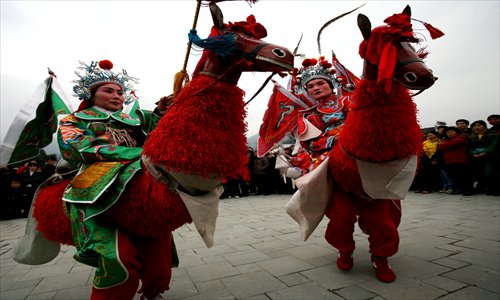
If Wuyuan is a little far try, ancient Longmen town in Fuyang city is about 5 kilometers from Hangzhou.
The town is said to be the hometown of Sun Quan, the founder of Wu (222-280), one of the three competing states in the Three Kingdoms period (220-280) of Chinese history.
The Longmen "Folk Expo" begins on the second day of the Lunar New Year (January 24) and this outing features folk opera and traditional music performances as well as the acclaimed Wu Kingdom Steeds horse act which can be caught at the Mingqian Garden.
It's also a carnival for children who can enjoy traditional performances like the dances for the God of Wealth who hands out gold horse shoes and dolls.
Getting there: By bus to Fuyang city from the Shanghai Long-Distance Bus Terminal at 1666, Zhongxing Road. Departure times: 7:50 am, 1:50 pm. Visitors can catch one of the 10 or more shuttle buses from downtown Fuyang to Longmen.
Admission: 68 yuan
Call 0571-6350-7877 for details
Website: www.hzlongmen.com
