A woodcut image by Sun Xun
Young Chinese artist Sun Xun's latest wood-print animated film, "Some Actions Which Haven't Been Defined yet in the Revolution," has been nominated for competition in the Berlinale Shorts section in the 62nd Berlin International Film Festival (BIFF).
Other Chinese animated films, such as classic ink-wash shorts "Three Monks," "Snipe and Clam," "Landscapes," and "Mantis Catching Cicadas," have also been featured at BIFF, but in the past 14 years, no Chinese animation short has been screened at the festival.
"After so many years of absence, it's really exciting for Chinese animation to be entering the Berlin International Film Festival again," said ShangArt Gallery, which promotes Sun's works.
As this entry marks the return of Chinese animations to top-class international film festivals, movie lovers see this as a positive sign for China's animated film industry, which many say is sorely in need of innovation and development.
The announcement has also triggered lively buzz speculating a revival of the use of wood printing or ink-wash techniques in the animated film genre, which enjoyed widespread popularity decades back throughout China, leaving an impression on the memories of many Chinese.
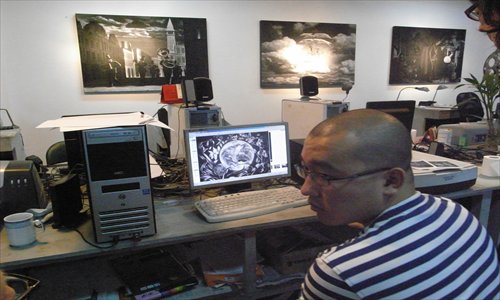
Sun, who graduated from the print-making department of the China Academy of Fine Arts and currently resides in Beijing, used techniques he learned in his studies to create an effect that has not seen much attention in a very long time: wood-print animation.
While ink-wash techniques have been prominent for thousands of years in China, Sun's chosen method of wood printing had its "golden years" during the first several decades after the founding of the People's Republic of China in 1949. However, in recent decades, the craft has seen little use.
The practice of using popular visual art techniques such as paper cutouts, soft ink-wash brush painting and wood cuts to create an animated film used to be very popular in Chinese animation, producing some beautiful classics.
In the period between the 1950s and the 1980s, China entered a golden era of animation. Many Chinese who grew up during that time remember sitting in front of a black-and-white TV, waiting for the music of famous ink-wash animation Little Tadpoles Look for Their Mummy to start. Such moments from the distant past often bring to mind sweet, nostalgic scenes that still linger in people's hearts today.
The old animated tale told the story of a group of little tadpoles unable to recognize their mother, a narrative which today is known to every child in China. Many believe that the show marked the height of classic storytelling through Chinese animation.
However, in recent years, the Chinese animation industry has floundered in the face of Japanese anime hits and Disney blockbusters, whose storytelling is seen as more sophisticated. In the midst of the invasion of foreign competition, the domestic industry failed to adapt to the new market reality.
While, to a large extent, the lack of innovation in storytelling was responsible for this plight, other reasons, such as the outdated concept that animation's role is primarily educational, had a hand in the decline of the domestic animation industry.
Foreign productions are considered far more original and their producers attach great importance to entertaining, according to Wang Wei, an independent researcher on animation. He believes animations should not be treated as a tool to teach children about good and evil.
"Animation belongs to everyone, not just kids," he told the Global Times. "And sometimes it can also carry very deep meaning, illuminating human nature as all other art forms do."
This sentiment echoes the declaration by BIFF's Berlinale Shorts that "the short film is radical and independent, at times controversial, disturbing, testing the limits of our comprehension... [and] often carries the seed of the stylistic and thematic characteristics that will later become the signature style of the artist."
BIFF's announcement has once again put Sun under the international spotlight. In 2010, another work of his, 21G, was included in the Venice Film Festival, and was the first Chinese animated film to appear at the festival.
Although the content of this animated short still hasn't been unveiled, Sun's entry to BIFF is a kind of practice in avant-garde art, exploring social issues that are far more profound than those found in traditional Chinese animation, according to ShangArt Gallery.
