
Twenty-year-old Wan Tong has a soft spot for metal and she gets a kick out of building robots that can pick up things.
"I'm building a tennis ball picking robot named Master," said Wan, whose first automotive creation was Epick, a fruit picking robot. "Building robots is like bringing ideas to life, it's a fascinating process," explained Wan, who is the only female member of Open Drone, a Beijing-based group of robot aficionados. One of the few female students studying electronic packaging technology at the Beijing Institute of Technology, Wan found the group of like-minded hobbyists through a friend. "[Open Drone] is a great meeting point for those who are into robotics, to learn and for fun," said Wan. Open Drone's main goal is to help members learn the basics of combining electric and digital design and encourage them to share ideas and know-how in the spirit of open source (shared intellectual property) hardware, which they believe has enough potential to be the "next IT thing."
Droid geeks
Droid lovers should watch their step as they enter Open Drone headquarters. In order to avoid stepping on the Wi-Fi car, a robot that looks like a smaller version of Star Wars' infamous R2D2. "You can try sending it to the elevator to 'pick up' somebody and direct them over here," suggested Jose Galvez, as he demonstrated how to control it via computer or cellphone. Galvez, 28, is at work but he left a robot at home watering his small strawberry plantation. "Its name is Guardino," Galvez said, showing a picture of the web of hoses and sensors that bend over a vase in his bathroom. "This is an Arduino open source single-board microcontroller that is connected to a hacked-up wireless router; I adjust the watering and the lighting at a distance, from any Internet-enabled device," explained the robot creator. He is also considering how best to modify Guardino so it can respond to his cat's movements, and perhaps even provide it with water when it needs it.
With a background in computer science, Galvez has been into robots ever since he received a programmable robot kit as a kid. He left Madrid for Beijing three years ago "to learn the history and the culture in a country with massive IT potential."
Last November, Galvez co-founded Open Drone with Samuel Huang, an embedded platform developer who had been involved in the original Quadcopter Group that came to a halt when some of its founders left Beijing.
Open source
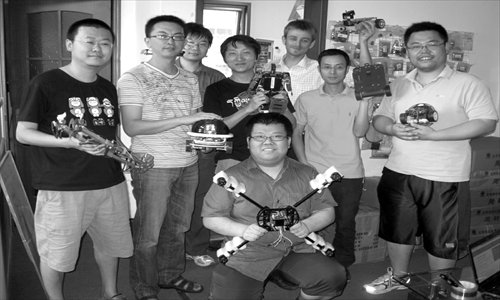
"There are a lot of people who are interested in new technologies and the IT sector holds a lot of possibilities. We thought we had to bring the group back to life," explained Huang. Around 10 members of various backgrounds meet weekly but there are 60 people registered with the group.
They order pizza, build robots, sometimes dismantle them and on some occasions, hold robot fights.
These days, the robot gang is working on a new flight controller for its quadcopter. "We will make it fly," said Huang, "by using an ARM Cortex-M3 CPU that can give the quadcopter level and stability."
Open source robotics has tremendous potential in China, according to the founders of Open Drone. "It's much cheaper to buy smaller components like chips and resistors and pre-assembled technology in China, namely controllers like the Arduino, would be far more expensive in Europe or the US," they noted. But more than supplying free hardware, sharing knowledge is at the core of open source projects. "Open source hardware projects are important because they offer students and people with low income or little education the opportunity to learn about robotics and IT," Huang noted.
"It's as if the secret recipe to make coca-cola went public," explained Galvez. "Everyone would be able to experiment and try making as much as they wanted at home," he added.
"There's a gap between research and development in the robotics field that the Internet and open source can help bridge," said Liu Wei, a teacher of digital and analog circuit at the Beijing Institute of Technology. "Groups like Open Drone help generalize knowledge in a field and potentially speed up the development of electronic design," noted Liu, saying that unlike what happens in the IT field, China is not at the forefront of robotics. Information communications technology teacher Nathaniel Brown agrees that open source can help democratize research in robotics and nurture interest in it. "Open source robotics drives down the cost of robotics and also makes the whole process more open," he said.
The 'next big IT thing?'
In May, Brown brought Beijing one of the most prestigious robotics competitions in the world, the First Lego League (FLL). "The main problem open source has is that it does not have a marketing or sales department so people do not always know that it exists," said Brown, suggesting that the lack of commercial robots explains why robotics is merely a hobby for most people.
Galvez is planning to launch a robotics group for beginners and organize a robot battling competition to promote hobbyist robotics and open source hardware in the capital. He isn't alone when he suggests open source hardware may be just the trend to shake the foundations of the IT field and online social communities. "It's still relatively unknown, most online communities have a language barrier that makes it difficult to find them so most people don't know how to contribute. Contributing is a very important step on the learning chain," he said.
"A lot of organizations don't see the benefit in sharing information and prefer to protect their patents but open source is the way to go and can even help these companies gain recognition," said Sun Zengqi, a professor with the State Key Laboratory of Intelligent Technology and Systems at Tsinghua University. In China, more than 200 companies, institutes and universities are engaged in robot research and development. Robot competitions and shows are held around the country, but reports of creative peasants from the countryside surface from time to time, telling tales of people without schooling, who are designing and building their own robots. These kinds of stories demonstrate the strong interest that's out there and the kind of people who would directly benefit from open source hardware. But many don't even know that if they Google "arduino" the search will retrieve lots of ideas and know-how to build robots at home.
For more info, visit www.open-drone.org
Liu Yixin contributed to this story
