"Cambridge is great, but why does every Chinese person want to go there?" said my friend Rob when I asked him, during my visit in early June, for advice about a day-trip from London. He had accompanied two groups of Chinese friends there recently. "Bath could be a better choice due to its Roman heritage and interesting Georgian architecture. It gives you an authentic feeling of old England, since most of the buildings have remained unchanged over the centuries," Rob advised.
With that I was sold on Bath. Just a few minutes after our conversation, I was already searching the Internet for information on the World Heritage City.
Located about 150 kilometers west of London in Somerset, southwest England, Bath is easily accessible via train, car or coach from London. It got its name from the baths that the Romans built around 60 AD, upon discovering a hot water spring in the area. The vibrant city, which still contains Britain's only hot spring, is now one of the most popular tourist destinations in England and is packed with visitors all year.
Book club
Although Bath is most famous for its Roman past, other claims to fame include one of England's best known writers, Jane Austen, once living here. Austen, knowing Bath as a prosperous spa resort and fashionable place at the time, moved to the city with her family in 1801 and stayed there until 1806. The romantic novelist set two of her novels, Persuasion and Northanger Abbey, in the vibrant city. Despite her dislike of Bath, as evidenced by a letter written to her sister, in which she expressed eagerness to leave the city, one of Bath's most celebrated residents has been honored with a memorial center.
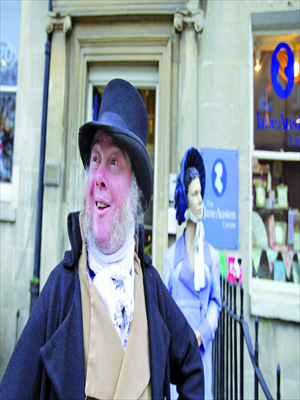
The Jane Austen Centre, located in the house she used to reside in, contains an informative exhibition of films, costumes and books that has been curated by Austen specialists. Dressed up in early 19th century attire for a picture after tea in the exquisite Regency Tea Room and the Austen-themed gift shop, you can easily feel like you are traveling back 200 years.
On top of the Jane Austen Centre, the other major venues to sample Austen's Bath are the Assembly Rooms. Situated in the middle of the city and dating back to the 1770s, the set of exquisite rooms are some of Bath's finest Georgian buildings and still function as venues for the city's cultural events.
Decorated with original crystal chandeliers, the Assembly Rooms are made up of four major function rooms, including the 30-meter-long ballroom and a card room. The rooms' histories are highlighted in the audio guide, which not only provides detailed introductions to the rooms, but also segments quoted from Austen's novels.
"Mrs Allen was so long in dressing that they did not enter the ballroom till late. The season was full, the room crowded, and the two ladies squeezed in as well as they could," Austen described in Northanger Abbey, reflecting the popularity of Bath as the center of socializing in her time.
Roman times
The Romans left their mark all over Britain, but nowhere is it more evident than in Bath. Their legacy can still be detected in the buildings constructed with certain ancient stones.
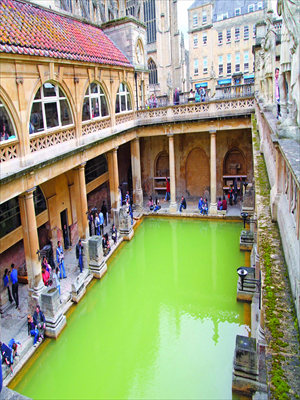
However, the best place to admire the grandeur of Bath during the Roman time is at the baths themselves, which now operate as a museum in the city.
Built around a hot spring over 2,000 years ago and unearthed by the Victorians, the Roman baths used to serve as a site for public bathing for the Romans. It was said that the waters at Bath could cure all disease.
Thus many Romans would travel for hundreds of miles to visit Bath. The complex now features four main sections, one of which is below ground: the sacred spring, the Roman temple, the Roman bath house and the museum.
To this day, the baths still enjoy a natural flow of bubbling, hot water. Surrounding the steaming pool are costumed performers, dressed as Roman priests and ladies of the upper class, who narrate Roman history and religion to visitors.
The four-storey museum, which could easily be mistaken for another old building from its homely façade, also displays treasures and other findings from the ancient site.
Bath today
"On your left are shops and on your right are shops," said my friend, adopting the air of a tour guide while we were looking for places for dinner. Looking back along the high street dotted with a variety of clothing and other merchandise stores, it is obvious that the city has been very commercialized.
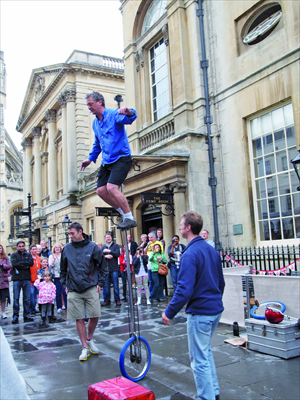
"Well, it is just the way it is. It is a tourist city. If it were not for the shops and the tourists, the city might seem boring," he said as we walked past a couple of street entertainers.
One of them was drawing a big crowd, who applauded as he rode on a three-meter-high unicycle. "The atmosphere of this vibrant city is still here and the theaters, museums and cultural venues still function. People continue to come to Bath to socialize - isn't that great?" he asked, and I thought to myself that it really is.
