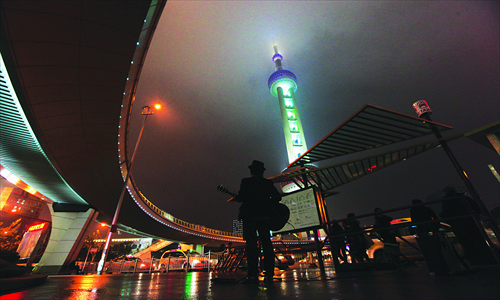
It's 8 o'clock on a cold, drizzly night and guitarist Xiao Li was singing a song of forlorn love as occasional passers-by paused to listen on their way home. Others just glanced as they walked past.
Wearing a black fedora hat and a casual black suit, the 29-year-old was performing at the bottom of the stairs to the elevated walkway in the middle of Lujiazui, near the front of the Super Brand Mall.
"There are more passers-by on the walkway, but I've been taught a lesson. Chengguan (city management enforcement officers) there moved me on," he said.
After trying different places and always being moved along, he finally found a regular spot by the stairs where management is more tolerant, although this also means a smaller audience.
He was not a lone performer. About 500 meters away, near the rear entrance to the mall, 31-year-old Lin Xiaoming was belting out a 1980s' rock classic into a microphone on a stand in front of him. He was backed by a long-haired drummer, rapping out dazzling rhythms on a three-piece drum kit.
Almost sympathetic
The band's songs warmed the chilly night and attracted a larger audience. After a few songs, a crowd of 15 people or so had gathered around the performers and the empty guitar box in front of the duo was being filled with bank notes and coins.
Xiao Li and Lin's band, Baihe (Lily), are some of the lucky city buskers, who have found an area that is almost sympathetic towards buskers. They know how hard it is for buskers to survive in Shanghai.
Xiao Li comes from Jiangxi Province and has been busking professionally in Shanghai for five years. He has tried virtually every busy shopping area in town. "I am constantly confronted by chengguan officers. Sometimes they tell me to 'gun dan' ('bugger off'). The worst time was when they confiscated my guitar and loudspeaker and I had to pay a fine of 1,000 yuan ($160) to get them back."
Lin is a comparative novice and has only been performing for a year but he agrees. "Once we were performing outside a department store near Zhongshan Park, but were ordered to leave. The authorities somehow feared that if we attracted a crowd, something unharmonious would happen. But we know that we don't pose a threat to anyone."
Busking is a gray area in Shanghai's laws. While urban rail transit regulations clearly ban busking on metro trains, no other regulations specify whether it is legal or not. Li Xiaohua, a lawyer specialized in criminal law, said that according to the law at present, a busker's performance can only be classified as begging or as a performance for commercial purposes.
If it is a performance for commercial purposes, buskers have to apply for approval from the Shanghai Municipal Administration of Culture, Radio, Film and TV and pay tax to be legal - which precludes the low-income spontaneous nature of busking.
In practice, busking is prohibited in many busy areas in the city with chengguan ever alert to crack down and move performers away. In the less populated areas the enforcement is usually more lax. In some special areas, like Nanjing Road East, street shows are allowed as long as the performers don't ask for money from the spectators.
This could be about to change. The Shanghai People's Congress has just announced plans to legalize street performances, including busking. A regulation governing street performances will be drafted soon and is expected to be introduced in three years. It will be the first city regulation covering street performances in China.
This is great news for Luo Huaizhen, a deputy to the Shanghai People's Congress and a playwright by occupation. Since 2006 he's been calling for legislation to better protect Shanghai's street performers.
Quality performers
Luo first proposed making street performing legal in 2006, after visiting Europe and being impressed by the quality of street performers in cities there.
"When I came back to Shanghai, all I saw were pathetic, bad performances by beggars calling for sympathy or people asking for help because, for example, one of their family members was dying. These are not artists. Street performers should be positive, original and stylish," he said.
"Street performers had been very popular in China since the Song Dynasty (960-1279) and were allowed even during the Republic of China (1912-1949). But in recent decades, in the process of urbanization, they have somehow disappeared."
Luo first put his proposal formally to the government in 2008 when it was approved and the government decided to introduce trial legislation to cover the 2010 World Expo in Shanghai, when visitors from all over the world were expected in the city.
"During a meeting to discuss street performer legislation, officials from six or seven government departments arrived. I was stunned - how come so many departments are involved with buskers?"
Luo said the departments included Shanghai Municipal Administration of Culture, Radio, Film and TV, Shanghai Municipal Afforestation and City Appearance and Environmental Sanitation Administration, Shanghai Local Taxation Bureau and Shanghai Public Security Bureau.
Unfortunately after Expo the legislation vanished. Luo thinks this was because too many government departments were involved with none willing to assume overall responsibility.
Luo admits that there are many difficulties involved in the legislation because there are no precedents in China.
Another difficulty comes from the common misconception that buskers are the same as beggars and are potential threats to public order. "Many Chinese people can't tell the difference between them, and as a result, they don't see the necessity to enact a special law for beggars," he said.
All the same
Wang Xiuyuan is a senior student majoring in business at the East China University of Science and Technology and she was one of the many who believed that buskers and beggars were the same. She changed her mind after spending the past summer doing a research project on Shanghai's street performers with two other students at the university.
The "Living Conditions of Street Performers" project was a comprehensive survey of people involved in street art including street cartoonists and buskers, spectators, security guards and chengguan officers. The team also sent questionnaires to citizens asking how they felt about street performers.
"Before we did the project, I thought of buskers as the beggars who sang outside metro stations, or the poor blind couples who play the erhu (the traditional two-stringed Chinese fiddle) under bridges. These people were actually the targets of our survey initially," said Wang.
But as they searched the city for street performers, buskers like Xiao Li and the band Baihe popped up. Seeing their genuine passion for singing and the quality of their performances, the students decided to refocus their research.
According to their survey of 100 Shanghai citizens, 34 have given money to buskers out of sympathy, 18 never gave money, six thought buskers should not be allowed to perform on streets and 36 said they would give money if they enjoyed the performances.
The respondents who said they didn't want to see buskers on the street were swayed by media reports of fake beggars or performers who lip-synced to encourage payments, Wang said.
Lan Ge is the secretary-general of the China Buskers' Union, a group based in Guangzhou with more than 100 members throughout the nation. The union has been fighting for the legal status of buskers by organizing concerts and events to raise the public appreciation of busking.
He said: "Street performances in China are very varied. Many play the erhu or other instruments badly in metro stations or busy shopping areas, trying to gain sympathy by showing how poor they are. Although they're different from beggars, they're of the same nature."
Different forms
The Global Times research shows that buskers in Shanghai come from diverse backgrounds and their performances take many different forms. Xiao Li, the busker at Lujiazui, for example, came to Shanghai in 1999 and first worked as a cook at a local restaurant, but was not happy. After seeing people performing on the streets on television, he quit his job and started a professional career as a busker.
"My first performance was outside the Jinjiang Amusement Park. I was so shy that I dared not raise my head," he recalled. In the following years, he took lessons to hone his guitar skills, and equipped himself with a loudspeaker. He became more and more confident and can now perform for up to 10 hours a day.
Lin Xiaoming, the vocalist of Baihe, was a salesman when he joined the band, and sang mostly on weekends. He is now between jobs. "I dreamt of becoming a singer when I was little. The dream has faded, but I still enjoy singing."
Few buskers can be called virtuosi but there is at least one in Shanghai who is. Yin Wangzi plays the traditional Chinese flute every weekend at the intersection of Nanjing Road East and Guizhou Road. The 61-year-old was a professional player with Shanghai Oriental Chinese Orchestra but retired last year having won several national awards. After retirement he took his beloved music to the streets to continue enriching his life.
Unlike other buskers, the silver-haired Yin refuses to accept money. "I don't lack money," he said. "I drive my own car here every day."
Yin's flute playing truly touches the people around him. Last Friday, after he finished playing people crowded around him, asking how was it he could play so beautifully. One onlooker, 59-year-old Li, said: "His songs remind me of my own dream to become a flute player when I was young - I was admitted by Shanghai Conservatory of Music in the 1970s but couldn't enroll because of my family background."
Another man, Huang, a tourist from the neighboring Jiangsu Province, asked for tips for playing because his son was learning the flute.
Most of the buskers in town, however, take the money and their average monthly incomes vary from under 2,000 yuan to 40,000 yuan. While more performances usually mean a higher income, quality, location, weather and season all count as well.
In his 2008 proposal Luo Huaizhen suggested that street performers be divided into those who were actually begging and those who were giving artistic performances. To tell them apart, Shanghai is likely to introduce a licensing system where buskers who have passed an audition will be given approval to perform at set locations and time slots.
This has sparked another controversy. Some fear that this will become another excuse for the government to collect money because licenses almost always require a fee in China.
But most buskers seem to welcome the move. Speaking on behalf of the China Buskers' Union, Lan Ge said: "Without clear and detailed regulations, busking will remain a blind spot in the city's administration and there will be no space for us.
"As long as the licenses let us perform legally, we are totally for it. Of course, legal rights come with legal obligations, like paying a license fee, but we think it's fair because we are occupying public spaces and regulations cost money."
Xiao Li, too, supported the law, but doubted whether the government would really introduce it. "This law has been talked about in Shanghai for many years." Lin questioned how practical it could be. "I'm sure lots of people will still play without a license."
Luo, from the city's policymaking body, said: "Lots of issues will arise with the legislation, but generally, I would counsel the legal departments to be more lenient and encourage street performances. If Shanghai successfully introduces this law, it will be an example for the rest of China."
