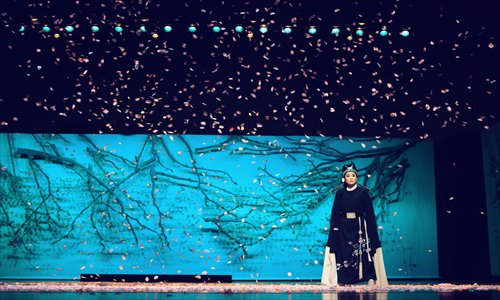
The character, wearing a snow white costume, falls onto a black wooden chair with his back to the audience. During his dying fall, he sings a last, short aria. This is the final scene from a new production of The Butterfly Lovers (Liang Shanbo and Zhu Yingtai) and the performer in question has based her final appearance on the same moment in the Western ballet, The Dying Swan. And during this scene, Mao Weitao, who plays the leading male role in the opera, admits that there are always tears in her eyes, tears that the audience cannot see.
Mao plays Liang Shanbo in this classic Yueju Opera (the opera tradition from Zhejiang Province) production which is generally regarded as the Chinese Romeo and Juliet. In Yueju Opera, all the roles have been traditionally played by women.
Legendary tale
The Butterfly Lovers is a legendary tale of love from the Jin Dynasty (265-420) and has been adapted into various performing art forms during its history, including other opera traditions such as Kunqu and also several film versions.
Based on the original story, and a 1953 Yueju Opera film of the same name, as the director of Zhejiang Xiaobaihua Yueju Opera Troupe, Mao set about producing its own version of The Butterfly Lovers in 2006.
And since it premiered seven years ago, the show has visited most major Chinese cities and has also played abroad in Singapore, Germany and Switzerland, among other countries. The show has been invariably described by critics as innovative, contemporary, and experimental.
When Tobias Biancone, the secretary general of the International Theatre Institute saw the opera in Switzerland in 2010, he commented: "the story predates Romeo and Juliet by 1,000 years but it contains many modern elements."
Mao's staging of the death of Liang Shanbo, for example, differs from all previous interpretations.
For Mao, the death of Liang Shanbo and that of the swan in The Dying Swan both represent "a kind of reincarnation, a reincarnation not only about life, but also about freedom and love. These things, I believe, are universal," she said.
Butterfly motifs have often featured heavily in the stage and film versions, and at the end of the story - although both lovers are both dead - they are miraculously transformed into a pair of butterflies.
In this latest version, however, two huge paper fans rise up from the stage at the end of the performance.
"A paper fan is a very typical prop in Yueju Opera, and the rising movement also implies the spiritual sublimation of the eternal love between the two leading roles," Mao explained to the Global Times.
Although the century-old, all-female cast rule was challenged after the founding of the People's Republic of China, Mao has still mainly played male roles since she started her career in the early 1980s. Almost all productions of the Zhejiang Xiaobaihua Yueju Opera Troupe still feature all-female casts.
Modern story
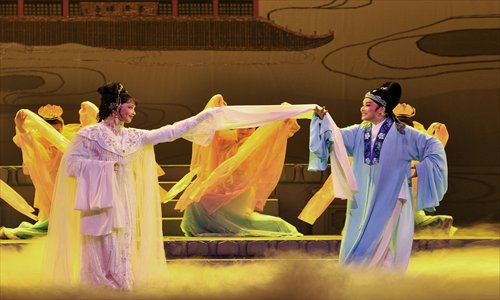
Throughout the history of Yueju Opera, most of the stories concern romantic love between a man and a woman in ancient China. But in 1999 Mao's opera troupe, the director of which is Mao's husband Guo Xiaonan, adapted a relatively modern story, Kong Yiji written by the leading 20th century novelist, Lu Xun (1881-1936) in 1919. Again, Mao played the eponymous male lead, a pedantic and frustrated scholar at the end of the Qing dynasty (1644-1911). And their latest production,The Good Sole of South Yangtze, is adapted from the German playwright Bertolt Brecht (1898-1956)'s work The Good Person of Szechuan. Tonight, Mao and her troupe will perform their 1994 work, The Romance of the West Chamber at the Shanghai Oriental Art Center.
Mao's portryal of Zhang Sheng in this production was widely acclaimed, and incorporated facets of traditional Sichuan Opera acting techniques into her performance. "And we innovatively used a revolving 360 degree stage and dry ice," added Mao.
Mao told the Global Times that she doesn't want to endlessly repeat the supposedly "beautiful" or "graceful" style attributed to typical Yueju Opera performances. "I want to push the envelope and to explore new possibilities. This type of exploration, I believe, will keep our Yueju Opera performances fresh and vigorous."
Date: Tonight, 7:15 pm
Venue: Shanghai Oriental Art Center
上海东方艺术中心
Address: 425 Dingxiang Road
丁香路425号
Tickets: 80 to 880 yuan
Call 6854-1234 for details
