METRO BEIJING / METRO BEIJING
Industrial evolution
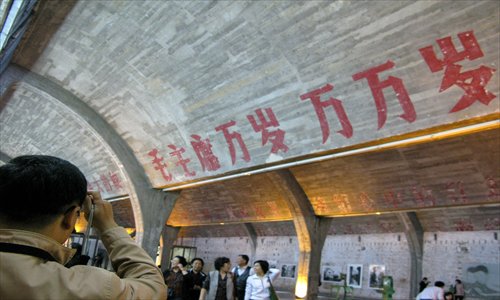
The 798 Art Zone bustles with tourists snapping photos of patriotic slogans ("Long live Chairman Mao") where Beijing's electronics production once stood. Photo: CFP
Imagine a CBD without glittering skyscrapers or bumper-to-bumper traffic. Gone are the Starbucks and instead the southeast corner of the capital hums with the industrial clamor of textile production and blasts of factory whistles.Following the founding of New China in 1949, Beijing was transformed into an industrial city. Manufacturing branches were built up in the exterior areas surrounding Beijing, with each area focusing on one particular sector, said Li Kuang, a Beijing-based architect specializing in the protection and renewal of industrial landmarks. The 798 Art Zone was once abuzz with electronics production, and western Beijing was home to steel production.
Because of environmental concerns, heavy industrial factories began to shutter from the mid-1980s on, relocating to suburban areas. During this period, many factories were demolished to make way for rapid urban growth. Only in recent years did industrial relics start to be seen as valuable pieces of history worth preserving. In the CBD, a 10-hectacre park now pays homage in renovated structures to the former textile factories.
Now with the notion of historical preservation more established, there still remains the question of what to do with these large structures, the oldest of which date back about 100 years. Some property owners seek mixed-use, artistic and tourist hubs a la the 798 Art Zone, which kept several factory spaces intact while re-purposing them for modern usage. Other structures have been turned into museums. But Beijing still lags behind its counterparts, both domestically and abroad. Compared with 200-plus preserved sites in Shanghai, Beijing numbers about 60, according to a survey conducted by Li last year.
These structures are an integral part of the cultural heritage of the city, said Yu Kongjian, dean of the College of Architecture and Landscape Architecture of Beijing. They're a key into the history of the city's development.
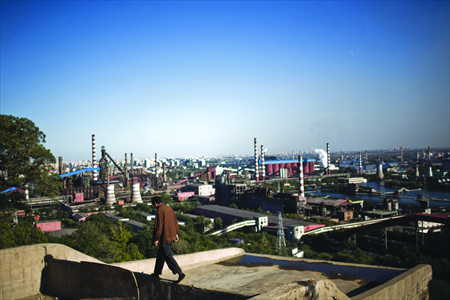
Shougang has an increasing amount of factories sitting latent that property owners hope to transform. Photo: Li Hao/GT
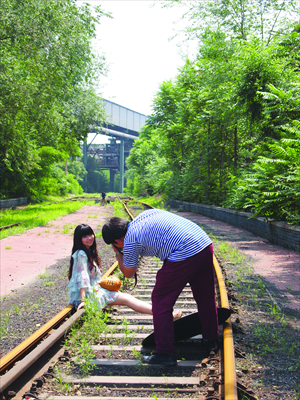
Lu Yao poses on the derelict tracks of Shougang while her boyfriend snaps a photo. Photo: Jiang Yuxia/GT
Vestiges of industry
Capital Steel Group - better known as Shougang - was once headquartered in Shijingshan district as part of western Beijing's steel production center. In 2010, the manufacturer relocated to Caofeidian, Hebei Province, citing environmental concerns. Since then, the 8.5-square-kilometer plant has become the latest industrial vestige in the capital to be transformed into a modern multipurpose space, with the 798 Art Zone being the most famous example.
On the Dragon Boat Festival last Wednesday, 25-year-old Beijinger Lu Yao travelled across the city to visit the spot and pose for photos in front of the long-forgotten railway line and factory buildings.
Besides the factory's historical significance, the space bore a special personal significance for Lu. "Visiting the factory reminds me of the time I spent with my mother at her lock factory," Lu said. "I grew up having dinners at the factory's canteen and baths in its public bathroom." But the factory from her childhood has been torn down, and she turns instead to these preserved places to relive her memories.
How, then, to measure the value of antiquated factories? According to the International Committee for the Conservation of Industrial Heritage, industrial heritage refers to the "remains of industrial culture which are of historical, technological, social, architectural or scientific value." These remains consist of physical artifacts, such as buildings and machinery, as well as intangible ones in the case of industrial processes and technology. At Shougang, architectural feats such as brick structures and towering chimneys house many of the innovations of China's steel production industry - the first oxygenator, the first basic oxygen furnace, the first automatic blast furnace.
Industrial primer
China was not at the fore of industrialization and is now playing catchup with preservation. The UK, the birthplace of modern industry, has the oldest remains from the first Industrial Revolution in the world in the mid-18th century. China saw the introduction of modern industry about a century later, and now has fewer preserved industrial sites compared with a lot of Western countries.
"Despite the relatively short history of China's modern industry, its development has been closely associated with the fate and history of the country and has profound Chinese characteristics," said Yu, one of the earliest experts engaging in industrial heritage protection in China.
For example, the shipyards in Tianjin are a reminder of the Self-Strengthening Movement (1861-95) in the late Qing Dynasty (1644-1911), which introduced modern industry to China to fend off foreign invasion.
The 798 Art Zone contains electronics factories built with assistance from the former Soviet Union in the 1950s. It provides a glimpse into the life of China's working class and the chaotic years of the Cultural Revolution (1966-76) with patriotic slogans such as "Long live Chairman Mao" preserved on its brick and cement walls. Today, filled with galleries, cafes and boutiques, 798 stands as the golden example of how to revitalize an industrial space.
Moving history forward
Shougang came about in 1966, the result of the Great Leap Forward (1958-61), when the Central Government aimed to turn Beijing into a major steel production hub. In the modern day, the plan is to turn it into an artistic center, following the successful path of 798.
Besides hosting group tours of a few points of interest in the factory, the majority of the Shougang plant remains under renovation. A few outdated buildings will soon get the axe to expand a central square which now can accommodate more than 8,000 people.
Detailed plans for turning the site into a cultural zone haven't yet been announced, so buzz on the Internet has filled in the gaps with conjecture that it will just be a profit-driven 798 copycat.
Head of factory renovation Chen Shijie clarified that the old site will have diverse functions with animation studios, theaters to put on regular performances and public park areas.
The best way of preserving industrial heritage sites is giving them new life by turning them into something useful, said Chen, who has been working in industrial renewal for over 20 years.
Some abandoned factory buildings lack modern facilities and access to public transportation. "But their economic values could be better brought out once they are transformed," he noted.
Yu cautioned that while the 798 Art Zone has been viewed as one of the most successful examples of preserving industrial history, problems have surfaced in recent years due to the rising rent. A number of artists have been forced to move to cheaper digs, he noted. The commercial explosion has also caused damage to historic buildings as new ones pop up.
However, to turn these sprawling sites into profit-making assets, more creative projects and usage should be introduced, said Yu, rather than relying on renting renovated buildings to companies who would set up business there.
These industrial relics have public and social value, and shouldn't set making money as the sole purpose, Yu said. He thinks the government should subsidize property owners to help bring in more cultural and creative industry.
Government role
The city government already has set aside special funds up to several million yuan for converting old factories into heritage sites. Cultural heritage authorities have been working with them to identify sites worthy of protection under law, said Chen.
However, there are no specific laws concerning the protection of industrial heritage and property owners can handle the assets at their own disposal. The former Beijing Film Studio in Haidian district, significant in the Chinese film history, was demolished last year and the land was sold to real estate developers as the company was in need of funding to build a larger studio in the suburbs.
Yu bemoaned the lack of authenticity in government-spearheaded or subsidized projects. In 2007, he was approached by the municipal government to help plan a makeover of 798 to meet the influx of tourists following the 2008 Beijing Olympics. He proposed planting natural vegetation such as grass and sunflowers in the area to imitate the atmosphere of the factory in the 1960s and 1970s. His proposal was rejected, and instead, flashy ornamental flowers went in.
As industrial renovation projects aim to mimic 798, they ignore that the district became an art arena in a more spontaneous way. Individual artists gathered together and rented their own studios in the then-affordable area, lacking any grand development plan. Whether a top-down approach like Shougang's could work remains to be seen.
"Integrity and authenticity are two important policies in renovating any industrial heritage site and it should be the same with [the current] projects," Yu said.
