METRO BEIJING / METRO BEIJING
Extreme summer sports
Thrill-seekers share tips on best ways to get your adrenaline rush this season
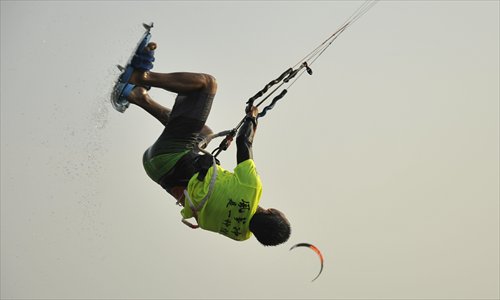
Deng Xiaocheng enjoys kiteboarding off the coast of Xiamen, Fujian Province. The sport will make its debut at the 2016 Rio de Janeiro Olympics, but has limited popularity in China. Photo: Courtesy of Deng Xiaocheng
The coastal city of Xiamen in Fujian Province is a haven for swimmers lured to its pristine beaches each summer, but Deng Xiaocheng prefers to hit the surf to indulge in a sport that never fails to turn heads: kiteboarding. Also known as kite surfing, the extreme sport requires participants to harness the power of the wind with a large controllable kite that propels a board they are strapped in to across the water.Using a nine-square-meter kite and a twin-tip board, Deng effortlessly skims across waves as he soars into the air and completes 360-degree turns. The sport provides a rush that is hard to match, the 29-year-old said.
"It's super exciting and free, bringing you supreme happiness," said Deng, his tanned complexion glimmering in the sunlight. Deng placed third in a speed race last year in the Kiteboard Tour Asia, an international competition for kiteboarders. It marked the highest finish for a Chinese competitor on the tour.
Summer's arrival ushers in one of the peak times of activity for extreme sport fans. Although kiteboarding and many other high-octane sports are still in their infancy in China, growing participation driven by people eager to test their limits is accelerating their growth.
Deng was introduced to kiteboarding in 2008. The sport was new to China at the time, but had already been popular in the West for decades.
Although there are more than 1 million kiteboarders worldwide, in China there are only around 500 regular enthusiasts.
"People need to have lessons to gain their International Kiteboarding Organization certificate before kiteboarding. Many kiteboarding instructors can help students achieve this certificate in three to five days," said Deng, a kiteboarding instructor who has taught students from their teens to their 60s.
Aside from being an accredited kiteboarder, there is also the cost of essential equipment that typically sets an individual back around 20,000 yuan ($3,211).
Taking the plunge
If spending tens of thousands of yuan on kiteboarding equipment and lessons isn't for you, there are lower thresholds for extreme sports enthusiasts that only require courage, not cash.
Zheng Jinzhang, 27, is the founder of On the Way, an outdoor sports club in Changsha, Hunan Province. His passion each summer is cliff diving, a sport that involves diving from cliffs into rivers or lakes. Zheng's favorite spot is a peak around 10 meters high overlooking a river at the Malahe Scenic Spot, about 400 kilometers east of Changsha.
"Most of my students are female. Cliff diving needs a person to be physically strong because we often trek through forests to find cliffs, which requires energy," said Zheng.
Safety is a top priority. In addition to ensuring water is adequately deep without hazards beneath its surface, Zheng requires all divers to wear life jackets. Diving outings organized by Zheng require everyone to "share costs and responsibility."
Zheng has seen a surge in white-collar workers participating in cliff diving since he took up the sport in 2010. Back then there were about 60 regular participants, but today that number has doubled.
Unlike kiteboarding which has a professional tour and has been included in the 2016 Rio de Janeiro Olympics in Brazil, cliff diving is strictly an amateur sport that lures people with its fun rather than fame.
"We're not athletes, and there is no requirement for cliff divers to perform difficult maneuvers," said Zheng.
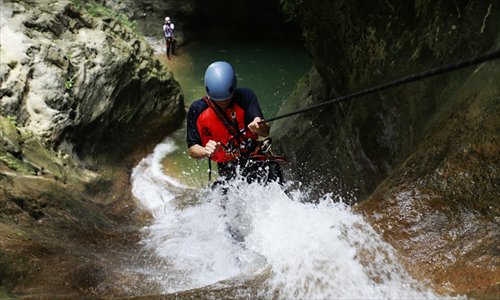
A man abseils down an 80-meter waterfall in Zigui county, Hubei Province. Photo: CFP

Tourists enjoy canyoning in Binzhou, Hunan Province.Photo: CFP
King of the canyonsSince 2009, Zhu Hui has been dedicated to canyoning, a sport that involves traveling through canyons by hiking, abseiling, swimming and kayaking. The highlight of Zhu's brief experience in the extreme sport was when he abseiled down a 130-meter waterfall at the Lamogu Nature Reserve in Zhangjiajie, Hunan Province.
"I took a route that hadn't been taken before," said Zhu, 36. "The difficulty of canyoning is proportionate to the terrain rather than the height of a waterfall. The smoother a waterfall's rock face is, the more difficult it is to descend."
For a new canyoneer, essential equipment includes a helmet, harness, ropes, wet suit and climbing shoes that cost around 5,000 yuan in total. Growing popularity of the sport in recent years has led to the founding of organizations, including the International Canyoning Organization for Professionals, which offers classes to the sport's newcomers.
While China's canyoning scene is still in its formative stage and dominated by amateurs, Zhu said more people are being drawn to the sport through classes that teach its basics in just two hours.
Canyoning only began to take off in 2009, said Zhu.
Zhu, who regularly organizes canyoning expeditions with more than 100 people, said around 60 percent of his companions are men.
"It's necessary for participants to find an authorized outdoor sports club to sign up for canyoning. Insurance is an essential part, and the market is flooded by clubs who don't meet this standard," noted Zhu.
Due to the lack of supervision and undeveloped commercial operations of outdoor sports clubs, most of the budding canyoneers in China take it upon themselves to plan their own routes.
But the risks of canyoning without a guide in rugged terrain are high, with injuries or even death a real threat. The Shanghai-based Youth Daily newspaper reported that in 2012 two outdoor sports enthusiasts from the city drowned after being caught in a flash flood while canyoning in Wencheng county, Zhejiang Province.
"Normally, my team and I have to find an appropriate waterfall by ourselves and try several different points to abseil down. Once we determine the safest route, we use it for group expeditions," explained Zhu.
One of the biggest tragedies to rock the sport was in 1999, when 21 tourists on a commercial canyoning expedition died in Saxetenbach Gorge in Switzerland after being swept away in a flash flood.
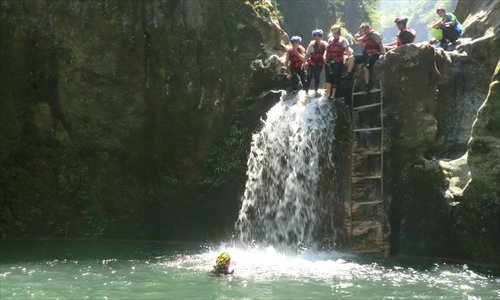
Zheng Jinzhang leads a group of cliff divers in the Xiangxi Tujia and Miao Autonomous Prefecture, Hunan Province. Photo:Courtesy of Zheng Jinzhang
Hurdles to expansionThe uncertainty and challenges of extreme sports add to their appeal in the eyes of many enthusiasts. Even brushes with death or injury aren't enough to turn enthusiasts away from their passion.
Deng had his own terrifying moment in June 2013 while performing a handle pass, a kiteboarding maneuver that involves being upside down while airborne, in Pingtan, Fujian Province. While suspended in mid-air, his right hand twisted awkwardly, breaking several metacarpal bones.
"Normal kiteboarders don't dare to do such difficult maneuvers, but I want to reach the heights of professionalism and won't give up," said Deng.
Even though kiteboarding's inclusion as an Olympic sport could spark new interest in China, Deng said it was unlikely the sport would match its popularity in Western countries.
"Based on the Chinese sport system, I think there will only be a focus on developing a professional team rather than promoting kiteboarding at the grass roots," said Deng.
Although Deng downplayed the prospect of extreme sports being embraced at the grass-roots level, Zhu and Zheng are more optimistic about growth being driven by white-collar urbanites eager to push their limits and unwind from their busy lifestyles.
"The real problem facing extreme sports is that there is no specialized department to supervise this market, nor are there any regulations governing most sports," said Zhu.
To better promote these fledgling sports, Zhu suggested that it is necessary to develop trips that combine various sports, like cliff diving and canyoning, for tourists.
