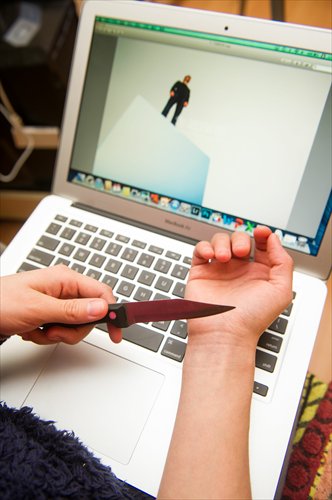
Psychologists say that live broadcasting one's suicide attempt is a call for help. Photo: Li Hao/GT
"At the last moment of my life, you blacklisted me."
Posted at 12:34 pm on November 30, it was the last message left by a 19-year-old man surnamed Zeng on Chinese media platform Sina Weibo.
Zeng was found by local police in his home in Sichuan Province, lying unconscious on the couch, later that afternoon. He was in coma, induced by having taken a large quantity of sleeping pills, and suffering from carbon monoxide poisoning, which he had brought about by burning charcoal in his room. He was pronounced dead shortly after arriving at the hospital.
Zeng's final message was preceded by a frenzy of others, posted the previous evening, in which he expressed his heartbreak over the failure of a romantic relationship, and the desire to end his own life. It has been speculated that his final message was directed at his former girlfriend.
Local police were alerted to the unfolding tragedy by concerned Net users who were following his posts, which have since been removed from Sina Weibo at his parents' request.
Searching for answers
Zeng's suicide is one the latest cases in which Chinese youths have live broadcast their attempts to end their own lives online.
In March 2012, a 22-year-old student from Nanjing, Jiangsu Province, posted a number of messages warning of her imminent suicide attempt on Sina Weibo, attracting more than 340,000 comments in reply.
The West China Metropolis Daily reported that in August, a young woman from Wuhan, Hubei Province, broadcast her suicide attempt on WeChat, expressing how she felt after swallowing a large dose of assorted medication, including 20 sleeping pills. In September, a woman in her 30s from Chengdu, Sichuan Province, posted photos of herself slashing her own wrists and taking sleeping pills on social media platform WeChat.
Zhang Chun, who founded the Nanjing Psychological Crisis Prevention Center in 2003, told Metropolitan that, along with the rapid development of social networking sites, the last two to three years have seen an alarming increase in the number of suicide broadcasts in China.
"Live broadcasting an attempted suicide is a call for help," said Zhang. "It arises from the desire to hear another person's point-of-view and to seek social support." However Zhang, who has intervened in half a dozen online suicide broadcasts in the course of his work, said that trying to seek solace from anonymous peers on the Internet could often complicate matters.
"There can be two kinds of comments that provoke great emotional feelings in the broadcaster - besides those that try to talk the person out of suicide, there are people who will tell the person to go ahead and die," said Zhang. "Insults and heckling from Internet users can expedite his or her attempt at suicide."
Frequently, those who broadcast their intention to commit suicide on social media are also met by comments of incredulity, accusing the person of staging a morbid prank in order to grab attention. Zhang said that such comments would place the person in a moral dilemma, where he or she would feel obligated to go through with the suicide attempt.
"[Otherwise], the person risks being accused of being a liar," said Zhang. "If they don't go through with the suicide, they'll feel guilty and ashamed."
In the hours before his death, Zeng posted a message that can be interpreted as addressing those that were provoking him to commit suicide.
"I'll be smiling from my grave knowing that you are the murderer," Zeng wrote.
"The risks [of calling for help online] are that many Internet users will respond in a way that is irresponsible," said Zhang.
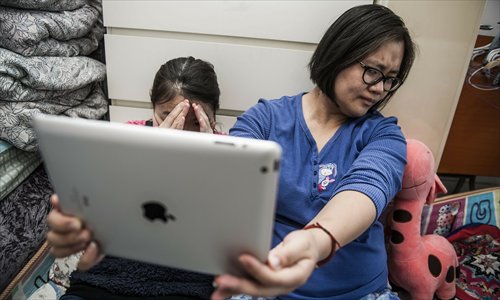
Some have suggested that Internet service providers should be obliged to stop online broadcasts of suicide attempts. Photo: Li Hao/GT
Survivor's guilt
Some Net users who followed Zeng's posts in his final hours have expressed feelings akin to survivor's guilt in the wake of his death.
"I've been thinking about it for days," said Helen Sun, a 19-year-old high school student from Heilongjiang Province who followed the entire incident online and posted comments to encourage Zeng not to end his life. "Since he's been gone, I've felt so guilty. I blame myself for not trying to dissuade him from committing suicide all the way through until the very end."
Sun told Metropolitan that she had known Zeng online prior to his suicide. When Zeng started writing on his microblog about wanting to end his life on November 29, Sun and some of his other online friends had tried to persuade him against it, before his broadcast went viral.
"Then it became more chaotic," said Sun. "Some commentators even started to make jokes about it, and a lot of people challenged him to die."
Although Sun was not one of those people, she said she felt responsible for his death.
"I feel like I'm a killer," she said. "When you experience what it's like to see a life expiring right in front of you, through the small screen [of a smart phone], but you can't do anything about it, then you'll know why I feel so guilty and depressed."
Other Net users who followed Zeng's posts have drawn similarities between what they knew of his life and their own. Prior to his online suicide, Zeng had gained a following of online fans for his covers of theme songs from Japanese animations.
"What should I do? Help me. I've become so immersed in his world," said 19-year-old Wen Mengting, who would often listen to Zeng's songs. She was especially stricken to learn that Zeng's parents were divorced, much like her own.
"I think he made a mistake by coming to Weibo to seek for comfort," said Wen, who added that she could have been Zeng's girlfriend to get him through this. "Only if we knew each other earlier."
"It's awful growing up in this kind of family," she wrote on her Sina Weibo after Zeng's death. "Maybe I have depression disorders too. Maybe someday, I'll kill myself, too."
"I used to have [suicidal] thoughts, thinking that I would make somebody regret treating me that way. For example, when I have a quarrel with my mother," she said. "But that kind of thought would go away very soon," she told Metropolitan.
Suicide contagion
Zhang said that the emerging trend of online suicides could lead to further copycat suicides. Posting pictures and documenting suicide online in this manner could romanticize the act of suicide, said Zhang, leading others who already have suicidal thoughts on and off to want to imitate the act.
One day after Zeng's death, an 18-year-old man from Fujian Province using the account name "Menghunyoupiao" on Sina Weibo posted a series of messages on his microblog revealing his intention to kill himself by self-immolation. He later abandoned his plans, but said in an interview with Metropolitan that his desire to commit suicide online was on account of Zeng.
"[After seeing Zeng's broadcast], I thought that I could also find comfort [through suicide]," said the man, who wished to be identified as Chen.
Six months ago, Chen was diagnosed with clinical depression. Later, he was told that he might have a brain tumor, awaiting further tests.
He began posting messages about his planned suicide in the early evening of December 1. At around 9:30 pm that night, a friend of Chen's called him after seeing his posts, and talked with him about the suicide attempt.
"After the call, I got confused and my thoughts became muddled," said Chen. "Eventually, I put aside my own pain and thought of my friends and parents, and finally decided to abandon the idea of committing suicide."
Chen insisted that his messages about wanting to end his life were not intended as a prank.
In a more high-profile case in the days following Zeng's death, Zhan Yilin, a well-known football player with the Shanghai Greenland Shenhua FC (football club), posted a lot of messages on WeChat's Moments that were interpreted as expressing suicidal thoughts, along with photographs of his crashed car.
Both Zhan and the club later released statements denying that the player had attempted to commit suicide, according to a report published by Sina Sports on December 5.
What is to be done
Zhang said that we should take any comments from people about wanting to commit suicide seriously, even if it sounds like a joke.
"You might think the person is just putting on a show," said Zhang. "However, among the three phases of a suicide attempt, which are thinking about suicide, evaluating whether to commit suicide, and putting it into action, a person talking about suicide indicates that he or she is already in the second phase."
To protect those who are considering suicide from being attacked on the Internet, and to prevent copycat suicides online, Zhang said that the broadcasting of suicide online should be banned by law.
He said Internet service providers should be made responsible for enforcing the proposed law, and if they did not act, they should be made culpable for any resultant deaths. "They [Internet service providers] should ban such posts, as well as work with emergency departments such as the police to help locate the person attempting suicide by using their IP information," said Zhang.
"Taking no action is the same as committing murder. It's like handing poison to person with suicidal thoughts."
