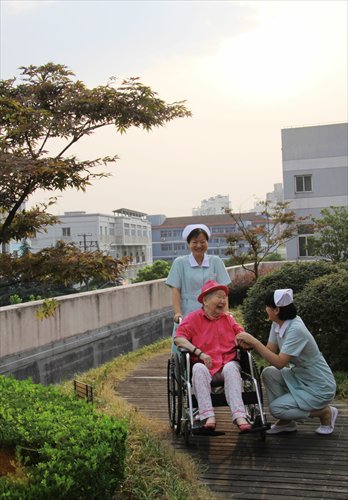
Hospice nurses and a patient share a joke at the Changzheng Town Community Health Service Center. Photo: Courtesy of the Changzheng Town Community Health Service Center
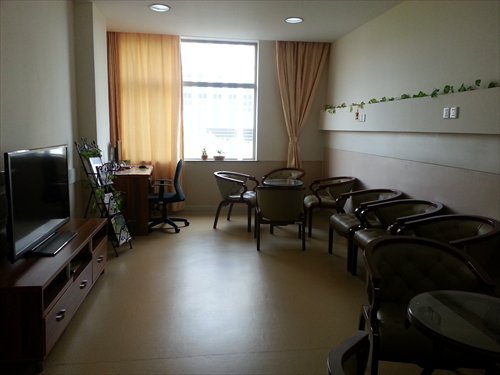
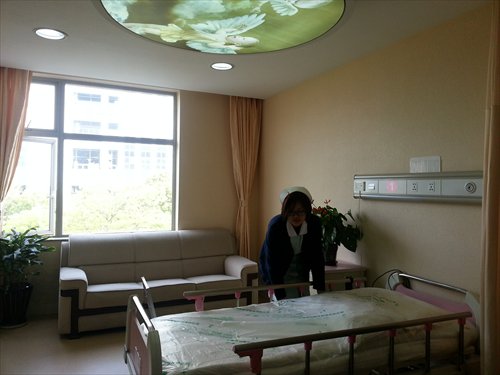
A room at the Changzheng center hospice Photo: Du Qiongfang/GT A nurse makes a bed at the Changzheng center. Photo: Du Qiongfang/GT
Although hospice care has existed in the West in some forms for centuries, it has only recently begun to develop in China. Shanghai is at the forefront of programs offering hospice and palliative care for patients suffering terminal illnesses.
It is a vital aspect of health care but traditional attitudes and misunderstandings have slowed the general public acceptance of hospice care in China.
The Shanghai Municipal Commission of Health and Family Planning reported that some 36,000 patients die of cancer in Shanghai every year, and 70 percent of the terminally ill cancer patients should have hospice care services for pain relief and counseling.
Since 2012 the Shanghai government has invested more than 40 million yuan ($6.45 million) in hospice and palliative care projects. More than 300 hospice palliative care wards have been opened in 74 community health service centers, a nursing home and a private hospital. Another 801 residents have been given hospice care at home. Over the past three years, more than 6,000 terminally ill cancer patients have received these services and saved hospitals an estimated 60 million yuan or so in unnecessary or ineffective medical treatments.
Still not accepted
The concept of hospice care arrived in China in the late 1980s but it has developed slowly and today is still not appreciated by many Chinese. Although Shanghai's (and China's) first independent hospice, opened in former Nanhui in 1988, there were no public palliative care services available for terminally ill cancer patients until 2012.
The Changzheng Town Community Health Service Center in Putuo district was one of the first community health centers to open a hospice ward which was set up in August 2012. Over the past two-and-a-half years, this hospice has accepted 289 patients and seen 232 die peacefully there. The center has been nominated as the "advanced care unit" and the "national hospice care training base" by the Chinese Association for Life Care but the real honors should go to the doctors and nurses who work there.
This is not even ordinary hospital nursing sometimes. It can involve disturbing symptoms like the time a cancer patient was admitted with a tumor on his neck. The patient's tumor had burst and become infected, riddled with maggots and producing a foul odor.
His doctor, Wu Sunjian, was a shy young man in his 30s, and treated the man carefully and gently, removing the maggots one by one with forceps. He gave up his vacation time to spend the next few days caring for the patient and changing the dressing regularly.
Another 46-year-old bone cancer victim was embarrassed by the odor produced by a lesion on his stomach. Because he had undergone several rounds of chemotherapy finding an appropriate vein for painkiller injections was extremely difficult and painful. Nurse Zhao Yan let him sit comfortably as she searched carefully and quietly for a vein so that he could receive an injection and she outwardly ignored the stench from his lesion and always kept a smile on her face.
"We can't see a patient while covering our noses or mouths or showing any reaction to the smells even though they can be terrible. Patients are very sensitive. Sometimes the stench fills the entire room and corridor. We try to keep the windows open and use carbon and plants that absorb odors but we don't upset the patients," explained the hospice care ward matron Li Ying.
Not prolonging life
Zhou Jialing, the head doctor at the Changzheng hospice care ward, said some cancer wards in hospitals tried treating these terminally ill patients but this just caused more pain and suffering. Palliative care is not about prolonging life.
"We just want the patient to live comfortably and reduce their pain in the days they are alive. If a single procedure might increase pain for one of our patients we won't do that," he said.
Zhou said sometimes there had been misunderstandings by patients' families about intravenous feeding. Intravenous feeding can prolong a patient's life for a few more days. But it can also lead to problems finding suitable veins and major physical discomfort afterwards. Palliative care doctors try to avoid intravenous feeding and sometimes a patient or their family cannot understand this approach.
Wu Yumiao, the director of the Changzheng center, said they tried to educate patients and their families about hospice care. "Our idea is to let the patients die with dignity, to improve the quality of their lives while they are alive but never to prolong their suffering."
Another problem the doctors encounter is when there is discord in the families. The hospice ward only accepts patients who have been assessed as incurable by second- or third-tier hospitals. But sometimes especially when the families are large, a family cannot agree about palliative care.
Unlike Western medical practice, in China it's common for doctors to only inform a patient's family if the patient is terminally ill. Some patients are unaware that they might only have a few days to live and this also causes problems. "I think there should be more education about death for Chinese people. Death is not something to be afraid of. It is a natural progress that we should accept peacefully," Zhou Jialing said.
Hospice staff have to be very aware of the psychological and emotional needs of their patients as well as their physical condition.
In their last few days terminally ill patients undergo a variety of pain. As well as the physical agonies, they have to face up to fear of death and depression. The staff treat each person individually.
Another older man, suffering from lung cancer, was admitted but remained uncommunicative and very depressed. Eventually he told the staff that his grandson had just been born but the family didn't want to bring the baby to see him. Doctors contacted the family and managed to reassure them that it would be safe for the baby to be brought to see the old man.
Without regrets
"Besides the basic treatment, palliative care involves close communication with patients and patients' families. This is how we learn what the patients want. Helping patients fulfill their wishes and letting them pass away without regrets is an important aspect of our work," Wu Yumiao said.
Nursing assistants and volunteers also play important roles in the city hospices. Volunteers from Shanghai Jiao Tong University's Shouwang Association visit the center every Sunday morning to chat with the patients.
Jin Chengming is a freshman who has been visiting the Changzheng center since last October and said that not only do the volunteers help the patients but they also learn things from them. Chatting to the older patients he has learned a lot about life.
Changzheng hospice has a pleasant environment - the warm-toned wards were designed by experts from Tongji University. Religious images help add a spiritual dimension for some. The Putuo District Commission of Health and Family Planning has spent more than 1 million yuan building the hospice wards in the district and offers every hospice a subsidy of 1,000 yuan to 2,000 yuan for each patient.
The average service cost for a terminally ill patient at a city hospice is 4,132.08 yuan for 23 days, according to health authority figures. The average cost to provide home hospice services is 633.15 yuan for 41 days.
The Changzheng hospice charges patients about 280 yuan a day and this can be covered by health insurance. Patients stay in city hospice wards for an average 23 days.
However, only 43 percent of the hospice bed space was used last year. Li Shuijing is an official with the Shanghai Municipal Commission of Health and Family Planning and said one of the reasons for the relatively low take-up rate was that the hospices have only recently been opened. "But the most important reason is the public concept of hospices. Most patients and their families have no understanding of a good way of dying. They still expect us to cure the tumors and don't know what the patients really want. These patients just want to spend their last days in peace. People should emphasize the quality of life when someone is dying. Everyone should support hospice care."
At present there are 237 qualified doctors and 332 qualified nurses available for hospice care around the city. The health commission organizes specialized training for medical staff, sending doctors and nurses to Hong Kong, Taiwan and overseas countries.
"We select doctors and nurses based on their qualifications, their experience, their personalities and whether they want to do this work," Wu Yumiao said.
Staff problems
But even though there had been a great deal of planning and careful selection of staff, the center ran into problems with many doctors and nurses unable to handle the work at the hospice care wards. In the six months after the hospice ward was opened two doctors threatened to resign if they couldn't leave and work in other hospital departments. Now the Changzheng center rotates the hospice ward doctors.
According to the young and dedicated Wu Sunjian, some doctors in hospices become frustrated because they can do nothing to save lives even though this is their professional goal.
The rotation plan seems to have worked. After two and a half years, all the staff accept and handle the work professionally when it is their turn on the hospice ward. And they have come to recognize the social significance of the work.
But still for some of the medical staff there is extra pressure from their families who do not like them dealing with dying people every day. "Hospice medical staff in Hong Kong and Taiwan think death is a sacred progress and people should not be afraid of this," said Zhou Jialing.
