Often dubbed the "backyard of Shanghai," Hangzhou in Zhejiang Province is a garden city with lush greenery and breathtaking scenery.
At just an hour away from Shanghai by high-speed train, it is easy to visit as a weekend break. Recently, the Global Times set off to explore the beauty and richness of Hangzhou, one of the most historic and cultural cities of China.
West Lake
Beautiful waterways are the pride of Hangzhou, with West Lake (pictured below) the city's crowning glory and most famous feature. It is the only lake in China that enjoys world cultural heritage status, and is world-renowned for its mesmerizing view and surrounding scenic attractions.
The Three Spans rank among the most famous features of the lake. They are the Su, Bai and Yanggong causeways, each built during three different imperial dynasties, and each with its own distinctive features.
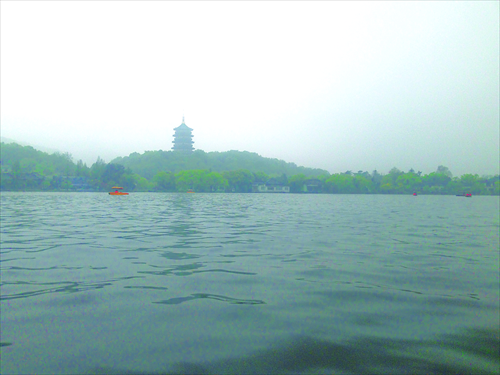
Su Causeway, which spans West Lake from south to north, was built by Su Dongpo, an influential literary figure in the Northern Song Dynasty (960-1127), during his tenure in Hangzhou. Well-known for the lovely peach blossoms running along both sides of the promenade, Su Causeway is probably the most popular of the attractions on and around West Lake.
Running east into the Solitary Hill and the Autumn Moon on Calm Lake scenic spot and rejoining the north shores of the lake at the Broken Bridge, Bai Causeway was built in memory of Bai Juyi, a great poet of the Tang Dynasty (618-907). Lined with towering trees and beautiful flowers, the kilometer-long thoroughfare is the most walkable of the three causeways of West Lake.
Perched along the less touristy western shore of West Lake, Yanggong Causeway was an architectural tribute to Yang Mengying, a governor in Hangzhou during the Ming Dynasty (1368-1644). The causeway is composed of six mini spans - Huanbi, Liujin, Wolong, Yinxiu, Jingxing and Junyuan.
Another good way to enjoy the lake is by taking a boat. Various types of boats are available for hire along the shore, catering to different budgets and needs. They include heavy wooden rowboats, small junks propelled by the owner's single oar, and full-fledged ferries.
Lingyin Temple and Liuhe Pagoda
Hangzhou has been an important place for Buddhism in Southeast China since ancient times. Its lakeside hills are dotted with temples, pagodas and grottoes decorated with Buddha statues. Lingyin Temple is one of the best examples, and can be found tucked away among dense flora near West Lake.
The history of Lingyin Temple can be traced back to more than 1,600 years ago, when an Indian master monk first built it. He believed the area was the secret retreat of the immortals. The temple's name can be translated as "soul's retreat."
The monastery is home to a number of palaces, halls and pavilions featuring figures of many Buddhist deities. It also houses an enormous collection of Buddhist literature and other treasures.
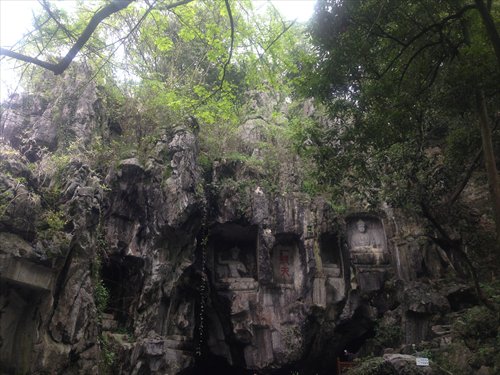
Lingyin Temple was first built more than 1,600 years ago. Photos: Yang Zhenqi/GT
Day trippers may also have time to pay a visit to nearby attractions such as Peak Flying From Afar, Yongfu Temple and Taoguang Temple, all of which are within walking distance of Lingyin Temple.
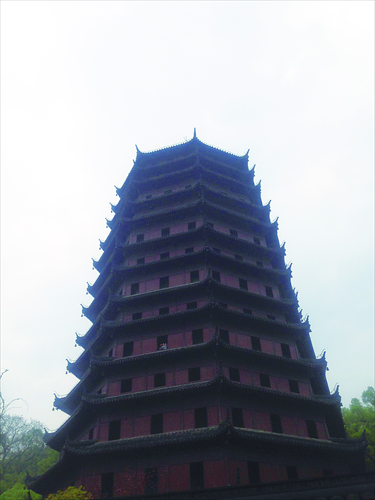
Liuhe Pagoda (Six Harmonies Pagoda) is nestled at the foot of Yuelun Hill, south of West Lake. Overlooking the Qiantang River, the tower was originally built during the Northern Song Dynasty.
The multi-story, wood-and-brick pagoda is a masterpiece of ancient Chinese architecture. The octagonal-shaped, 60-meter tower appears to be a 13-story structure from the outside, although it only has seven interior floors.
On each floor, there are more than 170 groups of exquisite Song Dynasty brick sculptures on the exterior and interior walls, the zigzagged corridor and the small chamber. The sculptures are all in good condition, with subject matter ranging across flowers, animals, gods and Chinese characters.
Visitors can climb the tower's spiral staircase to the top floor to get a view of the grandiose Qiantang River Bridge.
Hangzhou cuisine
Hangzhou dishes are well-known for their delicacy and lightness. Famous dishes include Dongpo Pork, West Lake carp in sweet and sour source, shelled shrimps with Longjing tea, West Lake water shield soup, beggar's chicken, tofu skin and minced bamboo shoot rolls braised in soy sauce, and stir-fried chestnuts with mushroom.
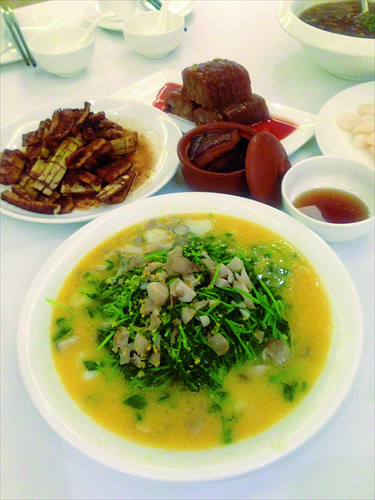
Zhiweiguan Restaurant, a time-honored dining franchise in Hangzhou, offers the most authentic Hangzhou-style cuisine (pictured left), according to reviews on dianping.com, China's Yelp-like site.
Make sure you don't miss out on snacks and refreshments such as steamed small meat dumplings, noodles resembling "cat's ears," and shallot with fried dough stick rolls at any of the chain's dozens outlets.
Xixi National Wetland Park
If you aren't on a tight schedule, then Xixi National Wetland Park (pictured below) in the western part of Hangzhou is well worth adding to your itinerary. Only 6 kilometers from downtown Hangzhou, the urban wetland was the country's first State-level wetland park and has long enjoyed the reputation as "the kidneys of Hangzhou" for its important role in the region's ecology.
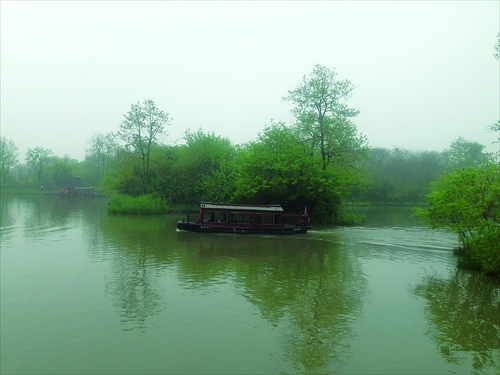
Covering a total area of about 11.5 square kilometers, the park has 10 scenic sights and three causeways. A one-day boat trip is highly recommended.
