METRO SHANGHAI / METRO SHANGHAI
Stepping out or on toes?
Shanghai’s dancing grannies trip some fantastic lights
By Published: Jul 01, 2015 05:28 PM Updated: Jul 02, 2015 12:03 AM

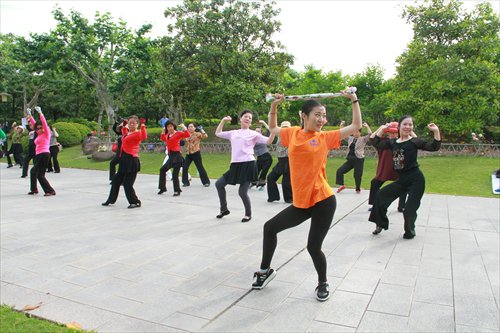
Some grannies enjoying their time dancing together Photo: Courtesy of Pei Lei
Shanghai NPC (National People's Congress) member Chen Suping recently submitted a 7,000-word report to the city government, calling for more consideration and assistance for the city's public dancers - the groups of usually elderly women who dance together in parks or on streets. Chen has just finished an eight-month study of Shanghai's public dancers and during this the 55-year-old talked to more than 300 dancers.
Scenes of groups of people - mostly retired women - getting together outdoors, in parks or on streets and dancing together invariably accompanied by loud music is replicated constantly in cities across China. Dancing in public has enriched the lives of millions of older citizens, but the music that they play has caused ructions with neighbors and passers-by seeking quiet lives.
It can provoke extreme reactions. In October 2013, irate neighbors in Hubei Province poured excrement on women dancing in a residential community. A month later, a Beijing resident drove out a group of dancers by setting his Tibetan Mastiff on to them and firing a gun into the air. Media has regularly reported conflicts between the dancing grannies and their neighbors - conflicts that usually result in shouting and arguments though some even become physical.
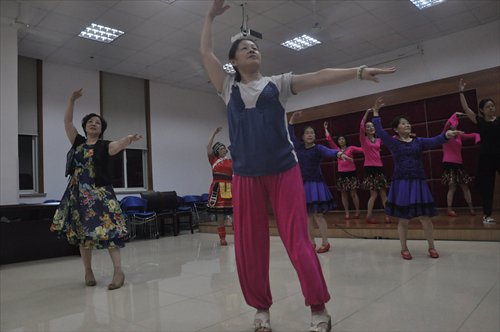
Some grannies enjoying their time dancing together Photo: Huang Lanlan/GT
Loud and pulsating
In Shanghai, Chen was personally involved in one of these dance debacles. As a noted Huju (Shanghai style) Opera expert and the head of the Changning District Huju Opera Troupe, she was delivering a lecture on opera in a quiet building. A few minutes after the lecture began, she found herself interrupted as loud, pulsating dance music engulfed the lecture room. "We couldn't hear anything else," Chen said.
Chen and some of her audience went outside and found a group of older women dancing in front of the building that contained the lecture room. It was 3 in the afternoon but when the Huju opera enthusiasts asked them to turn the music down they were roundly abused by the women who told them that the music was none of their business.
Chen and her companions argued back and the two groups eventually got into a physical struggle with each other. Chen is now reluctant to talk about this in detail. "That was terrible," she said. "It was shameful that two groups of mature women were fighting in public over such a trivial matter."
But from then on, Chen began looking more closely at and talking to the city's street and park dancers. "I realized that dancing in public had become a common social phenomenon," she told the Global Times. "We really can't ignore it - it's everywhere."
She began asking herself why these dancing grannies were so aggressive. Media reports were full of stories of them appropriating public spaces, playing noisy music late at night and quarrelling with neighbors who complained.
First Chen tried to discover who the dancing grannies were. She was living in an upmarket residential compound in Minhang district and found there were two granny dancing groups in her compound. Her ayi (housekeeper) Liu Xiaoyun had joined one of the groups and regularly danced with them after working hard all day.
Chen went with Liu to watch her and a dozen or so other women dancing to popular Chinese songs. The 46-year-old, like the other women, really got into the spirit of the music.
Chen's attention was drawn to one of the dancers who stood at the end of a line and looked rather isolated. She didn't move as freely as the others and she looked as if she was considerably older, perhaps in her 60s.
But when Chen began chatting to this 47-year-old woman she suddenly burst into tears and held Chen's hand tightly. She had had a hard life, once working for a furniture company but having to retire at the age of 45 because of poor health. In 2013 she had begun selling fruit to try to make some money to help her daughter who was studying in France.
Her daughter returned to Shanghai but then got married and gave birth to a baby. The daughter then left the city with her husband and the woman had to look after the infant.
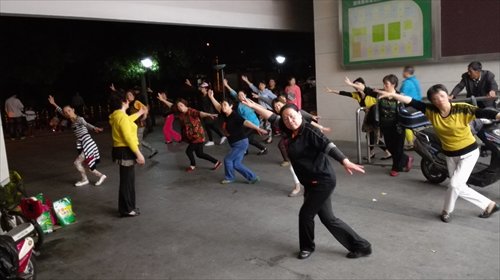
Some grannies enjoying their time dancing together Photo: Courtesy Huang Qiwei
Constantly exhausted
"I'm busy all day and I'm constantly exhausted," the woman told Chen. "Only this dancing relaxes me a little - it's a kind of relief."
After talking to more than 300 dancers, Chen concluded that as a group they deserve a lot more sympathy.
In her report she noted that 84 percent of the Shanghai public dancers were aged between 50 and 60, and 64 percent had no college education. She feels for the dancers - they were unlucky and have had to sacrifice a lot for the country. "In the 1950s and 60s, they were forced to do farm work in the countryside for years because of the zhiqing (educated youth) policy. Then in the 1990s, many of them lost their jobs when the market economy was introduced," Chen told the Global Times. "Most of them were not well educated and it was not easy for them to look for well-paid jobs and enjoy good living."
Chen talked about a 60-something woman she met during the survey. This woman was born in Anhui Province and in the 1950s she was sent to work on farms in the Xinjiang Uygur Autonomous Region. There she married a young man from Shanghai. In 2009, the woman arrived in Shanghai with her children, but her husband stayed in Xinjiang. "She didn't speak the Shanghai dialect and didn't know the city at all," Chen said.
She told Chen that in Shanghai she felt lonely and depressed but then began to be cheered up by the dancing. Every night, she went tangoing or waltzing with strange men (ballroom dancing is growing in popularity among the street and park dancers).
For this woman dancing was the ideal way to counter her depressed feelings. But her husband and children initially took against this, accusing her of immorality for dancing with strange men in public. Her husband even rushed back to the city to catch her in action and then remonstrated with her.
"She was really upset," Chen said. "Her husband and children thought it was indecent to dance with the opposite sex in public at night."
There was a happy ending though. The husband moved back to Shanghai at the end of last year and, after some persuasion, also took up dancing. The couple can be seen most nights dancing together as the sunlight fades.
Suspicious families
Fifty-eight-year-old Zhang Hongqing also loves ballroom dancing. He lives in Putuo district and for nearly eight years has danced at night in a nearby public square.
Luckily Zhang's family support him. "I'm an honest man and they believe in me," he laughed. "But don't always dance with the same woman - that will make your family suspicious."
At Zhang's dance space some 200 people practice ballroom dancing at night. They pay just 10 yuan ($1.61) per month to a man who plays the music for them. The money covers the cost of batteries and CDs.
Most of the dance groups in Shanghai pay a small amount to cover the costs of the music they dance to. "The amount is never more than 30 yuan," explained Pei Lei, a postgraduate student at Shanghai University of Sport (SUS) who has been leading a research team into the public dancing phenomenon in three provinces.
From last October to April this year, Pei's team distributed 3,000 questionnaires to dancers in Shanghai and Henan and Anhui provinces. "We found that all the dance groups were completely voluntary and dancers can come or leave as they please," he told the Global Times.
But the leaders of the groups play a vital role. Chen said that a good leader had to not only be good at dancing and communicating, but also had to have a good head for money and have had a good job before he or she retired.
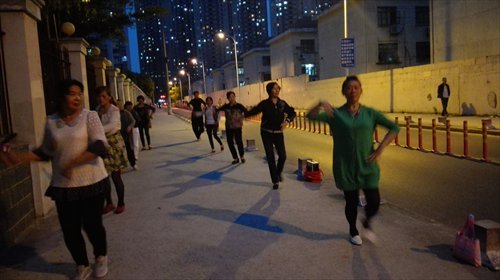
Some grannies enjoying their time dancing together Photo: Courtesy of Huang Qiwei
100 different dances
Zhang Guodi is the 62-year-old leader of a dance group at a residential community in Yangpu district. The attractive graceful woman has taught her 30-strong group some 100 different dances. The dancers here pay just 2 yuan a month although, if someone in the group is ill, Zhang will ask the others to pay a little more so that they can buy a gift for the sick friend.
When the Global Times met Zhang's team on a recent Thursday evening, they were rehearsing for a performance in the compound the following day. Some 20 elderly women wearing identical costumes danced to a patriotic song with Zhang at the front, correcting little mistakes and urging them all to smile throughout the performance.
The average age of the team is 60, some are widows, some are out-of-towners, some are not healthy but for all of them dancing is a way to be less lonely and healthy. An SUS assistant professor, Huang Qiwei, agrees with this notion. "Indeed exercise, entertainment and making new friends are the three big reasons for elderly people to take up dancing," she said.
Now Huang's school and the Shanghai Jiao Tong University are undertaking another survey into Shanghai's dancers and Huang came across Zhang's team last month. "This group was very different from the other dance groups - it was well organized and disciplined, to some extent like a professional troupe."
Zhang has persuaded her residential community to open its hall to the dancers on rainy days so that it doesn't annoy neighbors. And she turns the music volume down after 9 pm. "We are considerate - we never dance on the days the students are sitting the gaokao (the national college entrance examinations)," she said.
Although Zhang's team has solved many problems other groups are struggling to find proper spaces and practise areas.
Territorial disputes
Last August, when the Luxun Park in Hongkou district reopened after a year-long renovation, hundreds of dancing grannies rushed to the park on its reopening day, jostling for good sites and there were several "territorial disputes" reported.
Chen believes that scenes like this could be avoided if there were enough spaces allocated for dancers. "Almost every residential community in Shanghai has a 'culture center,' with large rooms or halls which can be used for cultural events. But nowadays, most of these centers close at 6 pm, and some are even rented out to private companies as offices," she said.
This is one thing the Shanghai NPC member hopes to change. In her 7,000-word report, Chen suggests that local governments make full use of these community cultural centers and make them available for use by the dancers.
Chen wants the government to help these dancers. "In the past many of them sacrificed a lot for the country's development, and now it's time for the country to do something in return."
