
The traditional clothing of the Han Chinese, hanfu, is making a comeback as enthusiasts hold events and form societies to celebrate the style of dress, which peaked in popularity during the Ming Dynasty (1368-1644) then fell out of favor during the Qing Dynasty (1644-1911), when the country was ruled by Manchu people form Northwest China.
So low is awareness of hanfu now that people usually mistake the clothing for Japanese or Korean styles, which themselves were originally influenced by hanfu.
"Japan's kimono and Korea's hanbok gown come from Chinese hanfu," said Niu Geng, director of Fenghuangyayun, a hanfu society based in Shanghai.
However, the rise of a "hanfu movement" in recent years has seen an increasing number of Chinese art and culture enthusiasts become interested in the clothing. Some of them have established groups to publicize the beauty of the costume.
Groups such as Fenghuangyayun regularly hold free activities during traditional Chinese festivals, letting people try on hanfu clothing and participate in folk customs that were once popular in ancient China but are rarely seen nowadays.
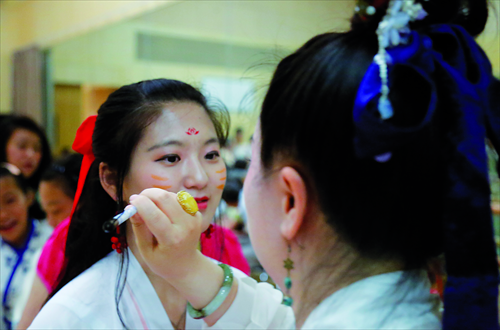
Women dressed in traditional hanfu clothing Photos: Courtesy of Yu Xinpeng
Custom-made
On the Saturday afternoon before the Dragon Boat Festival last month, dozens of people in hanfu attire stood in line at a public hall in Xuhui district. A young woman wearing a mask stood at the head of the line, from where she used mugwort leaves to sprinkle water on each person's head.
This is a traditional folk activity named mu lantang ("bath with mugwort leaf water").
In ancient times, the fifth lunar month was regarded as the month of "five evils" (scorpion, snake, spider, centipede and toad).
On the Dragon Boat Festival, which falls on the fifth day of the fifth lunar month, people participated in the mu lantang to avoid being attacked by the five evils. The young woman wearing the mask played the role of the "priest" in a kind of exorcism of evil.
Following this, visitors took part in a traditional game that sees each take a boiled egg, which they then strike against other participants' eggs. Whoever is the last to have an intact egg wins.
The next day, at another hanfu-themed event in an office building in Jing'an district, a group of young people sat around a table and made herb-filled sachets, which were traditionally worn to ward off the five evils.
According to Gu Jun, director of the Shanghai-based hanfu group Hanfuxinzhi, the sachets were popular as gifts from young women for their husbands and boyfriends.
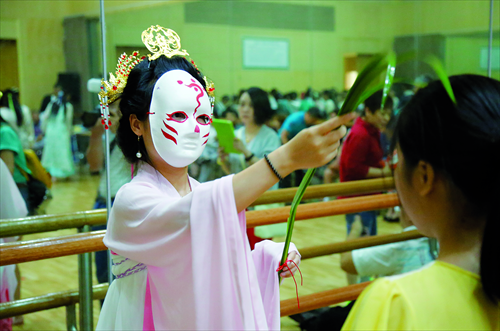
A woman performs the mu lantang rite to ward off evil.
Open to all
Niu's and Gu's hanfu groups organize many such folk customs events that are open to the public for free. During the events, many participants wear hanfu.
"In recent years, we've seen more and more local residents who are not familiar with hanfu coming as well," Niu told the Global Times. Usually, she has a few spare hanfu outfits on hand so newcomers can try them on. "We hope more people can experience the beauty of the costume,"she said.
Gu's group started holding hanfu-themed events for the public in early 2013, and to date has organized some 100 events including folk activities, lectures and handcraft workshops.
"More people get to know and appreciate hanfu by participating in our events," he said.
Gu has also established an online chat group in which hanfu lovers can talk about the costume and traditional Chinese culture. The group has almost 700 members.
"Indeed, hanfu is far more than a piece of clothing - it is a window into the great and profound Chinese culture," Niu said.
"Through trying on hanfu, learning traditional etiquette and joining in various folk activities, people can know more about our culture in a simple and interesting way."
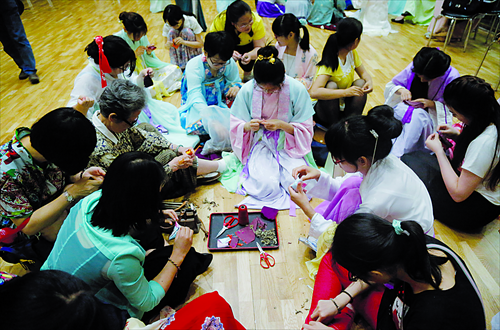
Fans of traditional hanfu dress make herb-filled sachets.
The next big day for Niu's and Gu's groups will be the Qixi Festival - one of the most important traditional Chinese festivals.
In ancient China, Qixi Festival was a time when females prayed to the gods for intelligence and better needlework skills.
Today, it is commonly regarded as China's Valentine's Day. This year's Qixi Festival falls on August 20.
On that day, many local hanfu groups will hold a series of activities that members of the public can participate in for free, such as the "moon worship ceremony," a popular activity that ancient Chinese females held on the Qixi Festival.
Those who would like to try on hanfu and experience traditional Chinese folk customs that day can contact Niu (137-6472-0206) or Gu's co-worker Wu Juanya (158-0098-8075) for details.
