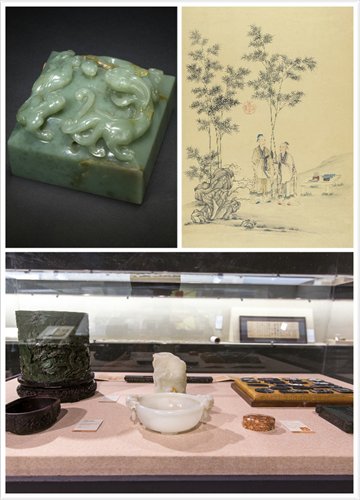
With the spotlight turning to the upcoming military parade in Beijing, an opportunity to glimpse what a similar practice from centuries ago looked like has arisen at new exhibition Times of Prosperity: The Imperial Art of High Qing, at Long Museum West Bund. Exhibits on display at Long Museum West Bund's new exhibition Photos: Courtesy of the museum
A 1739 scroll by imperial artists including the Italian missionary and painter Giuseppe Castiglione (also known as Lang Shining, 1688-1766) documents the grandeur and exactitude of a military parade of the time.
The work is just one of the 260-plus exhibits in the new exhibition. High Qing (1662-1795) refers to a golden age under the reigns of the Qing Dynasty's (1644-1911) early emperors Kangxi, Yongzheng and Qianlong.
The exhibits cover paintings, calligraphy, books, silk tapestry, porcelain, jade, lacquer, glass, enamel and red sandalwood furniture. All works are owned by private collectors from across the world.
Curator and auction house administrator Xie Xiaodong said the exhibition aims to outline the evolution of imperial art throughout the High Qing, and the roles the three emperors played in the process.
"It attempts to look at the High Qing's philosophies, values and aesthetics through the perspective of antiques," Xie said. "Moreover, the exhibition does not just reflect the tastes of emperors, but the inner world of that era's mainstream intellectual class."
Erudite rulers
Xie has divided the exhibition into four major sections. It begins with The Great Philosopher, which highlights the three emperors' erudition in philosophy, art and literature, and religion. It is this erudition that was conducive to the accomplishment and richness seen in imperial art during the period, Xie noted.
With exhibits including archives from missionaries written in both Western and Chinese languages, the section places the era in a global context and offers a historical perspective on the collective image of the three emperors, who Xie likens to the philosopher kings of Plato's The Republic.
The second section, The Great Unification and Modern China, addresses the High Qing's legacy in terms of territory, cultures and ethnicities. It features Kangxi's throne, Qianlong's sword, a range of green jade imperial seals, and paintings depicting military conquests, among many other items.
Jewels in the crown
But it is the last two parts, The Golden Age - the Images and Craftworks of High Qing, and The Diversity of Art in the Forbidden City, that are the most enjoyable.
The Golden Age has three sub-sections. The first focuses on the calligraphy and paintings produced by imperial artists revolving around Kangxi and Qianlong's inspection tours of the south.
The second sub-section foregrounds the emperors' roles as artists by featuring their inscriptions on paintings, and more particularly Kangxi's own poems.
The third sub-section is remarkably beautiful, with a full range of imperial antiques - the most valuable pieces include a blue-and-white porcelain vase bearing 1 million shou (longevity) characters, from the reign of Kangxi; a blue-and-white porcelain vase with an interlocking lotus design from Yongzheng's reign, and a jasper brush holder showing scholars in an imperial garden from Qianlong's reign.
Meanwhile, the last section looks at the influence of Europe and of previous dynasties. It reviews the influence that Italian and French missionaries and artists had on imperial paintings, porcelain, architecture and clocks.
An even more dominant trend was the three emperors' endorsement of the use of Song and Ming styles in calligraphies, paintings and porcelain.
Historic value
"There have been a series of imperial art exhibitions on early Qing Dynasty emperors in the past few years, but it is the first time a single exhibition has brought the three emperors together around the concept of High Qing, which is a popular area of academic interest," said Liu Wenpeng, associate professor at the department of Qing Studies at Renmin University of China.
He said the exhibits hold a wealth of research value.
"For example, the appearance of Zhao Hui, a war hero in incorporating Xinjiang into the Qing empire, was unknown, but one of the paintings provides evidence of how he looked," Liu said.
Chang Jianhua, professor with Nankai University and president of China Association for Social History, said the exhibits provide new referential resources for history studies.
"Apart from their cultural and artistic inferences, they touch upon historical information including ethnicities, religions and politics," Chang said.
"For example, the emperors' calligraphy works and inscriptions encompass their political and ruling considerations, and are worth further investigation."
Date: Until November 18, 10 am to 6 pm (closed Mondays)
Venue: Long Museum West Bund
Address: 3398 Longteng Avenue
龙腾大道3398号
Admission: 50 yuan ($7.83)
Call 6422-7636 for details
