Jiangnan Baigong - A Hundred Crafts from Jiangnan - the first comprehensive exhibition of intangible cultural heritage works from the Yangtze River Delta region showcases a collection of some of the finest art and craft from Shanghai and nearly 20 cities in Zhejiang, Jiangsu and Anhui provinces.
The nearly 100 works on display at the Duoyunxuan Art Center cover a range of styles and crafts listed as UNESCO Intangible Cultural Heritage items alongside country- and regional-level counterparts.
The exhibition is in four major sections: embroidery, Zhejiang crafts, stationery and traditional Shanghainese shikumen (stone-gated) architecture.
Duoyunxuan director, Zhang Xiaomin, said the exhibition aims to present a clear theme by narrowing the subjects down to art and traditional handicrafts from the Yangtze River Delta region, where similarities can be traced.
"It is the epitome of the shared lifestyle and memory of the same ancestors and roots, and reflects a regional culture that can be seen as one," Zhang said.
He said the exhibition tried to encompass each of the region's listed intangible cultural heritages that were above city-level, and very few had been left out. After the exhibition opened in mid-February, more pieces were added.
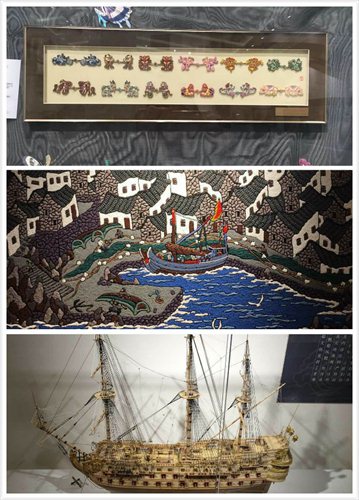
(From top) Some 100 works on display at Jiangnan Baigong - A Hundred Crafts from Jiangnan cover a wide range of styles and crafts. Photos: Liao Fangzhou/GT
Exquisite embroidery
The region, which was home to the embroidery and textile creators and designers for the imperial court since the Qing Dynasty (1644-1911), continues to pride itself with several distinctive and acclaimed embroidery styles today.
Prominently displayed in the exhibition is Shen embroidery, a style named after its founder Shen Shou, an embroidery master from Nantong, Jiangsu Province, and a sub-category of the famous Su embroidery, the embroidery style from Jiangsu Province.
Shen embroidery continues the trademark of the Suxiu style with flat, even smooth and shimmering works that tend to be graphically realistic.
The work of veteran Jin Leilei is represented here with a series of embroidered pieces based on the ink paintings of everyday vegetables and animals by master Qi Baishi.
Jin used threads of different thickness and colors to recreate the paintings and their ambience - these prawns and loofahs are as vivid as they were in the original works.
Another highlight is Yun embroidery, a silk craft that originated in Nanjing, Jiangsu Province and won acclaim for its elegance.
Dating back some 1,580 years, Yun embroidery was among the precious items created for the emperors in the Yuan (1279-1368), Ming (1368-1644), and Qing dynasties.
The Yun embroiderer Zhou Shuangxi impresses in the exhibition with three vertical scrolls based on a stamp series launched by China Post to honor this art form.
They show marvelously fine patterns of double fishes and other auspicious animals, and there seem to be more colors than is possible, most of them vibrant and vivid.
Working with Zhang Hongbao and Cai Xiangyang, Zhou also embroidered a 150-centimeter gown, a replica of the gown worn by the Qing emperor Qianlong. A dazzling creation, it glistens with 16 dragons, clouds of five colors, and lucky red bats spread across it.
The Longfeng brand qipao, the most sought-after made-in-Shanghai dresses combining traditional Chinese style and Western cutting, was born in 1936 and was listed as an intangible cultural heritage in 2009.
Several beautiful qipao are on show, but the real treats are three sets of exquisite buckles, one of them in the shape of the 12 animals of the Chinese zodiac.
Coastal legacies
The highlights of the Zhejiang section are largely associated with the sea and showcase an interesting regional culture that has been influenced by a coastal lifestyle.
Ship models from the coastal city Zhoushan are basic replicas of the century-old traditional craft, and the links with the ocean are further explored with the city's unique fishermen's paintings which portray the life and work of fishermen, the creatures of the sea and the ocean itself.
These paintings are boldly colored and brightly toned, with a somewhat surrealistic, imaginative style that conjures up a breezy atmosphere.
One of Jiang Deye's paintings shows large, vividly yellow fish near Putuo Mountain in autumn - the yellow and red fish look as if they are dancing amid blue waves.
There are also examples of the Zhoushan seashell sculptures on offer. Local artists used seashells to decorate furniture, and later as works of art in their own right.
One of the really breathtaking works on display is Xia Yuzhui's enormous Beauty Competition in which two beautiful peacocks stare competitively at each other, amid branches of flowers.
The peacocks' shimmering, delicate feathers, and the petals of the petite magnolias and the large rich peonies, and the other gorgeous details, are all made of meticulously cut and arranged seashells. The delicate lines of the feathers appear strikingly real.
The other two sections are probably not as intriguing for casual visitors but it is worth pausing by the stationery section to view the Hu brushes made in Huzhou, Zhejiang Province. These traditionally crafted brushes take more than 120 stages to manufacture.
Date: Until March 20, 9 am to 9 pm
Venue: Duoyunxuan Art Center
Address: 1188 Tianyaoqiao Road
天钥桥路1188号
Admission: Free
Call 6468-1020 for details
