Sleep makes up a third of our lifetimes, roughly. Naturally, then, people usually pick a comfortable pillow. But not Sima Guang.
Sima was a famous historian during the Song Dynasty (960-1279). He was diligent in his research and even had a special headrest so he'd avoid oversleeping, according to one contemporary account. He used a log, which would easily roll away when Sima shifted in his sleep, so he would be alarmed and get back to work.
Most Chinese people did use wooden headrests back then, though seldom would have chosen a log for the sake of a sound sleep. But there was another special kind of headrest used in former times: ceramic pillows.
Zhai Jinlu, 71, is an attentive collector of ancient pillows from across the country. His hobby started in the late 1980s, when he was deputy director of the PR department of Handan in Hebei Province.
Zhai now has more than 500 antique pillows, and says roughly 90 percent are ceramic. The others include bronze, wood, silver, jade and leather.
A part of his collection is currently on view at the Shanghai Textile Museum (150 Aomen Road, 6299-6969), together with dozens of embroideries that were used to decorate pillows in the 20th century. The exhibition is free and open to the public until May 10.
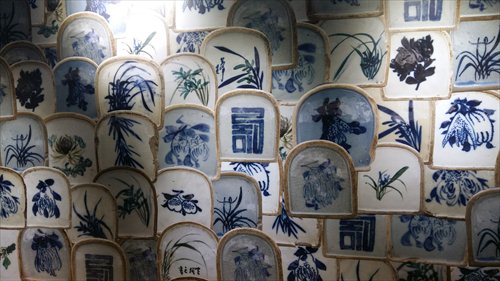
A collection of ancient ceramic pillows decorated with paintings is on display at the Shanghai Textile Museum. Photos: Sun Shuangjie/GT
Nonstop kilns
Most of Zhai's ceramic pillows were made in kilns in Cizhou county in Handan. These furnaces, collective known as the Cizhou Kiln, were the largest folk kilns in North China. Whereas the well-known government kilns in ancient times mainly served royal families, Cizhou Kiln was for the common people.
According to Zhai, ceramic pillows date back to the Sui Dynasty (581-618), as a cemetery from that era was discovered containing a miniature production model, about the size of two thumbs.
Styles of the utilitarian-sized pillows evolved during the Tang Dynasty (618-907), and by the Song Dynasty, ceramic pillows were refined with decorative paintings and carvings. The art and craft reached new heights in the late Qing Dynasty (1644-1911).
The history of Cizhou Kiln similarly evolved from the Northern and Southern Dynasties (386-589), matured in Sui and Tang dynasties, and peaked in Song and Jin (1115-1234) and Yuan (1279-1368) dynasties, and has continued its production through today.
Usually, ceramic pillows come in a few different major shapes, such as square, rectangular or elliptical, as well as in the form of an animal, baby or maiden.
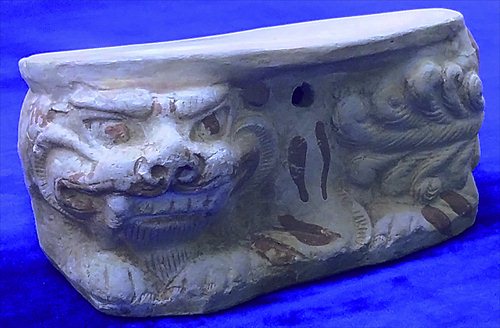
Popular animal figures are auspicious beasts like the lion and tapir (pictured above), which is believed to feed on people's bad dreams. Felines, babies and maidens are favored for symbolizing tenderness.
For basic square or rectangular shapes, five pictures are usually painted on the faces of the pillow. Common images include the four virtuous plants: plum, orchid, bamboo and chrysanthemum, with chrysanthemum being the most common. Dragons and fish are also liked for their auspicious meanings.
In the Song, Jin and Yuan dynasties, a number of poets and intellectuals participated in the making of ceramic pillows by creating calligraphy and paintings for them.
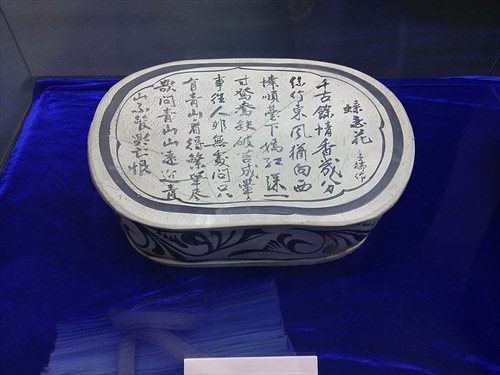
Among Zhai's collection is a pillow (above) with work by Wang Tingyun, a calligrapher and poet during the Jin Dynasty. Wang was a nephew of famous calligrapher Mi Fu, and his calligraphy served as a precious material to study calligraphy.
Some pillows use puns in their names to convey good meanings. On exhibit is a pillow featuring a baby holding up a lotus leaf (below).
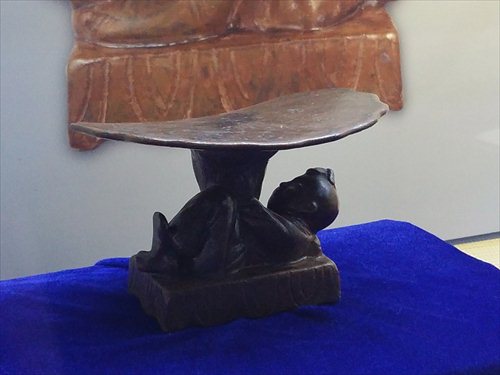
"Leaf" in Chinese is pronounced as "ye," which is also the pronunciation for "business" in Chinese, so the pillow bears wishes that the younger generation will continue the family business.
Meanwhile, these vintage headrests also serve as a mirror of social change in China.
Zhai showcases one ceramic pillow made during the social movements in the latter half of last century. It bears the phrase "Zheng Zhi Gua Shuai," which means that politics comes before all else in society.
Traditional Chinese Medicine theory
Ceramic pillows were popular across the country, especially in northern China, Zhai said. The cool material is more suitable in the summer, and Zhai said he himself still uses one in the hotter months.
Also known as a health guru, Zhai told the Global Times that the use of ceramic pillows is in line with theories of traditional Chinese medicine (TCM).
TCM emphasizes a balance of yin and yang energies. Zhai said that in TCM the head is yang while the feet are yin, so it's important to keep the head cool and the feet warm to maintain health.
"Using ceramic pillows are good for our body; it calms down our minds and meanwhile improves our eyesight," Zhai said.
