
People in Wenchang watch the launch of Long March 7 rocket on June 25. Photo: CFP
"Ten, nine, eight, seven …" People were counting down …
I was standing on the beach at Stone Park and staring at dazzling streams of golden light as they lit up the dark skies over Longlou Township on June 25 in Wenchang in South China's Hainan Province.
As the boom from the fireworks rolled in from the sea, people held their breath for a few seconds before they began singing songs eulogizing their motherland.
After the night-long celebrations at the shore, I got up early in the morning the next day and chatted with friends at the Laoba teahouse in Longlou about the miraculous sights we saw the night before.
Many overseas Chinese can trace their origins back to Wenchang, a county-level city in the northeast part of Hainan Island. Many of the habits of these overseas Chinese were inherited from the city's culture.
The Laoba teahouse is one of these. Different from British tea culture, the Laoba teahouse is a place for friends to chat, listen to stories and, more importantly, eat diverse local snacks.
The most popular topic that morning was how this small town managed to transform into a world-class space launch facility.
To make room for the launch site, 2,393 families (10,840 people) relocated to other places, a huge contribution by the people of Wenchang to China's space dream.
Speaking with a strong local accent, the owner of the teahouse talked to us with pride as we quaffed down our "Gebi'ou," the local name for coffee.
According to him, even someone who was once a poor fisherman in Longlou can now start a proper Laoba teahouse business.
Wenchang is a birthplace of Hainan Opera, the origins of which can be traced back to more than 400 years ago. Operas are often performed to celebrate happy occasions.
It just so happened that while we were there, a 3-day-long Hainan Opera performances were being held to celebrate the launch of the Long March 7 rocket in late June.
Wanting to join in the festivities, we drove to Dongjiao Township, which is close to Longlou, to take in the opera performance there.
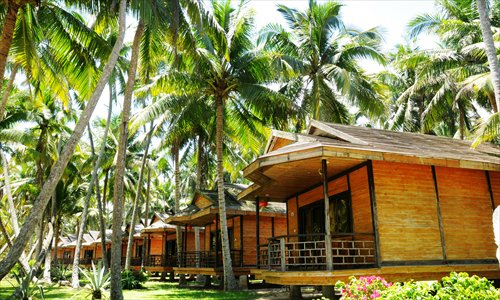
Coconut trees at the Hainan Prima Resort in Wenchang Photo: CFP
Coconut village
After enjoying some traditional Hainan Opera, our next step was the coconut forest in Dongjiao.
It was there that we learned why Wenchang is called "the coconut village" - It is home to more than 500,000 coconut trees.
A local tale says that one of the coconut trees was originally a woman.
According to the story, a fisherman's wife would stay behind on the beach waiting for her husband to come home.
One day he didn't return, but she continued waiting. Day after day she stayed on the beach waiting for the husband who would never return.
Relentlessly waiting by the coast, she eventually turned into a coconut tree that to this day still looks to the sea waiting for her lover's return.
It's because of this story that local people view coconut trees as auspicious.
When they commemorate engagements, marriages or births, they like to give coconut saplings or plant coconut trees together as a present.
This tidbit of local culture has turned the eastern suburb into a "coconut kingdom."
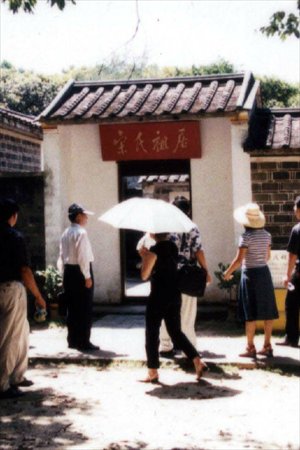
The gate to the Soong family ancestral home Photo: CFP
Soong hometown
Another great place to go in Dongjiao is the Hainan Prima Resort, where stand statues of Soong Ching-ling, honorary chairperson of the People's Republic of China; Soong Mei-ling, Chiang Kai-shek's wife; and Xie Fei, third wife of former president Liu Shaoqi.
Indeed, Wenchang is a place known for its cultural heritage.
The TV series Father Charlie Soong gave us a chance to learn about the Soong family's Soong Ching-ling and Soong Mei-ling, who also made Wenchang "the home of first ladies."
Wenchang is the Soong sisters' hometown as well as the place where their father Charlie Soong was born and spent his childhood.
The Soong house's style is a quiet traditional farm. Above the front gate of the house you can see a board with four Chinese characters "Songshi Zuju" (the Song family ancestral home) written by former Chinese leader Deng Xiaoping.
Inside the house, you can find old ploughs, harrows and shoulder poles, as well as a cooking bench that were used by Charlie Soong and his father.
A family tree and some photos of Charlie Song and his father can also be seen hanging on the wall.
About 200 meters northwest of the house is an exhibition hall, which displays material about the contributions to the revolution and world peace Soong Ching-ling made throughout her life.
Yummy seafood
It's often said that Wenchang has the best seafood in Hainan, especially when it comes to mackerel, which is exported to several other countries and regions.
To see just how true this was we went to Puqian Township, which borders Haikou and lies in northern Wenchang.
We never imagined that what would capture our taste buds was not the town's mackerel but a kind of local snack known as Puqian dross vinegar, which is also called "women's vinegar."
It was the best hot and sour snack I had ever tried before! The ingredients are quite diverse: vinasse, soup made from sesame oil, chili, garlic and seafood such as seaweed, prawns and conch as well as organ meats from cows and pigs.
It is the perfect snack, especially eaten with a little coconut milk during the summer.
The dross vinegar is reportedly very good for the skin and losing weight. It's no wonder young people like it.
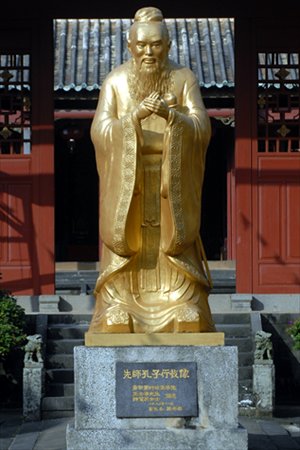
A statue of Confucius at the Confucius temple in Wenchang Photo: CFP
Back to downtown
After having traveled to several key towns around Wenchang, our last stop was Wencheng Township, the political, economic and entertainment center of the city.
I was impressed by its clean and refreshing environment upon our arrival.
The people of Wenchang care a great deal about traditional culture, so Chinese calligraphy can be seen everywhere, even on boards at bus stations.
The area also has a deep and rich history with the old buildings along the river were built in 1920s in a typical southern style.
There is also a Confucian temple in Wenchang, which is considered to be one of the aged temples in Hainan as it is the most intact one and was built during the Northern Song Dynasty (960-1127).
In the front yard, there is a statue of Confucius. Inside the temple are proper exhibits about Confucius, including portraits of Confucius and his 72 disciples.
Confucianism is closely associated with education in China, as such each year parents like to bring their children to the temple before the college entrance exams so they can pray for good results.
It was right about exam time when we visited the temple, so we could see families everywhere.
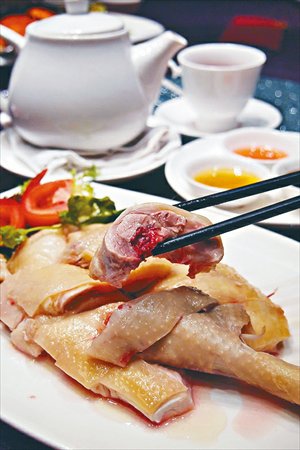
Wenchang chicken Photo: CFP
Delicious chicken
There is another thing that is just as famous as the Confucian temple - Wenchang chicken.
The way it is served is quite interesting - one whole chicken, one bowl of plain congee and some pickles.
Because of the special way it is prepared - simmered in a covered pot with salt over a slow fire - the chicken is very soft and flavorful.
The best place to eat Wenchang chicken is the food street in front of Wenchang Middle School.
This year marks the school's 108th anniversary, but it's not just the school's age that has made it famous in Hainan.
Over the past three years, more than 600 students got into China's top universities every year such as Tsinghua University and Peking University.
I saw banners congratulating students who performed well on their exams hanging outside the school.
Besides its fame as a leading educational institution, the school has another reason for its fame - the Wenchang Middle School volleyball team.
Volleyball is a favorite pastime in Wenchang. The Wenchang Middle School team has represented China at international middle school volleyball matches several times, a fact which local people are extremely proud of.
