Kang Meihua, born in Shanghai in 1958, began dancing in 2012. Line dancing, a globally popular dance category that features a repeated sequence of steps in which a group dance in one or more lines, was her starting point. A few months later, she turned to square dancing, a popular form in China in the past half decade in which amateurs dance in public spaces like plaza or parks.
"Compared with line dancing, square dancing is more flexible in movement of feet, and also has more movements for the hands, so it gives dancers more freedom in choreography," Kang told the Global Times.
Kang still dances each morning in a park near her home, but she doesn't call it square dancing. Instead, she uses specific terms from traditional Chinese dances, such as Dai Dance and Wa Dance.
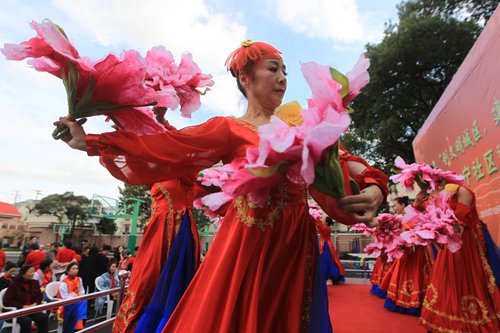
Wu Yiyi dances with her community team for residents in Jing'an district.
Wu Yiyi was born in Shanghai in 1956. In the 1980s she taught dance in a vocational school, and since retirement she has taught the dance team at the Daning Residential Community. Last week, Wu, together with other 18 dancers, presented a square dance at the intersection of Nanjing Road West and Xikang Road to cheer up runners in the Shanghai International Marathon.
Recently, the two, who live in neighboring communities in Jing'an district, have become friends, thanks to an art project initiated by Ming Contemporary Art Museum (McaM, 436 Yonghe Road East).
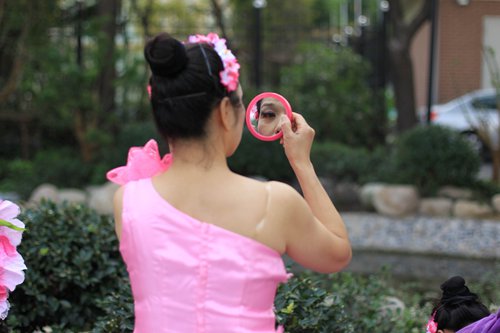
A senior community dancer checks on her make-up before a performance.
From group to individual
On October 23, dozens of audience members - half senior ladies and half young people - filled the seats full inside McaM to watch a show presented by artists Ergao and Zhang Dianling.
Within a duration of one hour, four senior dancers - Kang and Wu from Shanghai, Zeng Zhijun from Guangzhou and Cao Li from Chongqing - presented a galalike show that traversed different group dances popular in China since the 1960s, blended elements from Chinese opera, tai chi and even catwalks. Sometimes it seemed like a theater piece, as the four dancers brought to stage scenes of their daily lives, such as travelling and taking photos.
Zeng was the only male dancer, and had his particular way of dancing. He always danced alone with a hula hoop, and compared with other dancers who may follow set steps, his movements were improvised and free.
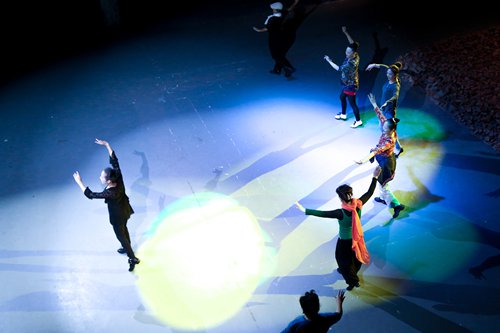
Senior community dancers present a refreshing show at Ming Contemporary Art Museum in Shanghai.
Watching the performance, a Global Times reporter was impressed with each of the dancers for their confidence and the pride seen on their faces. Unlike common square dancers who prioritize synchronization, those four dancers were more independent, as each had his and her own specific aura.
"Ergao and Diandian (Zhang's nickname) told us that we can dance whatever we like as long as we feel comfortable, and the whole process was so cool and brilliant!" Kang told the Global Times.
It's also the intention of the artists to bring out the individuality of the dancers. Ergao, from Guangzhou, and Zhang, from Chongqing, spent six days working and living together with the dancers in Shanghai to prepare for the show.
"The key task for us is to listen, listen to those uncle and aunties of their dance experiences and life stories," Ergao told the Global Times.
Ergao and Zhang interviewed every dancer to let them talk about what dance really means in their life experiences. Born in the 1950s, those square dancers had so many stories unknown to the younger generation, and the artists were interested to dig them out and to share them with younger audiences.
"Diandian and I were more like editors, while those dancers were choreographers who provided fundamental content to the show," Ergao said. "We'd like to bring out their authentic passion toward life and dance during the show, rather than to turn the show into a competition that focuses more on skills."
Hidden passion since "Loyalty Dance"
Although the four dancers specialize in different kinds of dance and they didn't know each other before the project, there was one thing that had linked them together in the 1960s and 1970s: the "loyalty dance."
The loyalty dance was a special dance created during the Cultural Revolution (1966-76) to promote the latest instructions from the Party. While posing some simple movements, the dancers would also sing red songs with blunt lyrics such as "revolution not guilty, to rebel is justified."
All of the four were loyalty dancers, just like most young people living through that time. Kang could still recall her excitement presenting loyalty dances on streets near the Bund.
Born in a family near the Bund, Kang had many chances in her childhood to go to theaters to see music, opera and dance shows, and had buried deep in her heart a craving for performing art. She had dreamt to become a Huju Opera singer, but she said her family would not agree because they thought it's not a decent job.
The direct reason that led Kang back to the dance scene was the death of her pet dog in 2012. She was devastated and one friend suggested she dance, she said, and then she became "an independent woman who is no longer a slave of domestic chores."
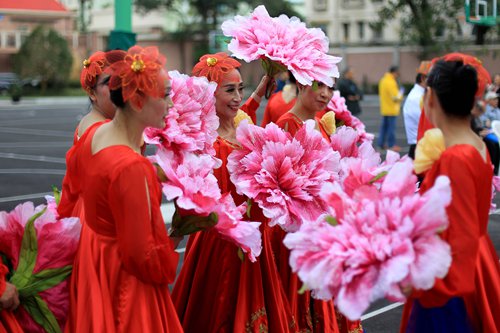
Senior community dancers gather at Daning, in Jing'an district, to present a performance for local residents.
Wu has also been obsessed with dance since childhood, and for her, loyalty dance became one of the most unforgettable memories from her experiences in the countryside of Anhui Province, where she worked in a village clinic for four years as one of the millions of intellectual youths that were sent from cities to villages for re-education.
"Those days were difficult, simple but happy," Wu told the Global Times. "We (intellectual youths) usually had dinner together, chatting and singing, and discussed dance programs deep into the night."
After Wu came back to Shanghai, she was spotted by her school headmaster for her dancing talent and was appointed in charge of organizing student dancing programs on the campus. In 2003, she joined the dance team of her residential community, and over the past decades, the team has won a lot of dancing awards and become a name card for the Daning community. Currently, she dances four times a week with her community team, and also takes dance classes in Hongkou district once a week.
Curiosity from both sides
When asked what those senior dancers share in common, Ergao told the Global Times that it was a curious mind that kept them still enthusiastic and passionate, like children.
"You can see their eyes are shining bright, and they're willing to know and learn new things in life, and they have curiosity toward the environment surrounding them," Ergao said.
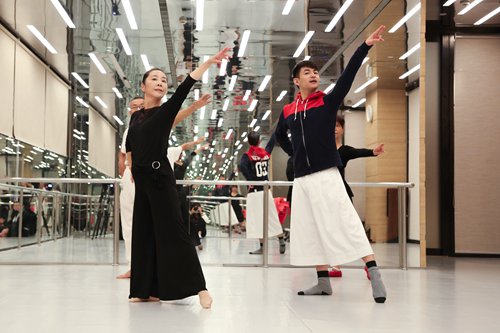
Chinese artist Ergao (right) works with Wu Yiyi (left) and other community dancers in a rehearsal.
Ergao was curious about square dancers as well. Over the past years, he had been familiar with negative social news about them -- usually called "square dancing dama" and blamed for making noises in the public space -- and he had felt shameful for such problems.
According to a survey by the South People Weekly, more than 56 percent of respondents thought the word dama connoted being absurd and unreasonable.
However, through this collaboration, Ergao found that those dancers were nothing but adorable. The misperception of dama was a result of lack of communication between the older generation and the young.
"So when collaborating with them, we chose a documentary approach to showcase what they were and what they are to our audience and young people," said the 32-year-old.
While for those dancers, working with professional artists were refreshing experiences as well. Both Wu and Kang told the Global Times that Ergao and Zhang inspired them in drawing influence from various cultural genres.
The collaboration between Ergao, Zhang and the four dancers was the first official program from McaM's half-year-long art project that feature square dancers. Before Ergao, Iranian artist Adel Andalibi was invited to do a dance workshop with a dozen of square dancers in August, as a prelude for the art project.
Kang was there as well. She told the Global Times that although there was a little bit distance between her and the artist due to language barriers, the workshop elevated her sense of dance a lot as Adel taught her how to use imagination in choreography.
According to Wang Weiwei, manager of this art project in McaM, the reason why they chose square dancers as its subject is that they make up the majority of the people participating in regular community events in town, and the aim of the project is to infuse more variety and vitality to local communities.
"Working with seniors is very different from working with artists," Wang told the Global Times. "It's a much closer relationship between us, like working with our parents, but meanwhile we will pay more attention to make both sides coordinate with each other during the process."
