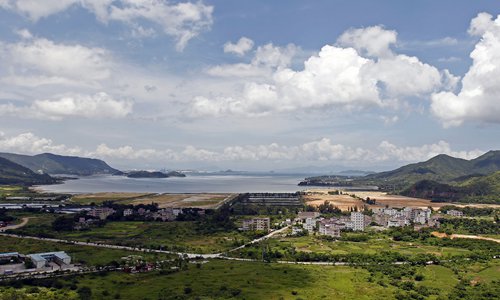
Baguang village Photo: CFP
People are often amazed by how fast the southern Chinese city of Shenzhen has developed from a fishing village into a global metropolis.
Located in the southern part of Guangdong Province and bordering Hong Kong to its south, Shenzhen became China's first special economic zone in 1980. Its rapid development over the years has made it one of the richest cities in China, following Beijing and Shanghai.
The tourism industry boomed as the economy grew. In the first half of 2016, Shenzhen ranked No.1 in inbound tourism in Guangdong, attracting over 174 million overnight visitors, according to a report from the Guangdong Tourism Economic Operation.
A typical tourism route would mostly include the famous tourist spots such as China Folk Culture Village, Sea World and Dongmen Pedestrian Street, but here I am going to introduce you an alternative route: Ancient villages in modern city, to explore the folk traditions and architectures on the out skirts of Shenzhen, and get a sense of what has been left behind the city's urbanization.
To promote the city's natural and historical areas, about 24 villages have been recommended for one-day trips by the Shenzhen Municipal Tourism Bureau. Additionally, the local government is working on the redevelopment of old villages.
In principle, the local authorities are planning to repair the historic walls, temples and buildings keeping in mind their historical value. However, many citizen are worried that rapid development may lead to the demolition of old villages as the city lacks space to develop.
You may need to act fast if you want to see these historic places before the bulldozers arrive.
Baguang village
Shenzhen's Baguang village is often compared to Jiuzhaigou valley, a breathtaking nature reserve and national park located in the north of Sichuan Province.
I first heard about the Baguang village from a postcard I got from a local friend. The postcard was a picture of a girl sitting on the beach at sunset in a fishing village.
I was stunned by the peaceful atmosphere and wondered where it was. On the back of the postcard, my friend wrote, "Baguang village, probably the last pure land in Shenzhen. You should visit before urbanization sweeps it away."
Baguang village stands out as it is now one of the two places in Shenzhen where you can enjoy unpolluted seafood. It is also famous for its peaceful atmosphere, as it is surrounded by mountains and faces the sea.
While the rest of the city is in a rush to develop, in Baguang village time seems to have stopped. It is a haven of peace outside the noisy city.
The noise of busy streets and traffic fades as soon as you enter the village and find yourself surrounded by some 300-year-old banyan trees. It is said that such ancient banyan trees can only be found in China, Japan and India now.
I guess the best thing of living in Baguang is leaving it. Many of these preserved traditional Cantonese-style buildings have been abandoned as young people leave village to seek their fortunes.
The ocean is a definite highlight of a day trip to Baguang. Fishing is a popular activity in the village. You can rent a boat for 300 yuan ($50).
In addition, Baguang has a 16-kilometer coastline. Compared to the Dameisha and Xiaomeisha beaches in Shenzhen, the beaches in Baguang village are not very crowded.
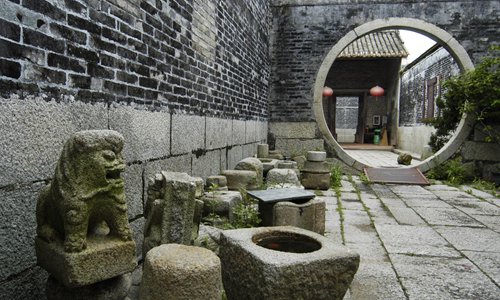
An alleyway in Dapeng village Photo: CFP
Dapeng villageThe 600-year-old Dapeng village, named after a giant bird from Chinese mythology, is located in the eastern part of Shenzhen.
It is about a one-hour drive from the Hong Kong border. Shenzhen's nickname is also derived from this giant bird, as the city looks like one of these giant birds from the air.
Dapeng village is an interesting place to visit as it was a key battlefield during the Opium Wars in the 19th century. The highlight of the village is a well-preserved fortress that was built during the Ming Dynasty (1368-1644) to defend Shenzhen and Hong Kong from Japanese invaders.
I recommend you to stop by the Dapeng Fortress Museum to have a bigger picture of the story, but you'd better do your homework about history before you go.
The residential houses in Dapeng village are typical Ming and Qing (1644-1911) dynasty-style homes. The quaint alleyways, narrow lanes and traditional houses are some of the biggest charms of this small Chinese village.
Sadly, the original inhabitants are almost gone. Most of them have moved to modern apartments "inside" the city. Most of the residents are now immigrants that have flocked to the village since the rent is cheap. Nevertheless, people are very nice to tourists and the street food is tasty.
The highlight of my trip was Xichong beach, the largest one in Shenzhen.
With a coastline stretching more than 133 kilometers, Xichong beach is famous for its soft sandy beaches and spacious environment. It has become a popular place to go surfing and sailing.
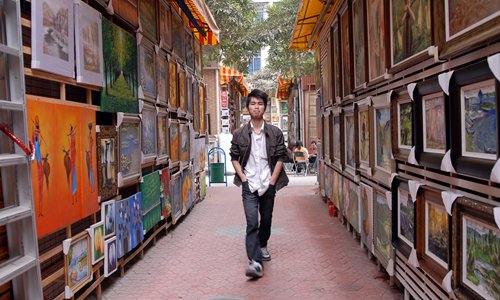
A man takes a walk through the Dafen Oil Painting Village in Shenzhen, South China's Guangdong Province. Photo: IC
Dafen Oil Painting VillageDafen Oil Painting Village is one of Shenzhen's landmarks. The name says it all. The village is not famous for its architecture or history, but its oil paintings. It is an internationally known village as artists there produce over 60 percent of reproduced paintings sold around the world.
The village is located in the suburb of Buji, Longgang district. You can get there by taking the subway directly to the Dafen Metro Station.
The village was founded by a Hong Kong businessman during the 1980s. After about a decade, the local government became involved and turned it into a cultural industry brand.
Technically speaking Dafen is not a village, but a few blocks of streets where they sell oil paintings and sculptures. It is smaller than Beijing's 798 Art District, yet bigger than Shanghai's M50.
There are more than 1,000 shops and 8,000 of painters living in the village, according to official statistics.
I'm sure you will stand in amazement as all the many paintings of Monet's Water Lilies or Da Vinci's Sunflower and other contemporary Chinese paintings. You will then probably wrestle with the question of whether or not you should buy something.
One thing you should take into account is that quality varies. Artists have to produce dozens of replicas on a daily basis to make ends meet, so quantity is definitely more important than quality.
As the global economy has softened, so too has the oil painting business in Dafen village fallen. In response, the painters have been shifting their focus from the international market to domestic market.
However, the central government's recent anti-corruption campaign has lead to a loss of orders from officials and luxury hotels.
Therefore, painters in Dafen are under pressure to do more than just copy the old masters, which has led to a rise in creativity.
If you don't like any of their paintings, you can bring a photo and ask a talented artist to reproduce it at any size you want. Just keep in mind it may take weeks to finish.
If you are looking for a piece of art to decorate your place, hotel or restaurant, a A-2 size painting is about 100-400 yuan.
Of course, feel free to bargain. Bargaining is like a national sport in China.
If you are good, you can cut down the price by 10-30 percent. Oh, don't forget to bring some yuan as its strictly cash only with these artists.
If you don't want to buy anything, you can spend an afternoon walking around and watching the artists paint inside the shops.
Talking with them might be a little bit challenging as their English is probably not all that great. You can also visit the local art museum, which is free of charge.
In addition, if you like art there are many ancient villages that have been transformed into art studios.
For example, the 300-year-old Dashuitian village located in the Bao'an district, which has a long history of print art, has been transformed into an industrial base for print art.
Rules of thumb
When to go: Shenzhen is located in a humid subtropical climate zone. It is humid, hot from June to early October, and warm and dry from January to February. As it is frequented by typhoons during the summer time, the best time to visit the city is from October to February.
Getting there:
Shenzhen is just a one-hour train ride away from Guangzhou, capital of Guangdong Province. There are multiple ways of getting there from Hong Kong, including the train, ferry and bus.
The best way is by the MTR subway.
Getting around:
Baguang village is located in Kuichong Township, Longgang district. Take bus 987 to Baguang port.
Dapeng village is located in Dapeng, Longgang district. Take buses H92 or E26, or take E11 to go directly to Dapeng Fortress.
