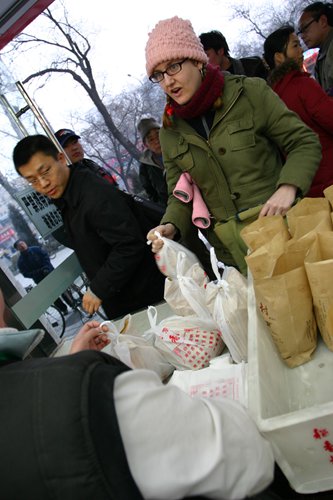
A foreigner buys yuanxiao in Beijing. Photo: Li Hao/GT
If you had to choose between sweet sticky rice balls and salty ones, which would you rather have?
Lantern Festival, the 15th day of the first month of the Chinese lunar calendar and the final day of Chinese New Year celebrations, is tomorrow, and people usually observe it with a traditional treat. Known as yuanxiao in North China and tangyuan in the south, the round and sticky rice balls symbolize the togetherness and happiness of families.
But despite the unity alluded to in the spherical treats, when it comes to the question of flavors, Chinese from different regions part ways. It's a case of north versus south, and yuanxiao versus tangyuan.
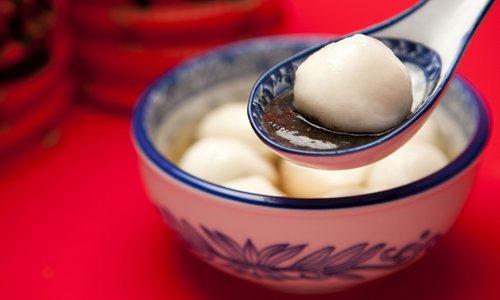
Yuanxiao are sweet and mostly filled with sesame, red bean or peanuts, while tangyuan are comparatively softer and can be either salty or sweet, with or without meat. There are also the seemingly "weird" flavors, such as fruits and flowers, and others like chicken with mushrooms or braised pork that further fuel the debate. Chinese social media lights up every year with debates on the topic.
A similar debate also goes on over whether rice dumplings for Dragon Boat Festival should be sweet like they are in the north or salty with meat inside like in the south. Other types of food that people fight over include tofu jelly and scrambled eggs with tomatoes.
Metropolitan invited some expats to join in the discussion and share their take on the traditional snack. What do Westerners living in China know about yuanxiao? Are they able to identify the filling when they bite into the treat? What is the most bizarre or exotic tasting yuanxiao they have tried? Metropolitan brings you their answers.

Foreigners learn how to make the traditional Lantern Festival treat, yuanxiao, from scratch. Photos: CFP, IC
Sweet treats all the way
A Beijing resident for more than two decades and founder of local fashion brand Plastered T-Shirts, 41-year-old Briton Dominic Johnson-Hill firmly stands with residents in the north in the yuanxiao/tangyuan "war."
"My heart is always in the north of China, so I will side with the north," he said.
Johnson-Hill celebrates the festival by eating sesame yuanxiao at home with his daughters.
"We always eat the sesame ones. We don't just eat them for the festival. We will probably eat them for a week after dinner as a dessert," he said.
"In my family, yuanxiao are always filled with sesame, or maybe red bean, but never chicken or pork. Yuanxiao are probably the most delicious Chinese dessert I can think of, especially in the north. They are soft and sweet, and when you bite in, the filling is warm."
According to Johnson-Hill, sometimes when people cook yuanxiao the skin breaks, and they will end up with some of the sesame filling in the soup, which makes it more delicious.
While still sticking to sweet treats, Beijingers are no longer satisfied with just the traditional flavors. More flavors, such as matcha tea, yogurt, durian, and jasmine flower, were created to cater to the city's adventurous foodies. Western fillings have also made a debut on the yuanxiao scene. One can get yuanxiao with fillings like chocolate, coffee and even cheddar cheese.
The Johnson-Hill family tried some yuanxiao with chocolate filling and loved the taste.
Yuanxiao components
The first time Saul Stollery, a 24-year-old Briton who lives in Beijing, tried the special Chinese treat he was a bit weirded out.
He had gone to a friend's hometown in Shantou, Guangdong Province for Spring Festival, and his friend's mother made a very special type of tangyuan.
"It was very sweet, and I liked it. Then they told me that it was made with bird spit, and I stopped eating," he said.
The tangyuan was prepared with the edible nest of swiftlets. The nests, which are made from solidified bird saliva, are a popular treat in China, especially in the southeast region of the country.
"I prefer the sweet ones," Stollery said.
On top of being influenced by Beijing's culture, Stollery's preference may also have something to do with where he is from.
"People in the UK often have a sweet tooth," he explained. "They like afternoon tea with desserts."
As the hot sweet filling runs out at the first bite, similar to a lava cake, it sometimes makes some foreigners wonder how the treat is made.
"Maybe pumping it in with a pipe?" Stollery said. "How else would you put the filling in? It's like the cream of a donut."
Johnson-Hill has no idea how yuanxiao are made either.
He reckons that it might involve putting the filling into flattened rice dough.
"And you roll it around in your hand. And then wave a magic wand and make it magical," he joked.
He was somewhat correct. The process does involve dough, at least. In the south, tangyuan are prepared with dough made from sticky rice flour, which is used to wrap it. However, in the north, the filling is thrown into a large container filled with flour and then rolled around many times so that it is evenly covered.
A circle of love
Szabolcs Diviki, chef de cuisine at Park Hyatt Beijing's China Grill restaurant, loves how sticky rice is used in many kinds of traditional Chinese snacks. He especially likes what sticky rice flour does to the taste buds.
"The tradition of making food with sticky rice symbolizes the family's sticking together," he said.
For him, such Chinese food traditions should be preserved.
The "sweet or salty" debate in China is similar to the sweet or salty popcorn debate in the West, except that it is not related to tradition, according to Diviki.
Just like the Chinese, expats like Diviki are also greatly influenced by where they live and who is in their family circle.
Diviki prefers his treat on the larger side with black sesame filling. He developed a liking for it from his Chinese wife.
In her hometown in Wenzhou, Zhejiang Province, the sticky rice balls are prepared in slightly larger sizes. They are yellow instead of white because they are covered in soybean powder and are served without the soup.
A festival of great significance in the Chinese culture, the Lantern Festival traditions include eating yuanxiao or tangyuan, going to temple fairs, solving riddles written on lanterns, and, for children, carrying paper lanterns at night.
Johnson-Hill always tries to put an expat's perspective into the Chinese culture that he loves. Every year, for the festival season, he produces special Chinese Spring Festival T-shirts, for example, ones with traditional Spring Festival food like dumplings, brazed meat balls in gravy, or a rooster for the Year of the Rooster, and during Lantern Festival, he gives free yuanxiao to customers who visit his shop.
For veteran expats like Johnson-Hill, enjoying some good old sesame yuanxiao is a must for enjoying the ambiance of the festival season.
"For Westerners who are sometimes disappointed with Chinese desserts, this is a Chinese dessert that will not disappoint you," he said.
"Yuanxiao are the Rolls-Royce of Chinese desserts, and if you eat them during Lantern Festival, hearing the fireworks go off outside, it's the ultimate experience."
