
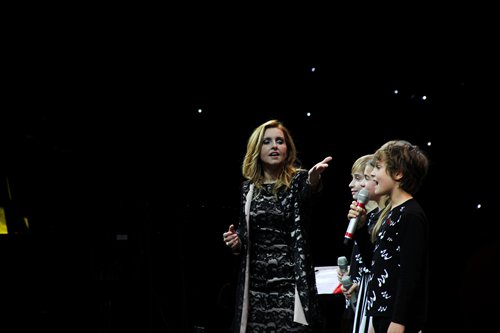
Simoni leads members of the Little Choir at the Shanghai Children's Art Theatre on January 1. Photo: Shan Jie/GT
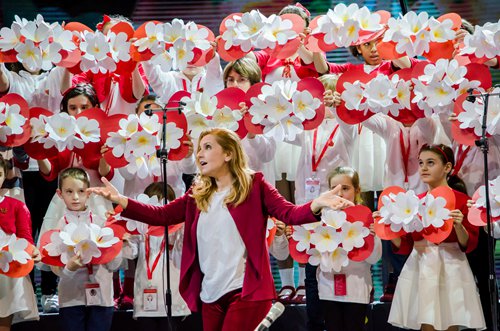
The Little Choir of Antoniano, directed by Sabrina Simoni (center), rehearses at the Shanghai Children's Art Theatre on December 30. Photo: Courtesy of Liu Yanhan
At the end of January, Italy's Little Choir of Antoniano announced on its official website that it would be returning to China in January 2018. The announcement follows the success it had with several concerts held in China early that month.
"It was different from other performances. I want to come again," said a 5-year-old audience member after a concert held by the choir on January 7 in Beijing. Another young audience member cried because he wanted to hear more music.
Since their first New Year holiday performance in China in 2016, the choir has been a big hit in China. The choir's success, however, extends beyond well-received performances, the choir's unique ideology and methods of training its young performers have also been studied and imitated by Chinese professionals over the past years.
Language of music
The Little Choir of Antoniano, the most famous children's choir in Italy and the Good Will Ambassador for the United Nations International Children's Emergency Fund, was established in 1963 and currently has 66 members between the ages of 4 to 13. Through its history, the choir has recorded some 1,000 songs, toured throughout Europe and taken part in TV and radio broadcasts.
After the great success the choir had with its first tour in Shanghai in January 2016, the choir held six concerts at the Shanghai Children's Art Theatre and two at Beijing's Tianqiao Performing Arts Center in January 2017.
Different from the most children's choirs that usually perform religious and folk songs on their tours of China such as the famous Vienna Boys' Choir and the Little Singers of Paris, the Little Choir of Antoniano sing children's songs for young audiences.
Their program includes songs about a plastic dinosaur toy, a vegetarian zombie and Granma Pina's noodles. The fun and amusing lyrics are sure to take any young child's mind away from the pressures of school.
"The concerts were extremely popular. The tickets for the six concerts in Shanghai sold out in two days. As for the Beijing concerts, even though that was the first time the choir visited, the tickets sold out in only a month," Liang Xiaoxia, general manager of the Shanghai Children's Art Theatre, told the Global Times on February 8.
Bringing the choir to China was no easy task, nor was it cheap. Since the choir members are all very young, each of them needed to be accompanied by a parent.
Language barriers were also a problem.
"For this reason, we recruited some volunteers," Liang said.
"I felt welcome and comfortable [performing in China]. It was exciting to sing in big theaters full of children and, at the end of the concerts, to give them high fives and take a lot of pictures with them," said 7-year-old Emanuele on February 3, one of the members of the choir.
Due to privacy concerns, the choir did not provide the full name of members or their family.
"I really think that music, singing and emotions are languages that embrace us all," Sabrina Simoni, director of the Little Choir as well as a children music educator, told the Global Times on January 19.
"In the future, we would like the Little Choir's concerts to come to our theater every year. Moreover, we will also cooperate when it comes to art education," Liang said.
Following in their footsteps
"Children choirs should give children the opportunity to grow up harmoniously and culturally with music," Simoni said. "Meanwhile, children also learn the value of rules and commitment."
Singing well in a choir is one thing, being capable of overcoming the small or large obstacles that life brings is another, Simoni noted.
"Singing, the choreography, being with friends and discovering new countries and new people are all the best parts of becoming a member of the Little Choir," said Emanuele, who has been in the choir since 2013.
"The choir is not only a singing school but also a school of life. [It involves] compliance with the rules, discipline and above all, being together," Isabella, Emanuele's mother, told the Global Times on February 3.
"It's nice to see a bunch of very different aged children who share everything," said Isabella, adding that the children's experience with the Little Choir also enriches parents as they too have a part to play.
The choir's singing come across as more natural as teachers pay more attention to the intonation and rhythm of the little singers during training, instead of focusing on singing techniques like most classical children's choirs do, according to Liang Ying on Thursday, a professor of vocal music from the Shenyang Conservatory of Music in Northeast China's Liaoning Province.
"Based on the age of the child, I teach them how to use their voice, to understand the meaning of the songs and to listen attentively to others," Simoni said, adding that she often tells children in the choir that each of their voices is unique and irreplaceable.
"In terms of children's music education, the children in the Little Choir have joined because they are interested in it, whereas in China what a child learns is usually determined by what the parents like," Liang Ying noted.
In an attempt to learn from the Little Choir, Liang Ying has founded the Children's Choir of Brilliant Stars in Shenyang. Making use of many of the methods from the Little Choir, the children learn both Chinese and Italian children's songs.
Similar choirs, from school level to provincial level, have also appeared in other parts of China, such as Shanghai and East China's Jiangsu and Shandong provinces. Some of them have even modeled their uniforms on those of the Little Choir of Antoniano.
"There is a lot of room for Chinese children's music, since the starting point is low. Also, it could be a part of quality education that should enjoy the support of policy," Liang Ying noted.
