In the evening of May 16, Thomas Michael Keneally, author of Schindler's List, delivered a lecture at Shanghai Library. As a highlight of Australian Writers Week, held between May 10 and May 18, the lecture discussed the behind-the-scenes research and writing of the best-selling novel.
During World War II, Nazis carried out a holocaust against Jews in Europe. Oskar Schindler, a Nazi Party member, saved 1,200 Jews from concentration camps. Inspired by Poldek Pfefferberg, a Holocaust survivor, Keneally published the Booker Prize-winning novel in 1982.
Steven Spielberg adapted it into a highly successful film in 1993, which won an Academy Award for Best Picture. During the lecture, Keneally said he felt he had to write the novel in a very clinical and neutral way.
"It was inappropriate to use a lot of adjectives, because adjectives are not enough to catch the full horror, like what is now happening in Syria," he said. "To say they are murders, barbarians, shameful, brutal, can hardly describe how bad things are."
Mary Gao, a postgraduate student studying Australian literature in Australian Studies Centre of East China Normal University, attended the lecture and said she has watched the movie many times because, although World War II is in the past, similar conflicts are still happening. "Schindler's story can help us avoid going astray by reviewing the past. This is what lies in the persistent influence of classic literary works," said Gao.
The Global Times spoke with Keneally before his lecture to discuss his approach to writing the novel.
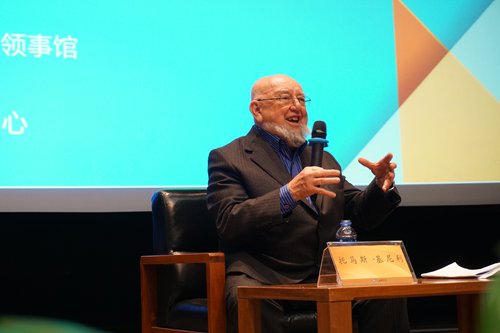
Thomas Michael Keneally, author of Schindler's List, delivers a lecture at Shanghai Library.
GT: Spielberg purchased the rights to Schindler's List and made it into a movie. Do you think the adaptation was faithful of the novel?
Keneally: In so far, as it shows how ambiguous the motivation of Schindler was, it is very successful. But the problem with the movie was that it couldn't put in all the interesting things, not even in three and a quarter hours. Spielberg had to concentrate on just some aspects of Schindler. But that is the nature of film, and within these parameters, it is very good.
GT: We see many paradoxes in Schindler. He was a Nazi, a munitions manufacturer, yet he saved many Jews. What brought about Schindler's change? Was the transition a reflection of humanity?
Keneally: From the beginning he wanted to be rich, but he didn't want to kill anyone on the way to getting rich. In addition to manufacturing, he became wealthy in the black market. If I had been making the film, I would have put a bit more in on his extensive black marketeering. He was also easygoing in nature; a genial man. He didn't want the SS to come into his factory and mess with people, which was partly due to his self-interest in black marketeering.
GT: Was saving Jews a self-salvage for Schindler?
Keneally: I don't think he thought of it that way. But now he is remembered as a rescuer. He was kind, but it was a pain to his wife when he left her after the war because he wasn't a hero to her like he was to the prisoners. So the movie turned him into a contradictory hero.
GT: What was the hardest part about writing this novel?
Keneally: I only wrote a certain number of words per day, but the stories involving survivors and the horrors that they went through remained with me in my subconscious. I started to have nightmares and get depressed. One of the reasons I wrote it was I wanted to dig out questions like, would I have done something like that had I been in that situation? Could I have been a Nazi who kills? I wasn't raised to hate Jews, but what if I was raised to hate Jews?
GT: Do you know of John Rabe, the German who saved 250,000 Chinese from being killed by the Japanese in the War of Resistance against Japanese Aggression? Chinese regard him as China's Schindler.
Keneally: I know about him. I think Rabe was probably a better-behaved human than Schindler. He was less involved in the black market. Also, the Japanese diplomat who issued forms for Jews to help them escape to Japan during World War II was admirable as well. They are all kind and have big hearts.
GT: Many of your works are reworkings of historical materials to try to figure out the mentality of a person who experienced major historical events. Why are you interested in such stories?
Keneally: I think they reflect upon the present. Racial hatred has not diminished. There are still so many refugees today. The tyrants helped create the refugees, but the West helped create them too by taking part in silly wars like that against Iraq, Vietnam and Afghanistan. I think all Western countries should get together and work out how to deal with it. Angela Merkel of Germany is trying to do so, which is remarkable. There are millions of refugees trying to get into Europe. They are going to have to take them in and work it out.
GT: What do you think we can learn about refugees from Schindler's story?
Keneally: We are all one species and we are on a human journey, which sometimes leads us to make life simpler, to stereotype a particular group and say they are blamed for everything. Hitler did that in the 1930s. Politicians should refrain from doing it now, but right-wing leaders in the West just want to stereotype Asians and attack newcomers. There are so many forces uniting us yet so many forces dividing us. We have to be united in various ways.
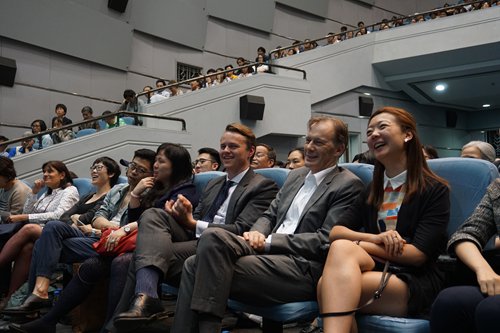
Graeme Meehan (second from right), Australian Consul General in Shanghai at the lecture
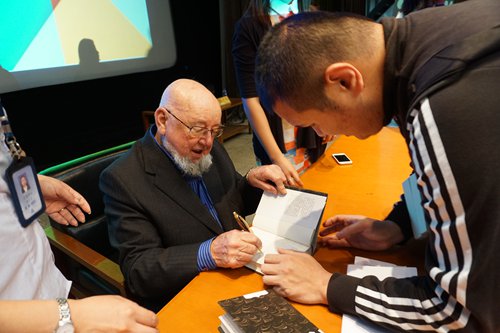
Keneally signs for readers. Photos: Chen Shasha/GT
