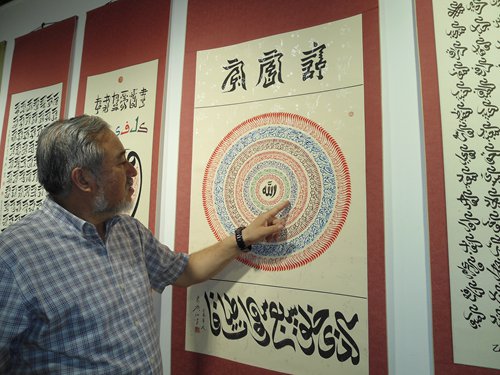
Haji Noor Deen Mi Guang Jiang introduces one of his artworks. Photo: Mukesh Sharma
As artists' hands paint the fusion of two civilizations, their axe-shaped brushes run over paper to weave a maze of Arabic and Chinese characters that spell out messages of peace and harmony.
"This one means love," says Haji Noor Deen Mi Guang Jiang, about one of his works that looks like a magnified image of some biological specimen. A number of artworks by his wife featuring curls and curves on vertically placed canvases also adorn the gallery. Fatima Cao Yiying's fluent Arabic and her calligraphy of passages from the Koran would have you believe the Chinese artist is from an Arab country.
The cultural fusion, known as Sini Calligraphy, has an appeal that beats many other pursuits.
Five Chinese calligraphy artists exhibited their creations in Qatar's capital Doha from May 15-20. Their skill in combining Arabic and Chinese scripts to produce beautiful ink on paper artworks enthralled Qataris and expatriates alike in the Gulf country.
Their exhibition offered a unique interpretation of Arabic calligraphy using Chinese styles. Comprising 60 works of calligraphy using traditional Chinese ink, each art piece had its own story to tell - from religious verses to salutations of peace.
Ma Guoli, Hu Baoguo and Teng Zhifa were invited along with Noor Deen and Fatima to Doha's hub of culture - the Katara Cultural Village, which sits next to the Persian Gulf.
Meters from the shore, the group of five taught calligraphy enthusiasts how to hold a brush and run it over paper with movements that produced both thick and slim strokes. Lines and curves overlapped to form entire structures that look integral yet disparate. As Noor Deen and his wife went about instructing the learners at the workshop, two other artists showed visitors how to use brushes made from horse hair to paint calligraphy on paper folded into blocks.
"The wooden brush with a cloth tied on it with thread is used for Arabic script, while the other [horse hair]brush is used in Chinese calligraphy," said Noor Deen, who is also fluent in Arabic. Based in Zhengzhou in Central China's Henan Province, the 54-year-old artist has held workshops and delivered lectures at Harvard University, Cambridge University and the Massachusetts Institute of Technology (MIT).
Noor Deen said he likes Doha but is unsure when he will be able to return for another exhibition.
The writer is a Doha-based journalist
