METRO SHANGHAI / METRO SHANGHAI
Growing number of foreign students in Shanghai learning Chinese writing
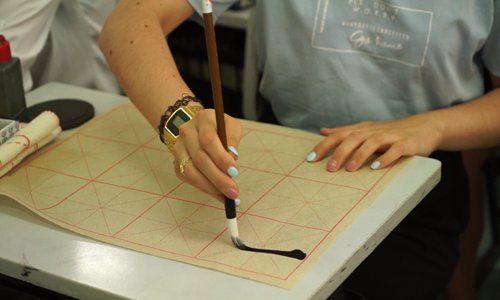
Chinese calligraphy, an ancient writing art, has developed various styles throughout the history of China. As a valuable and unique part of local culture, it continues to attract handwriting enthusiasts domestically and abroad even in the face of technological advances and digital alternatives to ink.
Something to write home about
Several international students from Shanghai International Studies University recently shared with the Global Times their experiences learning Chinese calligraphy.
"You have to take it as something relaxing, and don't get stressed," said María Alabarces Jiménez from Spain, who has been learning Chinese language and its writing for four years at an official language school in Málaga, Spain.
Jiménez's school has been promoting Chinese culture and providing Chinese calligraphy lesson via a teacher from Peking University. She started learning Chinese just for fun at the very beginning, but now hopes to make it her profession.
"Different from other languages, Chinese learning requires a longer period to go deeper into its culture, so as to understand how to improve," said Jiménez. "Learning Chinese calligraphy is quite difficult, so I have to pay attention to the order, ink, pressure and direction of the strokes. If I put too much pressure on the brush pen, then the stroke will be terrible."
For her, the most difficult part is to make a twist with a brush pen, which requires proper strength, speed and ink, but she believes more practice will improve that. "I myself want to teach Chinese in the future, so I have to study very hard."
Jiménez said she is the only person in her family learning Chinese, but people who know her keep asking questions about it, which demonstrates the growing global interest in all things China. "So I encourage them to approach Chinese culture, showing them how I write," she said.
Feel its soul
Yassine Hanane from Morocco encountered the same problems as Jiménez. When he started studying it one year ago, he found it was difficult to learn Chinese calligraphy, as it was hard for him to remember the sequence of strokes and hold the brush stably.
"Chinese and Arabic are totally different, but I will try to introduce it to my people," he said.
Đang Pooh from Vietnam has also been learning Chinese calligraphy for one year. His school provides optional courses, so he joined just as a hobby. "I think calligraphists are very cool; I have been dreaming to be one since I was a child," said Pooh, whose teacher told him during his first calligraphy class that he had a natural gift.
"Although less people are doing it now, many young people (in Vietnam) are interested in it," he said. "We have a tradition to visit a calligraphist every Spring Festival and ask for a traditional Chinese character written in calligraphy, then paste it on our wall," he said.
For Pooh, the most challenging part is to concentrate. "In Chinese calligraphy, one can do creations and make it like a painting. When you look at a piece of calligraphy, you can even feel the soul of it," he said.
Learning conscientiously
Rada Trunova from Russia is studying world economy but taking Chinese calligraphy for fun. "I found it is difficult because it is hard to keep my hand in one position all the time, but finally I can achieve beautiful hieroglyphs."
"I think learning calligraphy is a good way to improve Chinese writing and know Chinese culture better," Trunova said. Serafima Osipenko, also a student from Russia, agrees. "I have been learning Chinese (language and writing) for a long time, and I want to study Chinese history and culture. I think calligraphy can help me do it," she said.
"Russian uses an alphabet, complicated grammar and vocabulary, so we don't have such art. But I think in ancient times we did, because when we decorated a book, we used a special drawing to turn letters into particular shapes such as flowers," she said.
Yu Zhen, who teaches international students Chinese calligraphy as an optional course at her university, said that her students are learning it conscientiously. "They persist till the course ends, which means they are really interested," she said.
"Cultures are interlinked, but still there are differences. Students from Japan and South Korea can get used to the writing quickly, while European students, despite a tough start, have a strong interest because Chinese language is a totally different style (than theirs)," said Yu.





Something to write home about
Several international students from Shanghai International Studies University recently shared with the Global Times their experiences learning Chinese calligraphy.
"You have to take it as something relaxing, and don't get stressed," said María Alabarces Jiménez from Spain, who has been learning Chinese language and its writing for four years at an official language school in Málaga, Spain.
Jiménez's school has been promoting Chinese culture and providing Chinese calligraphy lesson via a teacher from Peking University. She started learning Chinese just for fun at the very beginning, but now hopes to make it her profession.
"Different from other languages, Chinese learning requires a longer period to go deeper into its culture, so as to understand how to improve," said Jiménez. "Learning Chinese calligraphy is quite difficult, so I have to pay attention to the order, ink, pressure and direction of the strokes. If I put too much pressure on the brush pen, then the stroke will be terrible."
For her, the most difficult part is to make a twist with a brush pen, which requires proper strength, speed and ink, but she believes more practice will improve that. "I myself want to teach Chinese in the future, so I have to study very hard."
Jiménez said she is the only person in her family learning Chinese, but people who know her keep asking questions about it, which demonstrates the growing global interest in all things China. "So I encourage them to approach Chinese culture, showing them how I write," she said.
Feel its soul
Yassine Hanane from Morocco encountered the same problems as Jiménez. When he started studying it one year ago, he found it was difficult to learn Chinese calligraphy, as it was hard for him to remember the sequence of strokes and hold the brush stably.
"Chinese and Arabic are totally different, but I will try to introduce it to my people," he said.
Đang Pooh from Vietnam has also been learning Chinese calligraphy for one year. His school provides optional courses, so he joined just as a hobby. "I think calligraphists are very cool; I have been dreaming to be one since I was a child," said Pooh, whose teacher told him during his first calligraphy class that he had a natural gift.
"Although less people are doing it now, many young people (in Vietnam) are interested in it," he said. "We have a tradition to visit a calligraphist every Spring Festival and ask for a traditional Chinese character written in calligraphy, then paste it on our wall," he said.
For Pooh, the most challenging part is to concentrate. "In Chinese calligraphy, one can do creations and make it like a painting. When you look at a piece of calligraphy, you can even feel the soul of it," he said.
Learning conscientiously
Rada Trunova from Russia is studying world economy but taking Chinese calligraphy for fun. "I found it is difficult because it is hard to keep my hand in one position all the time, but finally I can achieve beautiful hieroglyphs."
"I think learning calligraphy is a good way to improve Chinese writing and know Chinese culture better," Trunova said. Serafima Osipenko, also a student from Russia, agrees. "I have been learning Chinese (language and writing) for a long time, and I want to study Chinese history and culture. I think calligraphy can help me do it," she said.
"Russian uses an alphabet, complicated grammar and vocabulary, so we don't have such art. But I think in ancient times we did, because when we decorated a book, we used a special drawing to turn letters into particular shapes such as flowers," she said.
Yu Zhen, who teaches international students Chinese calligraphy as an optional course at her university, said that her students are learning it conscientiously. "They persist till the course ends, which means they are really interested," she said.
"Cultures are interlinked, but still there are differences. Students from Japan and South Korea can get used to the writing quickly, while European students, despite a tough start, have a strong interest because Chinese language is a totally different style (than theirs)," said Yu.
International students from Shanghai International Studies University learn Chinese calligraphy.
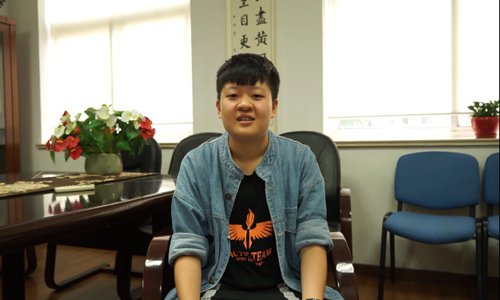
Yassine Hanane
María Alabarces Jiménez
Ðang Pooh
Rada Trunova
Serafima Osipenko
Yu Zhen (right) teaching students
Photos: Global Times
