
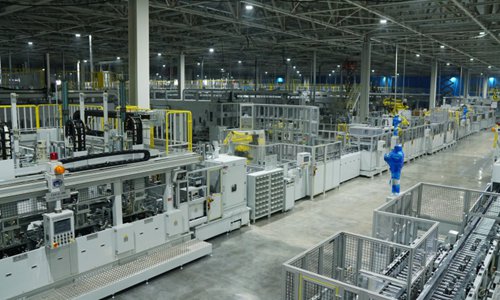
A view of Beijing Hyundai's new factory in Southwest China's Chongqing Photo: VCG
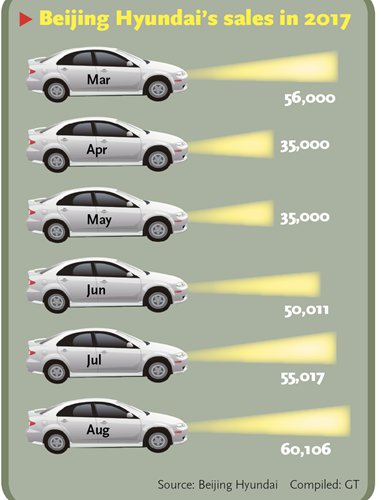
Graphics: GT
China's BAIC Motor Corp is fed up with its South Korean partner Hyundai Motors Co's "greed and arrogance" over a supplier issue for Beijing Hyundai Motor Co that has persisted since the two formed a joint venture (JV) more than a decade ago but recently the bickering became public amid sharp sales declines, sources familiar with the situation said.
"Officials at BAIC are very determined to solve the issue once and for all, even if that might risk losing the JV," an industry insider, who is in close contact with both BAIC and Beijing Hyundai, told the Global Times on Wednesday. Beijing Hyundai has become a burden for BAIC, which otherwise is doing great, so the company is "well-positioned" to deal with this, the insider said.
The issue centers on whether the JV should switch suppliers to local Chinese companies to cut costs amid sharp sales declines and fierce competition - the solution favored by BAIC - or stick to the current suppliers, mostly South Korean firms, some of which have direct or indirect financial ties with Hyundai Group.
Neither BAIC nor Beijing Hyundai could be reached for comment as of press time on Wednesday.
The disagreements became public after Beijing Hyundai suspended production at four different plants in China due to payment arrears to suppliers.
On Tuesday, just days after the firms said that those four plants had resumed production, new reports said yet another plant in China had been closed.
"Like every fight between companies, the core issue is protecting their own interests," one source said. But in this case, "Hyundai is too greedy," the source said.
"Frankly, I think BAIC is fed up with Hyundai's greed and arrogance," another source, who is close BIAC, told the Global Times Wednesday. "Hyundai has basically traded the JV for its interest in suppliers."
Both sources refused to be named because of the sensitivity of the issue.
According to one of the sources, the problem dates back to 2002 when the JV was formed. At the time, the South Korean firm insisted that Beijing Hyundai would use the company's long-time suppliers.
As one of many Chinese companies that were hungry at the time for foreign partners, BAIC agreed to the deal. Though the JV is a 50-50 partnership, Hyundai remained the decisive force within the company, the source said.
"There are about eight or nine vice presidents in the JV, but only one is Chinese and is usually in charge of sales," the insider said.
He said even children of Hyundai's executives were placed at Beijing Hyundai and "often behaved inappropriately at the company and disrespected their Chinese colleagues. It got so terrible that it became well-known in auto circles."
Still things went well for years as the partners enjoyed skyrocketing sales, but it turned sour when sales started to fall this year.
Beijing Hyundai's sales plunged nearly 30 percent in the first seven months of the year to 415,000 units, though improvements were seen recently, according to data from the China Passenger Car Association.
Following the sales drop, BAIC proposed to cut costs by switching to local suppliers as part of a localization strategy, but that was met with a firm pushback from Hyundai, which insisted on keeping the current suppliers for at least a few years. Those suppliers include Hyundai Mobis, a subsidiary of Hyundai Group.
"What happened was that as sales fell, BAIC's profits got hit but Hyundai still made money from its suppliers," one source said. "Obviously, that won't do with BAIC."
Apart from the high cost, miscalculations at Hyundai about the Chinese market also contributed largely to the sales woes in China, according to the sources.
"Hyundai is probably the only foreign automaker that doesn't bring its newest cars to China immediately," said one source who closely follows Hyundai's product updates. "[Hyundai executives] underestimated the pace at which consumers would want new models in China."
The source added that Chinese consumers who can afford better cars go for German brands, while for those on a tight budget, there are many foreign and domestic brands to pick from.
"South Korean brands have no established competitive edge. Their best advantage was cost, but that's gone for Hyundai because of its relatively high prices. And with their strategic mistakes, it just doesn't look good for them," the source said.
