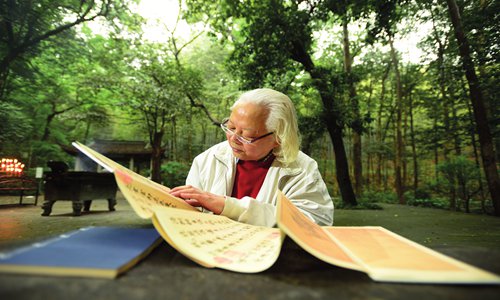
Artist Wu Shanming Photo: Courtesy of Wu Shanming
Introduction to the artistWu Shanming was born in 1941 in Pujiang, Zhejiang Province. He is a professor of traditional Chinese painting at the China Academy of Art where he also serves as a doctoral supervisor.
Wu is also the deputy head of the traditional Chinese painting faculty at the Chinese Academy of Painting, and president of the Hangzhou Artists Association. He is an expert in his field and enjoys a special allowance from the State Council.
He was also a deputy of the 8th National People's Congress and a member of the 9th and 10th People's Congress Standing Committee of Zhejiang Province.
Wu's artworks can be found in institutions such as The National Art Museum and the University of Oxford.
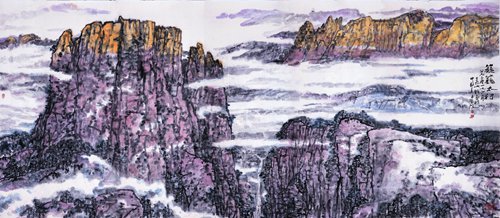
Wei Wei Tai Hang
Before the two sessions, the National People's Congress (NPC) and the National Committee of the Chinese People's Political Consultative Conference (CPPCC) in 2017, Wu Shanming, a professor and doctoral supervisor at the China Academy of Art, was invited to create a giant traditional Chinese painting which later became known as Wei Wei Tai Hang.
Talking about the creation of the work, Wu said that he took some students to Taihang Mountain to sketch from nature in 2015. The trip excited him. He had known that the mountain was one of the most important revolutionary bases in China during the War of Resistance against Japanese Aggression (1931-45) but had never imagined that the scenery could be that beautiful.
"I felt the magnificence of Taihang Mountain deeply," Wu said. "The towering mountain signifies China's national spirit and can represent China's great landscape."
Wu said while sketching on the mountain, it came to mind how important Taihang Mountain was to the revolution that happened in China. The revolutionary base had moved from Yan'an in Shaanxi Province to the Taihang Mountain area. After that, the revolution went on to victory. The move was viewed as a significant turning point in the Chinese revolution.
"I witnessed the local hospitality in the mountain area. People living there had contributed and sacrificed greatly for the Chinese revolution and the Chinese people," Wu said. "They are still very kindhearted, simple and honest, and they welcomed us artists warmly, which made us feel their positive energy all the time."
To pay homage to the two sessions, the Great Hall of the People sent a letter to the China Academy of Art requesting that Wu create a giant painting for the conference hall. After careful consideration, Wu chose to paint Taihang Mountain. He chose the most beautiful scenes and elements from his trip and carefully created the piece.
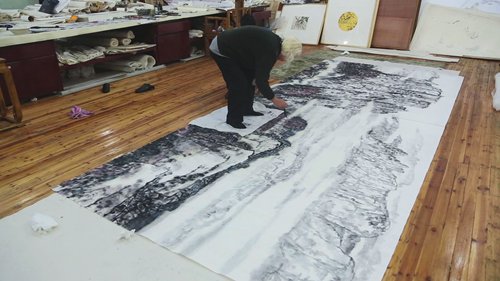
Wu paints the mountain's reddish brown rocks.
"Taihang Mountain is very special because under the morning sun the mountain becomes shiny with reddish brown rocks," he said. "To represent the golden and rosy appearance of the rocks, I mixed red color into thick black ink, making the background shine in the color of gold."
The brushwork on his painting is powerful. The strokes represent the lush and thriving plants and the majesty of the mountain. Wu also used a lot of purplish red. The colors are an almost exact reproduction of those in the photos his students took while sketching on the mountain.
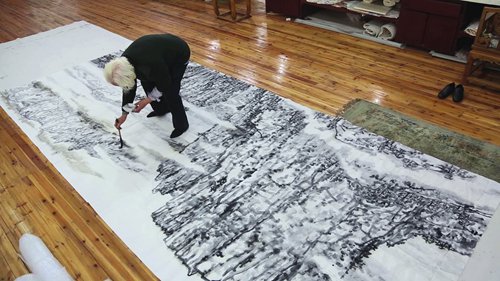
Wu's brushwork is bold, powerful and detailed.

Wu uses thick black ink to paint Wei Wei Tai Hang.
"I have great feelings for this work," Wu said. In the beginning, he thought about using dry brushes to paint the mountain but soon found that it would be better to use thick black ink.
Wu is a very famous contemporary portrait painter. He contributed greatly to the development of China's portrait painting. He broadened the vision of traditional Chinese painting, ushering it into a new era.
Wei Wei Tai Hang is the second most important themed work produced by Wu that focuses on landscape. The first one was Xing Xing Zhi Huo, Ke Yi Liao Yuan in 1970, which is in the collection housed at the Military Museum of the Chinese People's Revolution.

Wu is a meticulous painter.
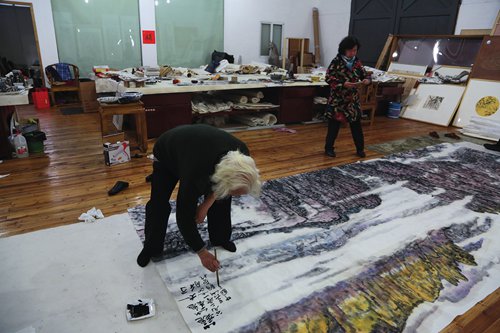
Wu inscribes on his painting.
Wu's notes in Ke Tu Yu Lu
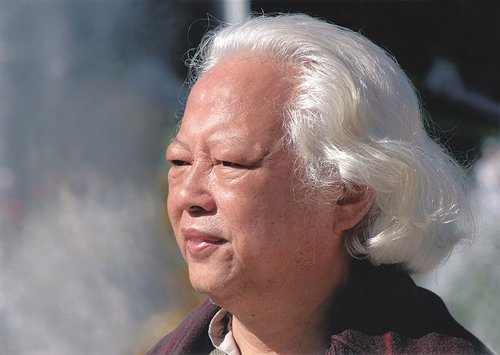
Wu Shanming
Traditional Chinese painting is a kind of art that has a strong personal style.Two types of painters will become well-known in this field, one is painters with famous works and unique styles, and the other is creative and innovative painters.
There are numerous of kinds of painting in different countries and regions around the world, but the styles are all similar. From the prehistoric drawings found during archaeological digs to date, the formats look largely identical with minor differences.
It is the same reason children's paintings are almost the same around the world.
The art masters in the East and West also have a similar understanding of what constitutes the essence and law of art.
To form a unique painting style and form, an artist should keep working, studying and self-cultivating for years. It takes time for artists to study the styles and prepare themselves to develop their own unique styles. They also need clear goals, basic painting skills and an appreciation and understanding of beauty.
Finally, purification of painting language is the only route to forming a unique style for artists. The purification is achieved after constant integration and recreation in art.
