
Chen Jialing Photo: Courtesy of Chen Jialing
Introduction to the artist
Chen Jialing was born in Hangzhou, Zhejiang Province in 1937 and graduated from the Zhejiang Academy of Fine Arts. He later became a professor at the Fine Arts College at Shanghai University in 1983.
Chen staged solo and joint exhibitions in over 20 countries and regions around the world, including the US, Germany, Japan, Hong Kong and Taiwan, between the 1980s and 2006.
In 2016, several of his works were displayed at the G20 Hangzhou Summit.
China's National Museum in Beijing witnessed the monthlong Chen Jialing Art Exhibition in September. A showcase of fine art by a renowned artist, the exhibition gained attention from people both at home and abroad for its elaborate painting techniques and diverse themes.
The four-part exhibition showcased the 80-year-old Chen's journey over the past decades, ranging from Yan'an in Shaanxi Province to Taihang Mountain and later West Lake in Hangzhou, Zhejiang Province. Combining traditional Chinese ink wash painting with traditional craft such as ceramics and silk cloth, Chen expresses the spirit of peace and development of contemporary times through his art, reflecting his love for his motherland, hometown, peace and life.
"I have been closely following the pulse of the times," said Chen in summarizing his body of work over the past five years. This year was the second time that Chen's exhibition was staged at the National Museum, which is widely considered as a stage of honor for artists.
Chen was a student of a string of Chinese painting masters, including Pan Tianshou (1897-1971) and Lu Yanshao (1909-1993). He also worked as a lecturer at the Fine Arts College at Shanghai University before gradually establishing his international fame in art circles. In 1984, his painting Kai Fang De He Hua (Lotus Coming Out) was awarded for "Excellent Work" in the seventh China National Exhibition of Fine Arts, the most celebrated exhibition for fine art in China. He won a silver medal for his work He Hua (Lotus) at the same event five years later.
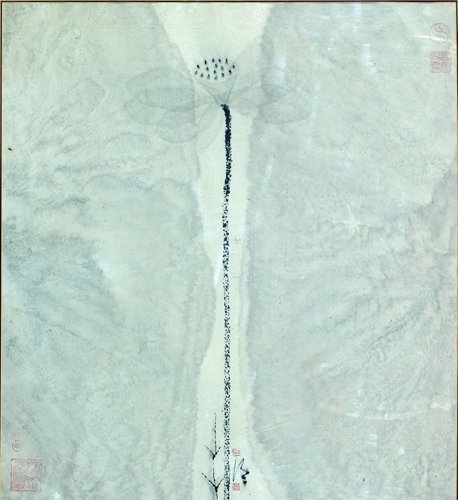
Bu Ran (Unstained)
Chen's paintings are distinguished in a way that highlights calligraphic and decorative elements in traditional Chinese paintings. He restructures the narrated objects' core elements and brings Eastern aesthetic features into the works, creating a unique approach to expression that has a strong sense of modernity.
Chen's creations started to draw international attention decades ago. American art critic Joan Lebold Cohen compiled Chen's artwork and systematically analyzed Chen's artistic philosophy in her book The New Chinese Painting 1949-1986 (1987). Chen's work Xia Guang (Skyglow) and Chinese painter Chen Yifei's work titled Duo Bu (Strolling) were described as the most distinctive and representative of artwork their time in the book and were used on the front and back covers respectively.
In recent years, Chen's artworks have won him global prestige in various exhibitions both in China and overseas.
Following the times
Chen's exhibition was first shown at the National Museum in 2013, one year after the 18th National Congress of the Communist Party of China (CPC). His second staging coincided with the year of the 19th CPC National Congress, just weeks before the meeting was due to open.
"Intentionally or not, I have always followed the rhythm of the time," said Chen, who has been recording the development of the country through his paintings. Over the past four years, he attended numerous events, including the exhibition to commemorate the 120th anniversary of Mao Zedong's birth, the Hangzhou Chinese Painting Biennale and the 2016 Chinese Contemporary Arts and Crafts Biennale. He also created artworks for national and international high-end events, such as the APEC Summit in Beijing in 2014 and the G20 Hangzhou Summit in 2016.
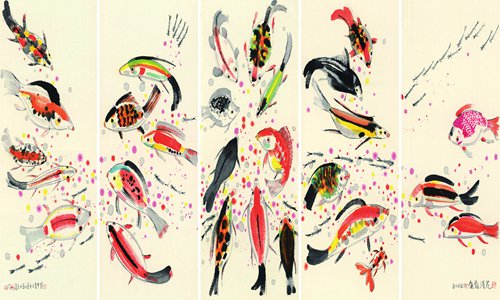
Hua Gang Guan Yu (Viewing fish at Flower Harbor)
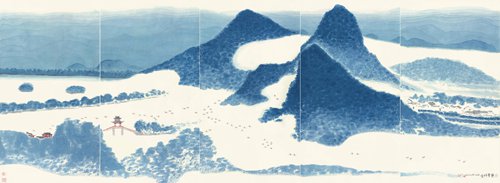
Shuang Feng Cha Yun (Twin Peaks Piercing the Cloud)
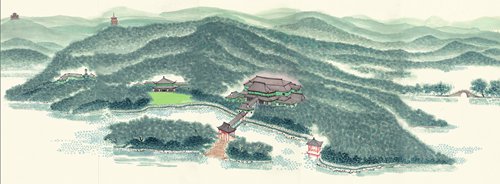
Xi Hu Jing Se (West Lake Landscape)
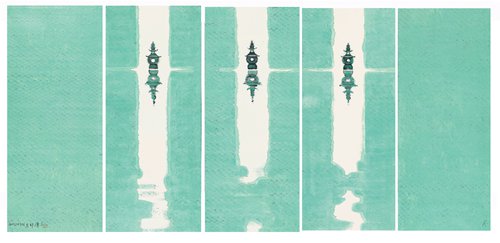
San Tan Yin Yue (Three Pools Mirroring the Moon)
Over the years, Chen has never stopped creating. He also participated in the production of the documentary Chen Jialing, which portrays his life and pursuit of art. The documentary received multiple awards overseas, and Chen was crowned a cultural ambassador at the Hawaii International Film Festival in 2015.
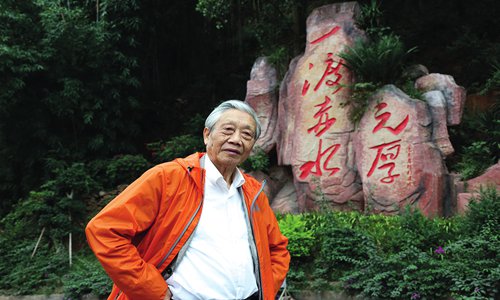
Chen Jialing Photo: Courtesy of Chen Jialing
Where it all began
The December of 2013 witnessed the 120th anniversary of Mao Zedong's birth. Encouraged by his friends, Chen traveled to Jinggang Mountain in Jiangxi Province, home to the CPC's first rural revolutionary base, and Shaoshan in Hunan Province, Mao's hometown.
"I still remember the first time I visited there nearly half a century ago when I was a young man who just graduated and started to work. Looking back, I feel very grateful for everything that the experience has given me," said Chen.
The Jinggang Mountain and Shaoshan were where Chen started to paint from nature. The landscapes carry many of Chen's memories from his youth. In the 1960s, Chen worked for the Fine Arts College at Shanghai University, and the college organized a school trip where young teachers went to Jinggang Mountain and Shaoshan by foot. The trip took more than a month, and those who were too tired to walk took transportation. But Chen insisted on walking all the way and reached the destination with a sense of having been on pilgrimage because the place played an essential role in the history of new China.
"That was a trip full of fun memories. I still remember the scene when we swam across the Tonglu river in Zhejiang Province to get to the other side. But now, the local development is enormous, and the society has progressed a lot," Chen said. Revisiting spots and encouraged by the big changes and local development, Chen painted Jinggang Mountain, which received accolades in art circles for its unique and rich-colored depictions.
"The painting reflects the spirit of the times," said Chen. "The spirit, vitality and passion of Jinggang Mountain will be passed on through generations."
