Illustration: Lu Ting/GT
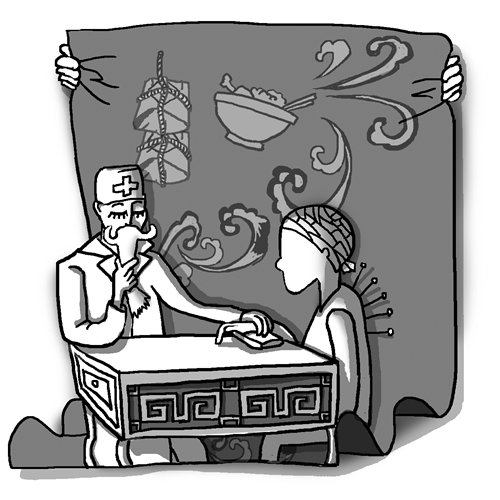
Even though I didn't expect a very hygienic clinic when my mother said we were going to take my grandfather, who is suffering from the aftermath of a paralytic stroke, to a laozhongyi (literally "experienced Chinese medicine doctor"), I was expecting more than a 50-square-meter apartment.
Nor was this laozhongyi a wizened old man in his 70s with a long white beard. He was a perfectly average businessman in his mid-40s who simply wrote us a prescription for some traditional Chinese medicines (TCM) after taking my grandfather's pulse and asking some basic questions.
Chinese medicine has a history of thousands of years. Some Chinese medicine is even added to dinner dishes as a sort of medicine-food homology, which means a disease can be cured when the medicine is consumed as food.
But now that modern Western medicine, such as antibiotics, has caught on in China, many Chinese would rather receive an IV drip at the hospital than spend several miserable weeks ingesting bitter roots and herbs.
However, the possible side effects of Western pills and injections have also compelled a growing number of ordinary Chinese people to return to TCM. According to radio.cn, the total industrial output of Chinese medicine in 2015 added up to 786.6 billion yuan ($119.19), accounting for almost one-third of China's entire pharmaceutical industry.
On the flip side, there is no guarantee of safety when it comes to TCM, as the sector is still largely unregulated and unsupervised. At the apartment-clinic I visited with my grandfather, I witnessed a woman who complained of having numb fingers get treated with an acupuncture needle that had not been sterilized before our so-called doctor stuck it into her.
Although patients go to TCM clinics on their own initiative, they should not be the ones taking all the risks. It is not uncommon to hear stories about TCM patients who were maltreated by their doctors. The mystery and mythology of Chinese medicine seems to prevent people from casting any doubt or asking any questions, but it also serves as an easily exploitable loophole for TCM charlatans.
In September, a reporter went undercover as a patient to a TCM doctor to get his rhinitis (hay fever) cured. The doctor charged an exorbitant amount of money to use infrared thermography to detect his body temperature, which of course could not cure anything.
The fact is that most TCM patients care very little about whether their TCM doctors are certified. So it should be up to the government to enforce certification and licensing of TCM doctors. Putting TCM doctors and their clinics under the same regulations as licensed medical doctors and hospitals is one solution.
The new Interim Measures for Administration of Traditional Chinese Medicine Clinics, released November 15, requiring that all new TCM clinics report to corresponding governmental departments, is a good start. TCM does have many indisputable benefits, so China should work toward protecting it as an intangible cultural heritage.
The opinions expressed in this article are the author's own and do not necessarily reflect the views of the Global Times.
