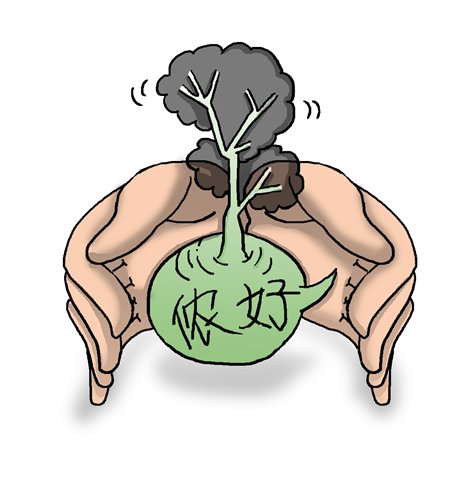
Illustration: Lu Ting/GT
The Shanghai dialect has always been part of the warp and weft of life in this city. Thus, this unique language deserves protection as an intangible cultural heritage that should be passed down to younger residents of the city as part of their overall education.
I've previously written in this space that foreign residents of Shanghai should strongly consider learning at least a minimal amount of Shanghai dialect in order to deepen their cultural understanding of the city's denizens. There is no better way to immediately shorten the distance between people here than through interaction in Shanghai's true native tongue.
Shanghainese is a fading language, destined by sheer demographic realities toward eventual extinction. Indeed, some scholars agree that unless drastic action or policy changes are implemented, Shanghainese will be finished within the next couple of generations.
Shanghai's emergence as an international center of trade and finance during the Qing Dynasty (1644-1911) mirrored the predominance of the Shanghai branch of Wu languages, supplanting Suzhou dialect, Ningbo dialect and other Wu branches common to Jiangxi and the surrounds of Taihu Lake. This is what made the Shanghainese language so inseparable from the city it is named for.
So why bother to take so much trouble over an ancient language that few outside of Shanghai are able to comprehend? Furthermore, with Shanghai now transformed into an epicenter of migrants from all over China and the world, does it even make sense to preserve a language that adds to the Babel of regional dialects that saturate the streets of this metropolis?
Wouldn't it be better to let all Chinese dialects die out in favor of speaking standard Putonghua in order to facilitate unity and common understanding?
I say no. To go down this road is to fundamentally misunderstand the importance of history and culture in our lives as well as to underestimate the ability of citizens to improvise and invent ingenious solutions to the problem of intercultural communication. We instinctively realize the strength and importance of diversity in other spheres, especially with respect to nature and the environment.
Science teaches us that diversity breeds strength and health. The many-branched tree thrives, while monocultures are disastrously prone to pests and predators.
The good news, however, is that people display a remarkable ability to adjust and to achieve at least a basic fluency in multiple languages. A thorough grasp of English, Putonghua or French should in no way preclude one from learning the basics of other languages. We are not all destined to be polyglots, but the ability to recognize, read basic directions and converse in simple sentences should in no way be considered an onerous task.
After all, it's common for children in many parts of the world to grow up with two or more languages in their native community. Aside from the diligent work of the many advocacy organizations struggling to preserve Shanghainese, today we can leverage the power of emerging technologies to aid in the cause.
It has never been easier for citizens to listen, film, transcribe and otherwise record Shanghainese discourse via mobile electronic devices. It's also no longer such a tremendous task to subtitle all forms of media, arts and entertainment. The golden age of Shanghainese opera, music, poetry, comedy and drama are as alive and relevant as they ever were, and possibly more accessible to non-Shanghainese speakers than at any other time.
With the transition of many of these forms of entertainment onto social media, the subtitle has become an even more powerful tool at our disposal to unlock Shanghainese for nonnative speakers. We can disseminate this cultural legacy quickly and easily to a youth demographic comfortable with this form of media and able to code-switch between languages and idioms.
With such powerful databases and technologies at hand, it would be tragic if the rich history and cultural treasure of the Shanghainese language were allowed to slip through our fingers.
The opinions expressed in this article are the author's own and do not necessarily reflect the views of the Global Times.
