METRO SHANGHAI / CITY PANORAMA
China’s largest biological storage facility preserves diseased samples for future research
You can take that to the bank!
Thanks to the rapid advancement of medicine, science and technology in recent decades, scientists and doctors have found solutions to many diseases that were once fatal or incurable. However, new diseases are constantly appearing due to the changing environment as well as people's lifestyles, which have brought new problems to this new era. Thus, it is urgent to preserve diseased samples for future research and solutions.
On Libing Road in Zhangjiang, Pudong New Area, Shanghai, there is a special bank not for cash but for biological samples such as human tissue, cells, blood, bodily fluids, organs, intestinal microbial and bacterial flora, DNA, RNA and proteins. With the advancement of science and technology, currently incurable diseases contained in these samples can be preserved for future scientific research and the benefit of humankind.
As one of the first major science and technology infrastructure projects of Shanghai Zhangjiang Hi-Tech Park, Shanghai Zhangjiang Biobank, set up at the National Engineering Center for Biochip at Shanghai, was officially launched in October of 2017.
According to Gao Hengjun, director of the National Engineering Center for Biochip at Shanghai, the Zhangjiang Biobank has a storage capacity of 10 million samples, the largest of its kind in China. It can provide important resource acquisitions and share applications of biological samples for basic or clinical research of major diseases.
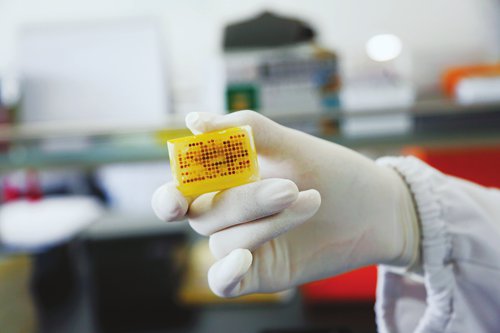
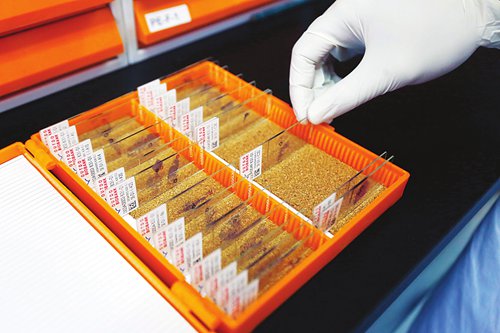
When entering the Zhangjiang Biobank, the first thing that comes into view are rows of shelves where numerous orange drawers store the biological samples. In these drawers there are stamp-sized tissue sections which have been preserved by paraffin wax technology at room temperature. To protect the privacy of patients, there is only a serial number and a QR code on each sample. All of the patient's information - including his or her medical diagnoses, family history of disease and information about if they smoke or drink - is recorded and stored in a computer system.
"The Zhangjiang Biobank stores all kinds of biological samples, as well as various clinical data and follow-up information related to these biological samples. It is a resource library where biological samples are professionally collected, transported, stored, managed and used according to strict technical standards and excellent quality management," Gao told the Global Times.
There are two kinds of human biological sample libraries. One is for healthy and normal people such as a cord blood bank, myeloid bank and specimen bank. When there is a demand, preserved samples can be taken out to cure one's own or others' diseases. The other is to store samples taken from diseased people. These preserved patients' diseased tissues and blood can be used to benefit humanity by seeking treatment to diseases and methods to keep people healthy. Shanghai Zhangjiang Biobank functions in the two categories at the same time. It stores biological samples from both healthy people (such as immune cells) and sick patients (such as cancer tissues).
Biological chips
Take cancer patients as an example, where in the past only a small part of pathological specimens collected at hospitals was used in testing. It was difficult to preserve other parts over a longer period; these would eventually be destroyed as medical waste.
But after the biobank was set up, pathological specimens could now be stored and their related information recorded, such as which medicine the patients are allergic to during their treatment and what side effects the patients suffered from during chemotherapy. When samples are accumulated to a certain amount, they can be sorted and analyzed to track, prevent and treat diseases. They provide evidence for early diagnosis of diseases and personalized treatment.
To date, the Zhangjiang Biobank has collected and stored nearly 400,000 biological samples of cancers, Gao told the Global Times. Scientists extract a small amount of diseased tissues from one biological sample and make a "biological chip" of cancer tissue with dozens other cancer tissue extracts taken from other biological samples. The biological chip can further be sliced into more than 100 biological chips as thin as 5 micrometers each, to be used in nearly 100 different experiments and comparative tests to research diseases, in medicine development or test reagents for disease screening.
The National Engineering Center for Biochip at Shanghai, China's largest biotech high-tech center, had 290 million yuan ($45 million) invested in it by the National Development and Reform Commission in 2003. It also developed a variety of biological chips of gene, protein, DNA, cell, and microbial and bacterial flora made of different kinds of biological samples. According to Gao, the development of biological chips involves multidisciplinary researches of molecular biology, genomics, microbiology, physics, chemistry and molecular engineering.
"If we use a metaphor to describe the relationship between biological samples and biological chips, biological samples are like rice and the biological chips are like the boiler. The results and products of the experiments carried out with the biological chips made of biological samples are like the cooked rice," Gao told the Global Times.
Liver cancer test strips
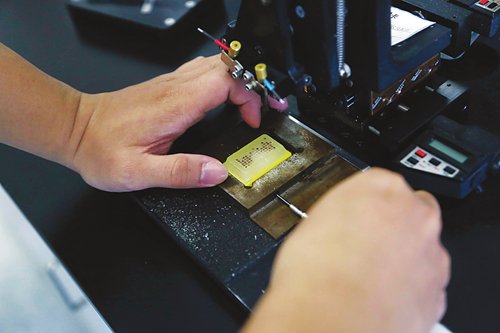
In the laboratory of the Zhangjiang Biobank, researchers take a small amount of a cancer sample out from its paraffin wax slice. They press dozens of such sample cylinders (which are less than 1 millimeter in diameter) into a honeycomb-like paraffin wax slice. Later, they cut the slice into dozens of thinner slices, just 4 micrometers in thickness. After dying them, the biological chips are complete.
Researchers inject a certain kind of medicine into batches of cancer biological chips to see if the cancer cells are sensitive to the medicine; they can then determine if the medicine is effective or not. Most of the world's top pharmaceutical corporations use this method to develop new medicines.
Through the research of biological chips based on a variety of cancer samples, the National Engineering Center for Biochip at Shanghai has developed 16 products, including Aifupei, a screening and diagnosis reagent of hepatitis-B-virus-related early-stage liver cancer, for family use.
"Since the liver has no nerves, when the tumor is small, patients can't feel it. Only when the tumor grows larger and the hepatic capsule covering the liver, which has nerves, is bulging with the tumor, the patient can feel the swelling pain. But by then it is already moderate or advanced liver cancer. Our product can detect liver cancer at its early stage," Gao said.
Like a pregnancy test strip, which is available at any pharmacy, these liver cancer test strips are also easily obtained at pharmacies out of concern for the privacy of hepatitis-B-virus carriers who are often discriminated by others.
State-subsidized biobank
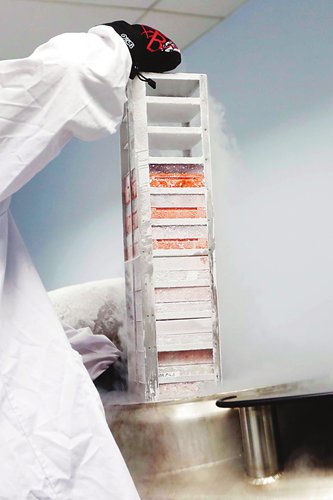
The Zhangjiang Biobank also has several liquid nitrogen tanks in which the temperature remains -196 C. Under such low temperature, all molecules and atoms stop their activity; theoretically, the tissues and cells stored in these tanks can be permanently preserved.
These liquid nitrogen tanks are used to store all kinds of cells and some cancer tissues. Other biological samples, such as serum, plasma, blood cells and DNA nucleic acid, are kept in ultra-low temperature freezers in which the temperature remains at -86 C. Some equipment was imported from abroad.
According to Gao, biobanks have been developed for over a decade in overseas countries. Take BioStorage, a biobank in the US as an example, whose storage capacity has reached 50 million samples. But compared with overseas biobanks, most of which are commercial projects, the State-subsidized biobank project in China has advantages.
According to Gao, many things that overseas commercial biobanks cannot do can be done at Zhangjiang Biobank. While the information of biological samples collected by overseas biobanks cannot be shared or made public, the information of samples stored at Zhangjiang Biobank can be shared to promote communication, cooperation and application in researches.
"The key to the development of our biobank not only lies in constructing the biobank according to standards, but more importantly in application," Gao said.
For example, a stomach cancer researcher can find a nationwide gastric cancer distribution through information of biological samples shared at Zhangjiang Biobank system. "When doing research, diversity matters a lot, such as the region and ethnic group of the genes, to make our research results more precise," Gao said.
"Since a biological sample includes tissues, cells, genes, proteins and all kinds of materials that carry all the characters of a human, theoretically researchers can do all the researches related to biology with it," Gao said.
On Libing Road in Zhangjiang, Pudong New Area, Shanghai, there is a special bank not for cash but for biological samples such as human tissue, cells, blood, bodily fluids, organs, intestinal microbial and bacterial flora, DNA, RNA and proteins. With the advancement of science and technology, currently incurable diseases contained in these samples can be preserved for future scientific research and the benefit of humankind.
As one of the first major science and technology infrastructure projects of Shanghai Zhangjiang Hi-Tech Park, Shanghai Zhangjiang Biobank, set up at the National Engineering Center for Biochip at Shanghai, was officially launched in October of 2017.
According to Gao Hengjun, director of the National Engineering Center for Biochip at Shanghai, the Zhangjiang Biobank has a storage capacity of 10 million samples, the largest of its kind in China. It can provide important resource acquisitions and share applications of biological samples for basic or clinical research of major diseases.
When entering the Zhangjiang Biobank, the first thing that comes into view are rows of shelves where numerous orange drawers store the biological samples. In these drawers there are stamp-sized tissue sections which have been preserved by paraffin wax technology at room temperature. To protect the privacy of patients, there is only a serial number and a QR code on each sample. All of the patient's information - including his or her medical diagnoses, family history of disease and information about if they smoke or drink - is recorded and stored in a computer system.
"The Zhangjiang Biobank stores all kinds of biological samples, as well as various clinical data and follow-up information related to these biological samples. It is a resource library where biological samples are professionally collected, transported, stored, managed and used according to strict technical standards and excellent quality management," Gao told the Global Times.
There are two kinds of human biological sample libraries. One is for healthy and normal people such as a cord blood bank, myeloid bank and specimen bank. When there is a demand, preserved samples can be taken out to cure one's own or others' diseases. The other is to store samples taken from diseased people. These preserved patients' diseased tissues and blood can be used to benefit humanity by seeking treatment to diseases and methods to keep people healthy. Shanghai Zhangjiang Biobank functions in the two categories at the same time. It stores biological samples from both healthy people (such as immune cells) and sick patients (such as cancer tissues).
Biological chips
Take cancer patients as an example, where in the past only a small part of pathological specimens collected at hospitals was used in testing. It was difficult to preserve other parts over a longer period; these would eventually be destroyed as medical waste.
But after the biobank was set up, pathological specimens could now be stored and their related information recorded, such as which medicine the patients are allergic to during their treatment and what side effects the patients suffered from during chemotherapy. When samples are accumulated to a certain amount, they can be sorted and analyzed to track, prevent and treat diseases. They provide evidence for early diagnosis of diseases and personalized treatment.
To date, the Zhangjiang Biobank has collected and stored nearly 400,000 biological samples of cancers, Gao told the Global Times. Scientists extract a small amount of diseased tissues from one biological sample and make a "biological chip" of cancer tissue with dozens other cancer tissue extracts taken from other biological samples. The biological chip can further be sliced into more than 100 biological chips as thin as 5 micrometers each, to be used in nearly 100 different experiments and comparative tests to research diseases, in medicine development or test reagents for disease screening.
The National Engineering Center for Biochip at Shanghai, China's largest biotech high-tech center, had 290 million yuan ($45 million) invested in it by the National Development and Reform Commission in 2003. It also developed a variety of biological chips of gene, protein, DNA, cell, and microbial and bacterial flora made of different kinds of biological samples. According to Gao, the development of biological chips involves multidisciplinary researches of molecular biology, genomics, microbiology, physics, chemistry and molecular engineering.
"If we use a metaphor to describe the relationship between biological samples and biological chips, biological samples are like rice and the biological chips are like the boiler. The results and products of the experiments carried out with the biological chips made of biological samples are like the cooked rice," Gao told the Global Times.
Liver cancer test strips
In the laboratory of the Zhangjiang Biobank, researchers take a small amount of a cancer sample out from its paraffin wax slice. They press dozens of such sample cylinders (which are less than 1 millimeter in diameter) into a honeycomb-like paraffin wax slice. Later, they cut the slice into dozens of thinner slices, just 4 micrometers in thickness. After dying them, the biological chips are complete.
Researchers inject a certain kind of medicine into batches of cancer biological chips to see if the cancer cells are sensitive to the medicine; they can then determine if the medicine is effective or not. Most of the world's top pharmaceutical corporations use this method to develop new medicines.
Through the research of biological chips based on a variety of cancer samples, the National Engineering Center for Biochip at Shanghai has developed 16 products, including Aifupei, a screening and diagnosis reagent of hepatitis-B-virus-related early-stage liver cancer, for family use.
"Since the liver has no nerves, when the tumor is small, patients can't feel it. Only when the tumor grows larger and the hepatic capsule covering the liver, which has nerves, is bulging with the tumor, the patient can feel the swelling pain. But by then it is already moderate or advanced liver cancer. Our product can detect liver cancer at its early stage," Gao said.
Like a pregnancy test strip, which is available at any pharmacy, these liver cancer test strips are also easily obtained at pharmacies out of concern for the privacy of hepatitis-B-virus carriers who are often discriminated by others.
State-subsidized biobank
The Zhangjiang Biobank also has several liquid nitrogen tanks in which the temperature remains -196 C. Under such low temperature, all molecules and atoms stop their activity; theoretically, the tissues and cells stored in these tanks can be permanently preserved.
These liquid nitrogen tanks are used to store all kinds of cells and some cancer tissues. Other biological samples, such as serum, plasma, blood cells and DNA nucleic acid, are kept in ultra-low temperature freezers in which the temperature remains at -86 C. Some equipment was imported from abroad.
According to Gao, biobanks have been developed for over a decade in overseas countries. Take BioStorage, a biobank in the US as an example, whose storage capacity has reached 50 million samples. But compared with overseas biobanks, most of which are commercial projects, the State-subsidized biobank project in China has advantages.
According to Gao, many things that overseas commercial biobanks cannot do can be done at Zhangjiang Biobank. While the information of biological samples collected by overseas biobanks cannot be shared or made public, the information of samples stored at Zhangjiang Biobank can be shared to promote communication, cooperation and application in researches.
"The key to the development of our biobank not only lies in constructing the biobank according to standards, but more importantly in application," Gao said.
For example, a stomach cancer researcher can find a nationwide gastric cancer distribution through information of biological samples shared at Zhangjiang Biobank system. "When doing research, diversity matters a lot, such as the region and ethnic group of the genes, to make our research results more precise," Gao said.
"Since a biological sample includes tissues, cells, genes, proteins and all kinds of materials that carry all the characters of a human, theoretically researchers can do all the researches related to biology with it," Gao said.
A staff selects a tissue section preserved in paraffin wax. Photo: Courtesy of Shanghai Zhangjiang Biobank
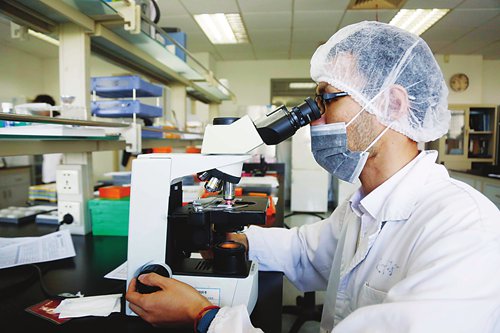
A staff's work routines at Shanghai Zhangjiang Biobank Photos: Courtesy of Shanghai Zhangjiang Biobank
A staff's work routines at Shanghai Zhangjiang Biobank Photos: Courtesy of Shanghai Zhangjiang Biobank
A staff's work routines at Shanghai Zhangjiang Biobank Photos: Courtesy of Shanghai Zhangjiang Biobank
A staff's work routines at Shanghai Zhangjiang Biobank Photos: Courtesy of Shanghai Zhangjiang Biobank
