
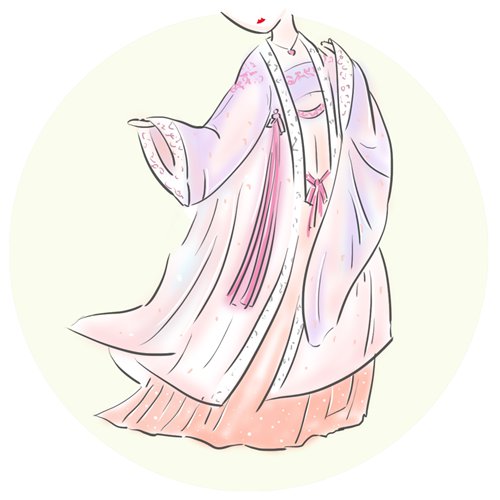
Illustration: Chen Xia/GT
April 18 marks the first-ever Traditional Chinese Costume Day, an event co-organized by the Central Committee of the Communist Youth League and anime-streaming platform bilibili.com to encourage young Chinese of all ethnic groups to wear their traditional clothing.
Hanfu, the traditional clothing of Han people, was worn for several thousand years. It is delicate and elegant, perfectly showing oriental aesthetics as well as the beauty of traditional Chinese painting and embroidery.
It's a pity that hanfu started fading away during the Qing Dynasty (1644-1911), when Manchu people from northeast China ruled the country and forced Hans to wear Manchu clothing. From then on, hanfu was gradually forgotten, leaving the world's largest ethnic group with no idea what their traditional clothes looked like.
Years ago, as a child, I saw a group photo of children from China's 56 ethnic groups in a textbook. In the photo, everyone wore traditional costumes from their own ethnic group - except the Han boy, who wore a simple, featureless Western-style T-shirt.
Later, when historical dramas began inundating our TV screens in the early 2000s, I was tormented by their poorly designed, curtain-like costumes. Most of them looked disappointingly ugly and shoddy, not to mention historically inaccurate.
Most ancient Chinese clothes were made of pure silk, cotton or linen, which were very difficult to preserve. To date, few complete sets of hanfu have been preserved, as the vast majority were destroyed by corrosion and oxidation. Prior to the recent "hanfu renaissance," the public knew little about this traditional costume.
Fortunately, hanfu is making a comeback with a rising number of people discovering and realizing the beauty of it. The first media coverage of modern Chinese wearing hanfu can be traced back to 2003, when a man named Wang Letian in Central China's Henan Province made Han Dynasty (206BC - AD220) style hanfu according to ancient paintings, then wore it out on the streets, Singapore-based Lianhe Zaobao newspaper reported.
Two years later, Wang told domestic media that wearing hanfu made him a "monster" in the eyes of other ordinary citizens. "Some called me Japanese," he added. "I had to repeat that I am Chinese," reported Jiangsu-based Nanjing Daily in 2005.
The public's grave misunderstanding of hanfu is one of the biggest obstacles that the hanfu renaissance has encountered. In 2010, some men in Chengdu, capital of Southwest China's Sichuan Province, forcibly removed a young woman's hanfu clothing off her body, then burned it in public, ifeng.com reported. Mistaking her Zhou Dynasty (1046BC-256BC) hanfu for a Japanese traditional costume, these ignorant hyper-nationalists assaulted the woman and destroyed her hanfu just to satisfy their misguided anti-Japanese feelings.
With a common Confucian cultural background, Chinese and Japanese traditional clothing do look similar in some regards. But they are not the same. Sadly, most modern Han people know nothing about their own traditional clothes.
Almost all hanfu fans have encountered similar embarrassing experiences, myself included. Whenever I wear my own hanfu out in public, there are always curious passersby who ask whether I am a Japanese, a South Korean, a cosplayer or an opera actress. Once I even heard two women behind me whispering that I looked like a prostitute.
Nonetheless, such ignorance and insults seem to have compelled hanfu fans to be even bolder. Instead of getting angry, we patiently explain to these people that it is the traditional costume of our Han people. Through our continued efforts, more and more people will become familiar with this clothing.
It's good to see that, after years of nongovernmental publicity of hanfu, authorities have finally initiated Traditional Chinese Costume Day in China, popularizing hanfu as well as the clothing of China's other ethnic minorities. As an important part of our culture, China's rich traditions and cultural confidence will help increase our collective sense of national identity.
The opinions expressed in this article are the author's own and do not necessarily reflect the views of the Global Times.
