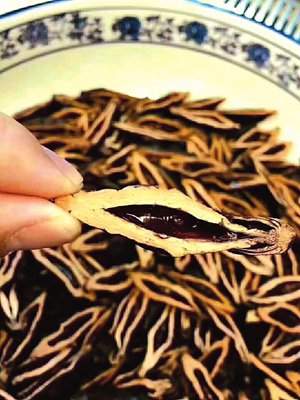
The inside of a betel nut Photo: He Keyao/GT
If you have ever got the chance to travel across Hunan Province in China, there is one local specialty that you will find it hard to ignore: the areca nut, or binlang in Chinese. The areca nut is actually not a nut, but the fruit of the areca palm. In English, it is more commonly known as the "betel" nut, named after the betel leaves the nut is usually wrapped in before it is chewed.
Hunan has long been the biggest processor and consumer of betel nuts in China. Walking down the street, you can easily find all kinds of various betel nut products: dried nuts, freshly-cooked nuts, individually sold nuts and nuts packaged together. During my recent visit to Xiangtan, the city with the highest consumption of betel nuts in the province, I started to realize the charm of this little fruit.
Origins
"The more you chew it, the better it tastes. A perfect snack for when you meet new friends. Spit one out and take another. It also helps build up a good appetite."
Those are the lyrics to a well-known folk song in Xiangtan that reflects the popularity of betel nut in the area.
According to The Historical Records of Xiangtan, betel nuts were introduced into the region more than 300 years ago. In 1649, back during the Qing Dynasty (1644-1911), the residents of Xiangtan were massacred by Manchu army soldiers in the tens of thousands. Disease and pestilence were left in the wake of the tragedy. One merchant surnamed Cheng, who on the advice of an old monk chewed betel nuts to protect himself from infection, managed to dispose of the corpses and clean up the area without falling ill. Thereafter the special little fruit became famous and quickly became a favorite treat among locals.
In traditional Chinese medicine, betel nut can help deworm one's body, aid digestion and ward off cold and dampness. Given the local climate - hot and damp summers and gloomy and cold winters - it's not surprising that betel nuts are popular in the region. Over the centuries, locals have developed various recipes to make betel nuts more pleasing to local people's taste buds.
"The most popular flavor among my friends are nuts soaked in cinnamon oil. They have a multi-layered flavor. You can easily find them at street vendors," said Zukun Li, a local foodie who possesses rich knowledge of Hunan food and has chewed betel nuts for decades. According to Li, the best-received brand of betel nut products is Zhang Xinfa, whose stores can be found across the country.
"The key is to keep chewing and its unique flavor will come stronger after a while. It's easy to get addicted, though," Li said.
Betel nuts feel quite hard when chewed. The slightly bitter taste is followed by a feeling of warmth and excitement that rushes through the body. It is advised that you make sure you are in a safe place the first time you try a betel nut as the arecoline inside may make people feel dizzy and even a bit drunk.
More than a snack
For people in Hunan, betel nuts are more than just something to be chewed, it is an inseparable part of local culture.
As an old saying in Xiangtan goes: "To feed the family, you need bread and milk; yet to treat a guest, you need betel nuts and cigarettes." It's clear that betel nuts have become a social tool that represents respect and hospitality.
"Most Chinese will make tea to receive guests, but for people in Xiangtan tea is not enough. Among the older generation, offering betel nuts is a basic courtesy," Li noted.
During holidays, many local families give betel nuts to relatives and friends as gifts and they are often present at traditional events such as weddings.
According to recent report by China Business News, the total production of betel nuts was valued nearly 30 billion yuan ($4.4 billion) in Hunan Province in 2017 and the industry continues to grow.
However, satisfying one's taste buds comes at a price. Research indicates that chewing betel nuts enhance the risk of oral cancer. In 2013, WHO classified betel nuts as a carcinogen and in 2017 it was included on China's carcinogen list by the country's Food and Drug Administration.
